AppalachianOceanGuy
Member
- Thread starter
- #1
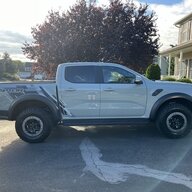
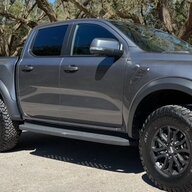
Back in September, I traded my 2018 F150 Raptor Crew Cab with just shy of 80,000 miles for a brand new 2025 Ranger Raptor. The Gen. 2 had served my wife and I well but as part of a personal fleet consolidation, we wanted to downsize to a more easily managed yet still utilitarian truck that both she or I could daily drive easily. Living in a mountainous region, we spend a lot of miles on narrow winding roads where the wide stanced full sized beast is a bit of a handful for my wife at times. It also doesn’t fit in many local parking lot spaces and, perhaps most importantly, our garage very well either. After driving the slightly miniaturized Ranger version of the Raptor, we felt it would be an excellent choice to meet our needs. I posted on the Raptor forums that I had made this move and was asked to provide my thoughts and feedback on the new edition. Now that we have had the truck for three months, logging over 4,000 miles in that time, I feel that I can share some fairly fleshed out initial impressions and comparisons. For reference, I had the new and much improved BF Goodrich K03s shod on my Gen. 2, which also came on the Ranger Raptor
First off, let me say that the two trucks are more alike than different, as you would imagine. It is important to note that I have not driven a current Gen. 3 F-150 Raptor, so some or all of my impressions may very well be true for the Gen. 3, I just don’t know. One of my colleagues has a Raptor R, but when I rode in it before I made my change I didn’t notice all the differences because, well, we know what the star of that show is.
I’ll write this up to highlight what I think are things I like better in the Ranger, things that are different, expected and as a result equivocal between between the two and things I don’t prefer or are disappointed by in the Ranger version.
Pros/Likes of Ranger Raptor
Some differences are expected, so not surprising or a pro or con.
Now for the cons/disappointments.
Some of the neutral points I just mentioned may seem like cons, but to me they are just differences. Obviously, if performance alone is the reason a person chooses a Raptor, well there is an obvious choice to be made and no reason to settle for less than the full sized R version, price not withstanding. But I have found some true deficiencies in the truck that could easily be remedied by Ford.
So there you have it, my impressions of my 2025 Ranger Raptor versus my previous 2018 Gen. 2 F-150 Raptor. These impressions are my own and others may have completely different experiences and opinion. I’ve been as critical as I can in efforts to be thorough, so it may seem that I’m not happy with my truck. That presumption would be completely incorrect. I am extremely happy with the choice we made to go with the Ranger. It suits our needs perfectly and is a much better road driving truck to us, with a truly magnificent cockpit. My wife really likes driving it as well, even more than the bigger beast. Most of my nitpicks are just that, nitpicks. Give it more power, a more aggressive exhaust note, a larger gas tank and some sort of integral step at the rear tailgate area and it would be absolute perfection, as long as you put some brakes on it so it inspires confidence that it will stop.
First off, let me say that the two trucks are more alike than different, as you would imagine. It is important to note that I have not driven a current Gen. 3 F-150 Raptor, so some or all of my impressions may very well be true for the Gen. 3, I just don’t know. One of my colleagues has a Raptor R, but when I rode in it before I made my change I didn’t notice all the differences because, well, we know what the star of that show is.
I’ll write this up to highlight what I think are things I like better in the Ranger, things that are different, expected and as a result equivocal between between the two and things I don’t prefer or are disappointed by in the Ranger version.
Pros/Likes of Ranger Raptor
- Handling/suspension- We use the truck on road primarily and what off roading we do is around our wooded property so we aren’t rock crawling or overland adventuring. Our closest sand excursion is a beach, not Baja, like I presume is true for many owners, so very slow speeds. While it isn’t a sports car in any form or fashion, with its high center of gravity and knobby all terrain KO3 tires, the more compact body and much improved Fox suspension provides a very confident driving experience at reasonable speeds on twisting mountain roads. There’s noticeably less body roll and pitch and yaw under braking and acceleration. The suspension is well buttoned down, particularly compared to the Gen. 2, which floated and rolled hard and under steered tremendously mercilessly when pushing even the slightest bit through any curve. My wife notices immediately how much better the Ranger handles and how much less work is involved for her to pilot it through the mountain back roads. It feels nimbler and lighter on its feet than the Gen. 2 did. It also provides a slightly better ride in the process. While we didn’t mind the big Raptor on highway trips, we feel it is less fatiguing to ride/drive in the Ranger long distances.
- One of the most notable differences and improvements in the Ranger, is the interior. The fit and finish, quality of materials and upgraded technology are significantly better in the newer truck. Again, this may be true as well in the current F-150 versions as well, I don’t know. There is much more use of soft tough materials in the Ranger, providing a much needed relief from hard plastic and slick leather. The seats are extremely comfortable, particularly on long hauls, and everything looks and feels quality. Of course the tech, from the upgraded touch screen to the LED digital dash, brings the truck to the 2020s, whereas the Gen. 2 felt a tad outdated even when new. That is no longer the case. I do miss the optional carbon fiber trim though.
- The final pro, for our needs, is the size. Sometimes bigger is better, but sometimes the best things come in small packages. In our case, we rarely used the full capabilities of seating 5 adults or maxing out the 150’s slightly longer and wider bed. The 150 SCREW’s bed was not all that capable anyway and so far we haven’t missed it at all. But the ease of navigating in town and parking is markedly better, particularly for my wife. I also don’t have to worry as much about getting clipped or dinged in parking lots as much due to the truck sticking out or cramping the edges of small parking spaces. I don’t mind parking away and walking, but I don’t want my wife to park remotely by herself, particularly at night.
Some differences are expected, so not surprising or a pro or con.
- While overall a pro for us, not everything about being small is a positive. The reduced interior storage is meaningfully limited. The center console gets crowded quickly and most unappreciatively, the under seat storage in the rear means less room for things like tow straps, tie downs, tire gauges, ice scrapers, trailer hitch and locks, jump starters, etc. etc. These things will fit in a large tool box, but then that has to stow away in the bed versus everything easily fitting under the rear seat in the full size truck.
- Upgraded tech can be a good thing, but it can also detract. More tech though, means more menus, more interaction and more complexity to carry out basic tasks at times. For example, selecting information on the gauge cluster takes a few more steps of menu selection and just seems a bit less user friendly. The implementation is also less useful in some ways. In my Gen. 2, for example, I preferred the feel of the sport steering wheel setting. I selected it and it stayed selected, defaulted every time I drove the truck. With the Ranger, I assign it to “My Raptor” setting, but that “My Raptor” has to then be selected every time without any default. There are other things like that, it’s is just one example. Finding satellite stations that aren’t saved to preset is truly a pain and would be hugely distracting while driving. At least the Car Play is wireless. Getting your phone on/off the wireless charging tray is a bit cumbersome, at least with an iPhone max. I do find less need for Forscan in this truck.
- Mileage. With a smaller, lighter and less powerful engine, one would think that MPG would be better than the 150. It isn’t, at least it hasn’t been significantly for us. MPG on our Gen. 2 was 16-19 city/highway. So far it’s been about the same, maybe slightly better in town, but nothing significant. Maybe with less power on tap we have our foot in it a bit more perhaps?
- That segues nicely into the main equivocal thing, the power. The 3.0 H.O. Ecoboost engine isn’t as powerful as the 3.5 iteration. For the same reasons I expected the MPG to be better, I expected the performance to “feel” close to the same as the 150. It doesn’t. Not even close. I would rate this as a con, however testing and reviews clearly show the Ranger to measure substantially slower than the 150, so it shouldn’t come as a surprise. I figured the lower torque might be the issue, but testing with the Ford Performance tune, which adds a ton of torque, doesn’t meaningfully improve acceleration even if it may feel like a major improvement on the butt dyno. On the road, it doesn’t feel slow, it just doesn’t feel fast. Passing power is adequate and acceleration is fine, but the Gen. 2 felt special, and quick, particularly for a truck. The Ranger Raptor doesn’t feel quick. It feels special, just not for acceleration performance. I don’t buy a truck for drag racing, but let’s be honest, most Raptor buyers want performance out of them. So if only Ford would offer a Ranger Raptor R someday, say with 625hp and at least that much torque, that would be a fantastic idea. Ford, are you listening?
- Presence- One of the things that makes the big Raptor special is that it stands out from its siblings, and every other truck out there. It’s brawny looks, highlighted by the fender flares, contrasting trim, aggressive exhaust, menacing triple grill LEDs, visible off road suspension and on some, in your face graphics, makes a statement. It is a menacing sight, particularly in certain color combos. The Ranger Raptor captures some of that same presence, but not to the same extent. As Rangers go, it certainly is set apart and is easily the best looking trim. But it isn’t as aggressive in appearance as it’s big brother. It appears taller rather than wider. The front end isn’t as distinctive without the fog pocket cutouts, signature amber DRLs and often imitated LED grill markers. It’s a good looking front end, not over the top stylistically and provides much improved functionally out of the factory, it just doesn’t stand out as being special quite as much. The exhaust is also a bit more benign. Perhaps it’s the smaller engine not making the same growl as the slightly bigger version, but the audio soundtrack is much more reserved. My Gen. 2 made nice noises, particularly when under higher throttle situations. I haven’t had the same experience yet in the Ranger, only just whispers. Either is the equal of the mighty 6.2 of course, but I don’t expect it to be closer to a Lightning either.
- Aftermarket practically doesn’t exist. The truck just entered its third year of sales in the US and of course even longer overseas, and yet there is precious little available to customize or improve it, particularly compared to big brother or the competitions Tacos. Maybe that speaks to its completeness as a package, IDK.
Now for the cons/disappointments.
Some of the neutral points I just mentioned may seem like cons, but to me they are just differences. Obviously, if performance alone is the reason a person chooses a Raptor, well there is an obvious choice to be made and no reason to settle for less than the full sized R version, price not withstanding. But I have found some true deficiencies in the truck that could easily be remedied by Ford.
- Brakes- I wasn’t particularly enamored by the brakes on my Gen. 2. They felt, well, like truck brakes. They weren’t particularly powerful or confidence inspiring, but the Raptor is a big, heavy vehicle so that is to be expected I suppose. I even tried aftermarket pads and rotors, but nothing really changed. The outright stopping power is of course significantly hampered by the knobbies after all. But even the Gen. 2’s brakes are better than the Ranger Raptors. I’ll just say it clearly, they are terrible. Outright stopping power aside, there is absolutely zero feel to the pedal. No feedback at all, zip, zilch nada. There is no bite from the pad onto the rotor either. Ever. I thought being a new vehicle they just needed more break in than other vehicles for some reason, but nothing has changed. It’s just weird, and concerning. Maybe it’s from 30 years of driving performance cars and I’m jaded and spoiled, but I find their performance almost unsafe. Well maybe I’m being too critical here as they do, indeed, bring you to a stop, you just aren’t always sure that they are going to. In fact I will have my dealer take a look when I go in for my next service. You have to really mash the pedal firmly to get any performance from them. They do stop adequately then, but only at the verge of ABS threshold braking. Maybe some may think they are just smooth, I think they are just awful. Do you get the impression that I don’t like them? I’ll report back if they do find something wrong.
- I mentioned earlier that the truck seems tall, not wide. That translates into the rear bumper and tailgate height being as high, if not higher, than the 150s, due to the off road suspension. With the Ranger, there is no integrated tailgate step however. It is extremely challenging to get into and out of the bed of the Ranger Raptor as a result. I’ve started to make sure I have a small step ladder handy at the house when I need to climb up into the bed. There is no step molded into the bumper either. Ford needs to come up with something, perhaps something like the newest Tacomas retractable rear step, to make it easier and safer to get into the truck.
- Gas tank. As I mentioned, the gas MPG is essentially the same as the Gen 2’s, but the 150 has a 36 gallon tank. The Ranger Raptor’s tank is a sip over 20 gallons. Do the math and you know what the complaint is, range, or lack thereof. I feel like I’m driving from gas station to gas station, because I essentially am. Maybe there is a good reason they didn’t fit a bigger tank, I don’t know but I sure wish they could have figured out how to shoehorn an extra 10 gallons or so in somewhere. I always fill my tank with 1/4 remaining when possible. That’s something a mechanic taught me years ago to help keep any sediment in the bottom of the tank from getting sucked into the fuel filter, injectors, etc. That means I’m filling up every 250 to 280 miles instead of 400 plus on the old Raptor.
So there you have it, my impressions of my 2025 Ranger Raptor versus my previous 2018 Gen. 2 F-150 Raptor. These impressions are my own and others may have completely different experiences and opinion. I’ve been as critical as I can in efforts to be thorough, so it may seem that I’m not happy with my truck. That presumption would be completely incorrect. I am extremely happy with the choice we made to go with the Ranger. It suits our needs perfectly and is a much better road driving truck to us, with a truly magnificent cockpit. My wife really likes driving it as well, even more than the bigger beast. Most of my nitpicks are just that, nitpicks. Give it more power, a more aggressive exhaust note, a larger gas tank and some sort of integral step at the rear tailgate area and it would be absolute perfection, as long as you put some brakes on it so it inspires confidence that it will stop.
Sponsored
Last edited: