
Sponsored
Loading

MasterCylinder
Well-Known Member
Let me just inject here, if any fuel additives actually performed and did what they are marketed to do, the word would spread like a wild fire and you wouldn't be able to find a supplier that could keep them in stock and on the shelf. They do have a place for use though. I use to use octane boosters in my older cars because of the higher compression and moisture removers and preventatives but that was yesteryear's fuel not today's.I just finished watching a You Tube about non Tier level gas in Ford engines.
Since there are not any Tier level stations near me ( Chevron, Shell, etc) I usually use Circle K, Citgo, cross country usually Loves. According to the video these are on some of the worst gas lists. Knock on wood I have not had any issues yet.
From now on I will be searching Tiel Level.
Thinking maybe adding an injector cleaner such as Chevron Tectron.
Any thoughts?
Ford's Warning, I did a basic breakdown relationship to additives.
*Note: Use of any fuel for which the vehicle
was not designed can impair the emission
control system, cause loss of vehicle
performance, and cause damage to the
engine which may not be covered by the
vehicle Warranty.*
Do not use:
• Diesel fuel.(self explanatory)
• Fuels containing kerosene or paraffin.(damages emission systems and dilutes the energy content of fuel)
• Fuel containing more than 15% ethanol
(E15) or E85 fuel. (ya your engine loves corn, added mainly as environmental, does have more octane than gasoline but less energy that has to be compensated for in the end fuel product)
• Fuels containing methanol. (corrosive and lowers energy of gasoline)
• Fuels containing metallic-based
additives, including manganese-based
compounds.(damages catalytic converters and increases emissions)
• Fuels containing the octane booster
additive, methylcyclopentadienyl
manganese tricarbonyl (MMT).(most octane boosters, environmental concerns, can foul plugs, clogs catalytic converters, damages emission systems)
• Leaded fuel, using leaded fuel is
prohibited by law.(self explanatory, but tetraethyl lead was mainly an anti knock agent back when used)
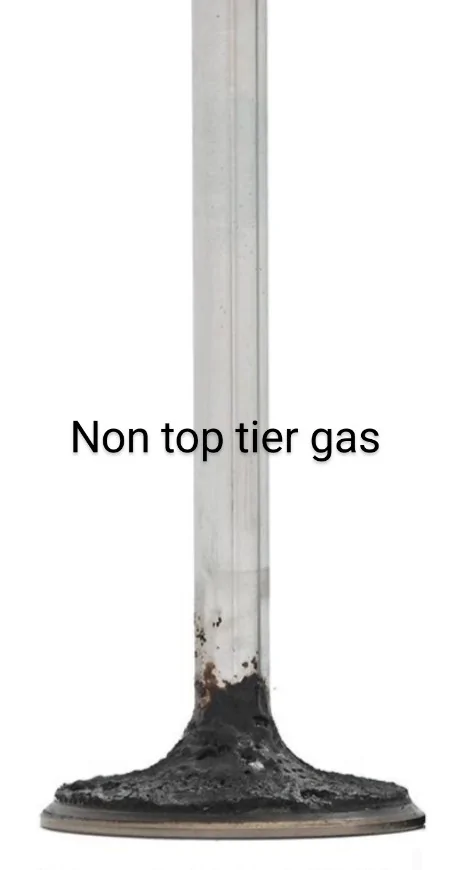
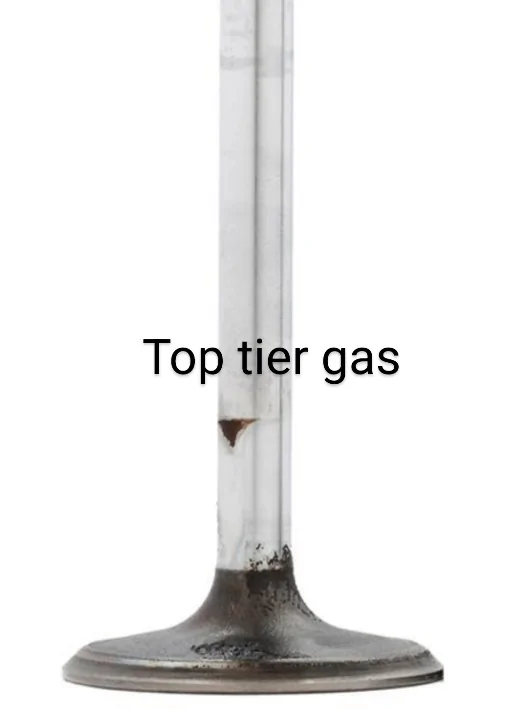
Here's my humble opinion it's your money, your vehicle. Today however with the complex nature of the makeup of gasoline with over 150 chemicals and hydrocarbons, unless your a chemist and know the formulations of both the additive and gasoline's, additives alter the many years of research and development of what we call gasoline/petrol. Top Tier fuels contain 3-5 times the proven cleaning agents (the P's I call them, short for polys, PEA's, PBA's etc....), in all the fuels be it 87-93 octane (usa ratings) and they work. See picture of valves below at 6000 miles, same engine. As long as your using a Top Tier fuel you shouldn't need any additives, it's in the gas. Top Tier fuels also benefit older cars to clean the system over time. Ranger On!
Trimjb
Well-Known Member
- Thread starter
- #18
Thank you for the write up.Let me just inject here, if any fuel additives actually performed and did what they are marketed to do, the word would spread like a wild fire and you wouldn't be able to find a supplier that could keep them in stock and on the shelf. They do have a place for use though. I use to use octane boosters in my older cars because of the higher compression and moisture removers and preventatives but that was yesteryear's fuel not today's.
Ford's Warning, I did a basic breakdown relationship to additives.
*Note: Use of any fuel for which the vehicle
was not designed can impair the emission
control system, cause loss of vehicle
performance, and cause damage to the
engine which may not be covered by the
vehicle Warranty.*
Do not use:
• Diesel fuel.(self explanatory)
• Fuels containing kerosene or paraffin.(damages emission systems and dilutes the energy content of fuel)
• Fuel containing more than 15% ethanol
(E15) or E85 fuel. (ya your engine loves corn, added mainly as environmental, does have more octane than gasoline but less energy that has to be compensated for in the end fuel product)
• Fuels containing methanol. (corrosive and lowers energy of gasoline)
• Fuels containing metallic-based
additives, including manganese-based
compounds.(damages catalytic converters and increases emissions)
• Fuels containing the octane booster
additive, methylcyclopentadienyl
manganese tricarbonyl (MMT).(most octane boosters, environmental concerns, can foul plugs, clogs catalytic converters, damages emission systems)
• Leaded fuel, using leaded fuel is
prohibited by law.(self explanatory, but tetraethyl lead was mainly an anti knock agent back when used)
Here's my humble opinion it's your money, your vehicle. Today however with the complex nature of the makeup of gasoline with over 150 chemicals and hydrocarbons, unless your a chemist and know the formulations of both the additive and gasoline's, additives alter the many years of research and development of what we call gasoline/petrol. Top Tier fuels contain 3-5 times the proven cleaning agents (the P's I call them, short for polys, PEA's, PBA's etc....), in all the fuels be it 87-93 octane (usa ratings) and they work. See picture of valves below at 6000 miles, same engine. As long as your using a Top Tier fuel you shouldn't need any additives, it's in the gas. Top Tier fuels also benefit older cars to clean the system over time. Ranger On!


My main concern was my lack of knowledge of different fuels that I was adding to my Ranger.
I will from here out shop Top Tier when available.

John E Davies
Well-Known Member
- First Name
- John
- Joined
- May 26, 2024
- Threads
- 71
- Messages
- 843
- Reaction score
- 1,185
- Location
- Spokane WA USA
- Vehicle(s)
- 2024 Ranger Raptor Velocity Blue (fastest color)
- Occupation
- Retired aircraft tech
Can you elaborate on the source of those pics or did they come “off the Internet”? Did they come from two identical engines running different fuels in lab test conditions, and did all valves in each engine look exactly the same?See picture of valves below at 6000 miles, same engine. As long as your using a Top Tier fuel you shouldn't need any additives, it's in the gas. Top Tier fuels also benefit older cars to clean the system over time. Ranger On!
How about stabilizers? Do you think they are snake oil too?
Thanks.
John Davies
Spokane WA USA
MasterCylinder
Well-Known Member
Can you elaborate on the source of those pics or did they come “off the Internet”? Did they come from two identical engines running different fuels in lab test conditions, and did all valves in each engine look exactly the same?
How about stabilizers? Do you think they are snake oil too?
Thanks.
John Davies
Spokane WA USA
Pictures are from ISO17025 lab test on my hard drive archive from 2016-17
Your other questions research ATSM6201-08. The last numbers are certain files which probably are not acessable without paying, so you can just use the ATSM6201. engine used was a 4cly ford port fuel injection so you'll know if you found it. You probably will only have access to a few pages but there are many sub information pages. Files are for members only and I let that go some years back.
In all my 50 + years around all types of engines, never found a fuel stabilizer that would extend the life of this corn fed crap gas we have to live with more than a few months.

Sponsored
John E Davies
Well-Known Member
- First Name
- John
- Joined
- May 26, 2024
- Threads
- 71
- Messages
- 843
- Reaction score
- 1,185
- Location
- Spokane WA USA
- Vehicle(s)
- 2024 Ranger Raptor Velocity Blue (fastest color)
- Occupation
- Retired aircraft tech
I agree 100% about that statement, but NON ethanol gas will definitely keep for a year, that is my time limit on stored fuel for power equipment. I use Archoil 6200 standard dose, I date the can with a Sharpie and dump any leftover stuff a year afterwards into a mostly fresh car tank for disposal, even though it doesn’t “smell” bad. All power equipment tanks get drained off season, and I do not normally drain the bowl unless it has a quick drain like my snow thrower. These engines run great, even the ones twenty years old. None have required carb rebuilds. For small quantities of gas, I use disposable 1 mil syringes to measure…In all my 50 + years around all types of engines, never found a fuel stabilizer that would extend the life of this corn fed crap gas we have to live with more than a few months.
My RR gets mostly ethanol free when I can get it - it often is unavailable on long road trips. The gas is always treated at the normal dosage. And without fail in winter, when it is rarely driven, I make sure it has a nearly full tank.
I rarely use the double “cleaning” dose, only in really unusual situations .
I hate ethanol gas, it should be criminal to pay corn farmers federal subsidies to grow food to turn into fuel, what a waste.
John Davies
Spokane WA USA
Last edited:
MasterCylinder
Well-Known Member
Your location probably helps with that because of the temperature and humidity difference from TX where I'm at it's usually the moisture content that get us down here because ethanol is a moisture magnet. Some states also have winter/summer formulas, might check into that just for curiosity, one might provide longer storage for you. One thing I've learned if your going to use additive for stabilization, using the highest octane available does help because many times it has additives the lower price stuff does not. In storage many never think about octane drops, in 87 it will degrade in as little as 3 months not a real big issue for small engines but autos yes.. You might experiment with a few gallons of 93 gas in a can, zero additive and compare, might save you some money. Higher octanes have fewer unstable hydrocarbons from the get go. Might last you 6 months with good storage practices without a thing. Like you I keep-em full as I don't drive the miles I use too plus I use high octane. I've had to replace many a carburetor in untold types of engines because of the green and crystallization and other unworldly gunk in the passages could not be cleared up. I've experienced the moisture in 4wheeler brakes lines crystalizing and clogging up the brake lines down here. Even the fuel in my diesel generator will clog up the injector if I don;t run it often enough and that old thing would run on used cooking oil if needed, filtered of course, Lol!I agree 100% about that statement, but NON ethanol gas will definitely keep for a year, that is my time limit on stored fuel for power equipment. I use Archoil 6200 standard dose, I date the can with a Sharpie and dump any leftover stuff a year afterwards into a mostly fresh car tank for disposal, even though it doesn’t “smell” bad. All power equipment tanks get drained off season, and I do not normally drain the bowl unless it has a quick drain like my snow thrower. These engines run great, even the ones twenty years old. None have required carb rebuilds. For small quantities of gas, I use disposable 1 mil syringes to measure…
My RR gets mostly ethanol free when I can get it - it often is unavailable on long road trips. The gas is always treated at the normal dosage. And without fail in winter, when it is rarely driven, I make sure it has a nearly full tank.
I rarely use the double “cleaning” dose, only in really unusual situations .
I hate ethanol gas, it should be criminal to pay corn farmers federal subsidies to grow food to turn into fuel, what a waste.
John Davies
Spokane WA USA
Last edited:
Border411
Well-Known Member
- First Name
- Shaun
- Joined
- Jul 3, 2024
- Threads
- 2
- Messages
- 64
- Reaction score
- 51
- Location
- Northern VA
- Vehicle(s)
- 2017 Ridgeline (trade in on a 2024 or 2025 Ranger)
- Occupation
- Private Security (Retired Law Enforcement)
I only use Top Tier fuels, and throw a can of Berrymans B12 in each vehicle every 10k miles. You can get the B12 on sale for $5 a can, and yes it does make a difference (from my independent testing).

richman555
Well-Known Member
- First Name
- Rich
- Joined
- Mar 11, 2023
- Threads
- 8
- Messages
- 223
- Reaction score
- 271
- Location
- Collegeville, PA
- Vehicle(s)
- 2025 Ford Ranger 2.7 XLT FX4
- Occupation
- Software Engineer
I use a bottle of Chevron Techron every oil change. I use the 20oz. bottle based on the tank size.
Does it work? I can't tell but I feel my engine runs like a bat out of hell (placebo affect).
My main concern is there is not many top tier fuel gas stations nearby and I have had clogged fuel injectors in my last automobile.
Does it work? I can't tell but I feel my engine runs like a bat out of hell (placebo affect).
My main concern is there is not many top tier fuel gas stations nearby and I have had clogged fuel injectors in my last automobile.
Sponsored


