Lion77
Well-Known Member
- Joined
- Feb 27, 2025
- Threads
- 34
- Messages
- 979
- Reaction score
- 1,426
- Location
- United States
- Vehicle(s)
- 2024 Ranger Raptor
- Occupation
- Electrical Engineer
I wanted to add a few more points to this conversation about the Pro Cal and 10R60 based on more research into transmission tuning. I looked into some articles on factory tuning on the GM 10 speed as a proxy, since it was co-developed with Ford. While they are not identical, they share a similar architecture, and a lot of the same basic tuning concepts are applied across the industry. There were more detailed articles on the GM transmissions than on the Ford version.
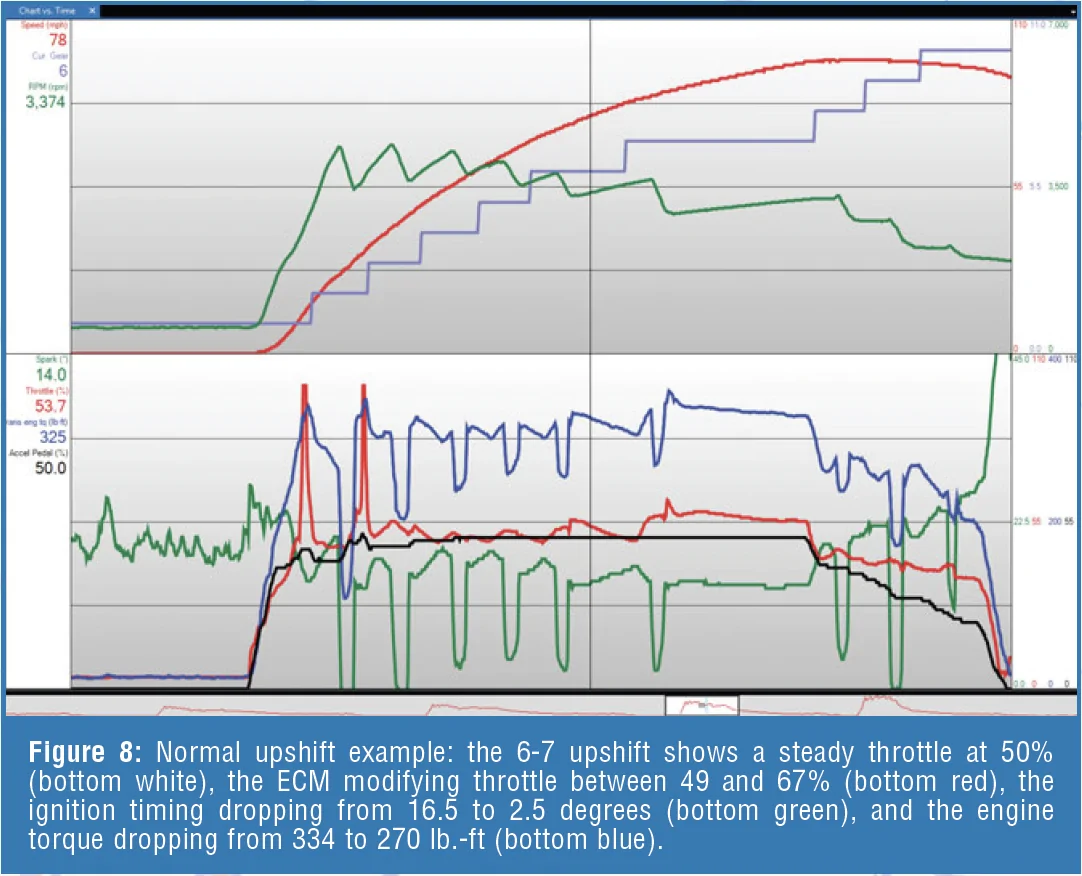
Basically, the OE calibrations torque limit during shifting and torque lock engagement. In GM's example, they limited torque to 270 lb-ft instead of the 430 even at WOT for the 2.7L Turbo Max + 10 Speed. Since all engines are now drive by wire, when the engine goes to map, the calibration engineers can do whatever they want regardless of driver demand.
Suppose you push the pedal to the floor (100% driver demand) in a tall gear at 2k RPM on the highway, you have it in manual shift to hold gear. In older cars that's a no-no, because your lugging the engine and could cause severe knock, since the older cars had mechanical throttle body, the OE's could NOT limit air flow, so you could lean out the engine, their only option was to dump as much fuel and limit spark advance since they didn't have control over throttle body position. In modern engines, the ECU now also controls throttle body position. So, the ECU will only allow a safe throttle body position, timing advance and fueling ratio for the engine at that RPM and load.
YOU can't lug it anymore. You can give it 100% throttle command, but it's never going to give you more than what the calibration was mapped out as a safe operating range. Period.
So how does this translate to transmission durability? The same concept is applied to the shifts. Ford Performance calibration engineers can limit torque during shifts and torque lock engagement to the same as stock or whatever the deem as safe, then only allow higher torque output from the 3.0L after the lockup phase, which isn't going to really impact the service life of the torque lock clutches. Holding torque capacity (what it can manage once it's synced and engaged) is very different from slip capacity (what it can manage while it's still engaging). Slip capacity is where things wear out, overheat and fail.
So, all this concern over the impact on the 10R60 lifespan, at least as far as FP Pro Cal is concerned is really not taking into account how the ECU programming actually works in synchronizing the 3.0L output, including torque limiting and the 10R60 operation.
As long as the 10R60's holding capacity isn't exceeded, the ECU can torque limit to the same torque as stock during shifts and lockup, there would be no real impact to lifespan (i.e., as the torque lock clutches wear normally over 150k~200k miles, they will slowly lose their holding capacity like any part that wears from friction, so with a higher torque output, you might reach the limit of their holding capacity a little sooner once they have a lot of wear on them, but not necessarily that they are going to wear out faster under the same driving conditions).
Beyond that or possible increased mechanical stresses on axles / drive shafts from the higher torque, I'm not really seeing why the FP Pro Cal would have any meaningful negative impact on 10R60 lifespan, especially with all the factory safeties and torque limiting that the Pro Cal is still implementing and tuned for what the stock powertrain was designed to handle. Remember, this is a Ford High Output cal., it's not aftermarket in the traditional sense. So, it was developed with all the OE development / design knowledge available.
I would make a wager that at the end of the day, you will not see a significant difference in service life between a bone stock RR and bone stock RR with just a FP Pro Cal (and maybe an IC), but no other power adder mods.
I expect at least 150k, maybe 200k service life on the 3.0L / 10R60 even with a Pro Cal unless maybe you drag race it and brake boost it weekend after weekend, which would cause a lot of wear and early failure on even stock systems.
Basically, the OE calibrations torque limit during shifting and torque lock engagement. In GM's example, they limited torque to 270 lb-ft instead of the 430 even at WOT for the 2.7L Turbo Max + 10 Speed. Since all engines are now drive by wire, when the engine goes to map, the calibration engineers can do whatever they want regardless of driver demand.
Suppose you push the pedal to the floor (100% driver demand) in a tall gear at 2k RPM on the highway, you have it in manual shift to hold gear. In older cars that's a no-no, because your lugging the engine and could cause severe knock, since the older cars had mechanical throttle body, the OE's could NOT limit air flow, so you could lean out the engine, their only option was to dump as much fuel and limit spark advance since they didn't have control over throttle body position. In modern engines, the ECU now also controls throttle body position. So, the ECU will only allow a safe throttle body position, timing advance and fueling ratio for the engine at that RPM and load.
YOU can't lug it anymore. You can give it 100% throttle command, but it's never going to give you more than what the calibration was mapped out as a safe operating range. Period.
So how does this translate to transmission durability? The same concept is applied to the shifts. Ford Performance calibration engineers can limit torque during shifts and torque lock engagement to the same as stock or whatever the deem as safe, then only allow higher torque output from the 3.0L after the lockup phase, which isn't going to really impact the service life of the torque lock clutches. Holding torque capacity (what it can manage once it's synced and engaged) is very different from slip capacity (what it can manage while it's still engaging). Slip capacity is where things wear out, overheat and fail.
So, all this concern over the impact on the 10R60 lifespan, at least as far as FP Pro Cal is concerned is really not taking into account how the ECU programming actually works in synchronizing the 3.0L output, including torque limiting and the 10R60 operation.
As long as the 10R60's holding capacity isn't exceeded, the ECU can torque limit to the same torque as stock during shifts and lockup, there would be no real impact to lifespan (i.e., as the torque lock clutches wear normally over 150k~200k miles, they will slowly lose their holding capacity like any part that wears from friction, so with a higher torque output, you might reach the limit of their holding capacity a little sooner once they have a lot of wear on them, but not necessarily that they are going to wear out faster under the same driving conditions).
Beyond that or possible increased mechanical stresses on axles / drive shafts from the higher torque, I'm not really seeing why the FP Pro Cal would have any meaningful negative impact on 10R60 lifespan, especially with all the factory safeties and torque limiting that the Pro Cal is still implementing and tuned for what the stock powertrain was designed to handle. Remember, this is a Ford High Output cal., it's not aftermarket in the traditional sense. So, it was developed with all the OE development / design knowledge available.
I would make a wager that at the end of the day, you will not see a significant difference in service life between a bone stock RR and bone stock RR with just a FP Pro Cal (and maybe an IC), but no other power adder mods.
I expect at least 150k, maybe 200k service life on the 3.0L / 10R60 even with a Pro Cal unless maybe you drag race it and brake boost it weekend after weekend, which would cause a lot of wear and early failure on even stock systems.
Sponsored
Last edited: