Sponsored

ProCal Tune and 10R60 Transmission

Lion77

Well-Known Member
Joined
Feb 27, 2025
Threads
28
Messages
786
Reaction score
1,150
Location
United States
Vehicle(s)
2024 Ranger Raptor
Occupation
Electrical Engineer
I wanted to add a few more points to this conversation about the Pro Cal and 10R60 based on more research into transmission tuning. I looked into some articles on factory tuning on the GM 10 speed as a proxy, since it was co-developed with Ford. While they are not identical, they share a similar architecture, and a lot of the same basic tuning concepts are applied across the industry. There were more detailed articles on the GM transmissions than on the Ford version.

Basically, the OE calibrations torque limit during shifting and torque lock engagement. In GM's example, they limited torque to 270 lb-ft instead of the 430 even at WOT for the 2.7L Turbo Max + 10 Speed. Since all engines are now drive by wire, when the engine goes to map, the calibration engineers can do whatever they want regardless of driver demand.

Suppose you push the pedal to the floor (100% driver demand) in a tall gear at 2k RPM on the highway, you have it in manual shift to hold gear. In older cars that's a no-no, because your lugging the engine and could cause severe knock, since the older cars had mechanical throttle body, the OE's could NOT limit air flow, so you could lean out the engine, their only option was to dump as much fuel and limit spark advance since they didn't have control over throttle body position. In modern engines, the ECU now also controls throttle body position. So, the ECU will only allow a safe throttle body position, timing advance and fueling ratio for the engine at that RPM and load.

YOU can't lug it anymore. You can give it 100% throttle command, but it's never going to give you more than what the calibration was mapped out as a safe operating range. Period.

So how does this translate to transmission durability? The same concept is applied to the shifts. Ford Performance calibration engineers can limit torque during shifts and torque lock engagement to the same as stock or whatever the deem as safe, then only allow higher torque output from the 3.0L after the lockup phase, which isn't going to really impact the service life of the torque lock clutches. Holding torque capacity (what it can manage once it's synced and engaged) is very different from slip capacity (what it can manage while it's still engaging). Slip capacity is where things wear out, overheat and fail.

So, all this concern over the impact on the 10R60 lifespan, at least as far as FP Pro Cal is concerned is really not taking into account how the ECU programming actually works in synchronizing the 3.0L output, including torque limiting and the 10R60 operation.

As long as the 10R60's holding capacity isn't exceeded, the ECU can torque limit to the same torque as stock during shifts and lockup, there would be no real impact to lifespan (i.e., as the torque lock clutches wear normally over 150k~200k miles, they will slowly lose their holding capacity like any part that wears from friction, so with a higher torque output, you might reach the limit of their holding capacity a little sooner once they have a lot of wear on them, but not necessarily that they are going to wear out faster under the same driving conditions).

Beyond that or possible increased mechanical stresses on axles / drive shafts from the higher torque, I'm not really seeing why the FP Pro Cal would have any meaningful negative impact on 10R60 lifespan, especially with all the factory safeties and torque limiting that the Pro Cal is still implementing and tuned for what the stock powertrain was designed to handle. Remember, this is a Ford High Output cal., it's not aftermarket in the traditional sense. So, it was developed with all the OE development / design knowledge available.

I would make a wager that at the end of the day, you will not see a significant difference in service life between a bone stock RR and bone stock RR with just a FP Pro Cal (and maybe an IC), but no other power adder mods.

I expect at least 150k, maybe 200k service life on the 3.0L / 10R60 even with a Pro Cal unless maybe you drag race it and brake boost it weekend after weekend, which would cause a lot of wear and early failure on even stock systems.
Sponsored

 
Last edited:
Lion77

Well-Known Member
Joined
Feb 27, 2025
Threads
28
Messages
786
Reaction score
1,150
Location
United States
Vehicle(s)
2024 Ranger Raptor
Occupation
Electrical Engineer
10L80 Transmission Performance & Torque Management

Gears Magazine - Shift Anatomy: The GM 10-Speed

Ford Ranger ProCal Tune and 10R60 Transmission 1776171168549-sk


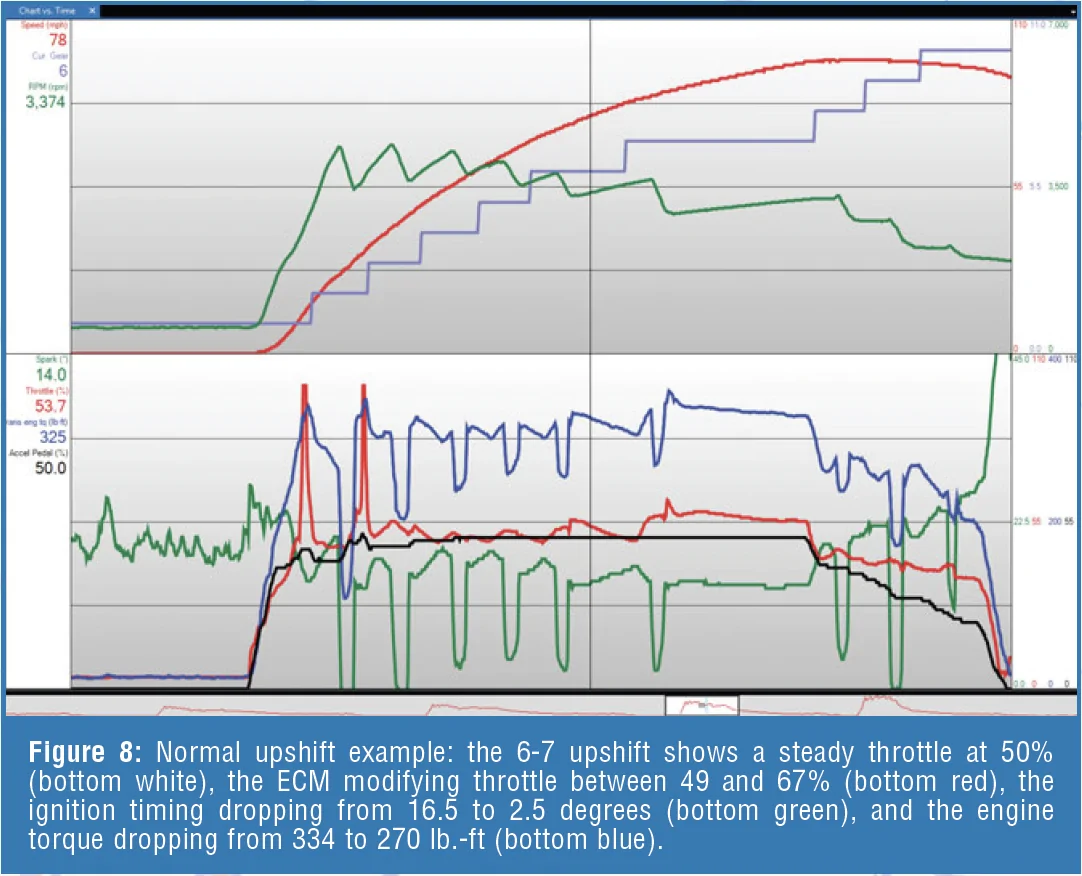
A picture is worth a 1,000 words as the saying goes. The ECU drops the torque output during shifting to whatever the ECU calibration was tuned for. Ford Performance Pro Cal is no different, the increased power output of the Pro Cal isn't relevant to the shifting, it's likely that the FP Cal uses stock or something close during shifting to ensure high reliability.

The extra 106 lb-ft has no bearing on torque lock clutch durability since they can toque limit to anything they want to during the actual shift and lock-up phase of the 10R60. I can tell you with a high degree of certainty the Ford Performance calibration engineers aren't doing anything sketchy in the name of performance because their goal is to provide added performance while also maintaining factory-like reliability. It's Ford's Performance name going into the cal's, so it would look very bad for them to be calibrating their own vehicles to point of early failure.

So, FP Tune it, drive it and have fun!
 

Lion77

Well-Known Member
Joined
Feb 27, 2025
Threads
28
Messages
786
Reaction score
1,150
Location
United States
Vehicle(s)
2024 Ranger Raptor
Occupation
Electrical Engineer
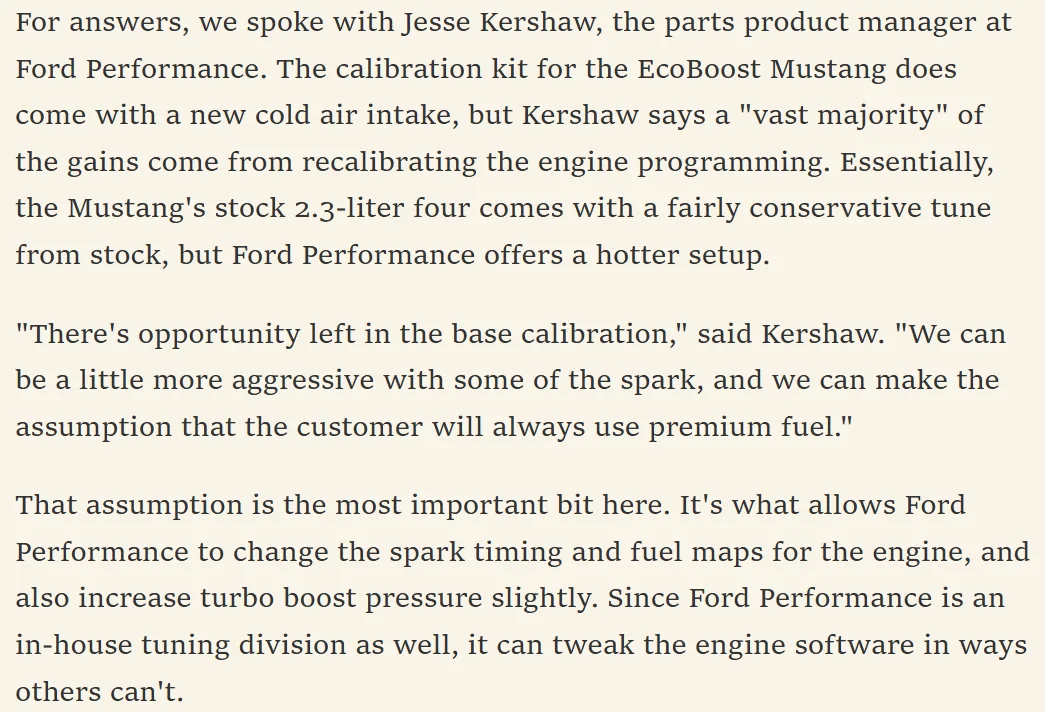
How Ford Got V8-Level Torque Out of a Four-Cylinder Mustang

There's a key piece of information in that article regarding Ecoboost calibrations from Ford Performance. This applies to all Ecoboost calibrations and why the factory ECU cal's don't maximize power and torque.

It is NOT due to mechanical limitations. It is due to Fuel Octane. I've stated this before but finally found the article I had read back when I got into performance cal's for my 2015 Mustang Ecoboost when I had that.

Ford Ranger ProCal Tune and 10R60 Transmission 1776859539136-n
Ford designs nearly ALL of their ecoboost engines to be able to run on 87 Octane. The vast majority of their customers will at some point run 87 either to save on fuel costs or because they simply aren't well informed on the why there are fuel grades.

The one or two exceptions might be the 5.2L Supercharged Predator engine in the GT500 / F-150 Raptor R, but anyone spending that kind of money on a car with that much power is expected to understand the need for higher octane in performance engines. All the other variants are still intended to be primarily "street + utility vehicles", so they are all tuned to be able to run on 87 without damage, even if you sacrifice power and efficiency to do so.

Car enthusiasts, engineers, technicians etc. are probably more well educated on the reasons, but your average joe or soccer mom? Not so much. So the default engine tuning baseline is the assumption that a customer may not know and use 87, 89 etc., so their OE tuning requirements factor in the WORST CASE because they cannot control what the user does, no do they want people cracking pistons by using low octane because they didn't know.

Remember, the average person will perceive it as "well you didn't tell me that, why would you design it this way to allow that to happen?". Regardless of the fact that it was user error, if they can implement an engineering control to prevent that, then they will play it safe and for good reason.

Ford Performance is their in-house performance division; it is a part of FoMoCo. They know their customers are "car people" and much better educated. The legal language also states that if the user uses fuel grades below 91 and damages the engine, it's on YOU!

So, the Pro Cal's, aside from optimizing shift schedules and throttle mapping, tap into the headroom left by eliminating the requirement to scale back to lower octane.

Example: user runs 91 or 93, ECU scales up timing for more power. User then decides to put 87 back in because gas prices are higher, the ECU don't know what fuel grade is in the tank, so it can only get so aggressive on 91 with timing advance to allow enough headroom to scale back timing for lower grades if the operator suddenly switches fuel grades to avoid damage. After that vehicle has been re-fueled with 87, the first time that engine starts up and is put under load, it will see knock, but if the timing on 91 is maximum that is safe for that grade, then damage will occur on 87 before the ECU can figure out it needs to scale back. So the need to accomodate fuel grade changes is what limits your actual potential on higher grades like 91, 93. Basically, you're getting may half of the potential of 91 by needing to still accodate a switch back to 87 if that makes sense.

By eliminating the need for that safety margine to accomodate lower fuel grades (87, 89 etc.), Ford Performance can get more aggressive with timing on 91+ to safely maximize performance without exceeding the mechanical design parameters because the only safety margine that is needed is for 91 and higher grades. That's why Pro Cal power gains are sometimes pretty good (like with the 3.0L), but other times not that much (3.5L in the F-150 Raptor).

Larger displacement engines are typically LESS octane sensitive, so they tend to be less knock prone between fuel grades, which means there are less gains from higher octane in larger displacement engines than in smaller ones. The factor cal on the 3.5L in the F-150 Raptor, even though it is still tuned to be able to safely run on 87, is still closer to its maximum potential due to octane sensitivity of that engine design. So there's less gains by eliminating 87~89 in the 3.5L vs. the 3.0L.

The Pro Cal for the 3.0L RR buys you substantially more power and torque gain than in the F-150 Raptor where you're only gaining about 16 HP in the F-150 Raptor vs. 50 HP in the RR. The 3.5L in the F-150 Raptor is largely based on the 3.5L in the regular F-150's, but the standard 3.5L in the work truck F-150's is really optimized for 87, where the 3.5L in the F-150 Raptor is optimized for 91 (more power) but with the ability to still safely run on 87. It's all about fitting the customer's use cases and needs. You want power or utility / economy?

Small Displacement = more octane sensitive, benefits more from premium fuel grades, offers less of its potential power with factory multigrade ECU cals.

Larger Displacement = less octane sensitive, smaller benefits from premium fuel grades, offers more of its potential power with factory multigrade ECU cals.

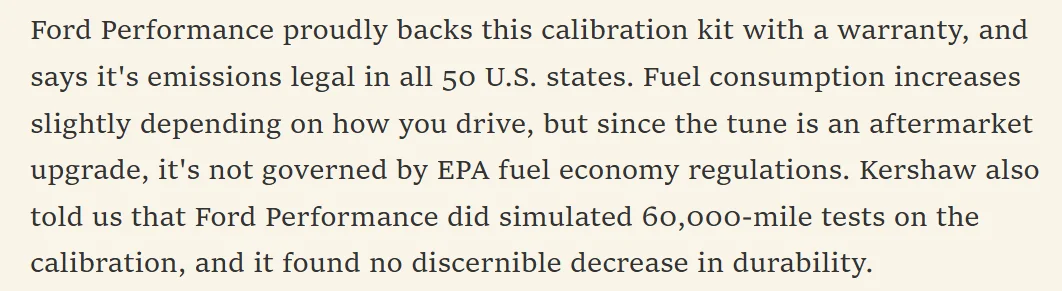
At the end of the day however, the Pro Cal for the RR will yield nearly identical long-term reliability to the factory ECU cal pending maintenance and no component / assembly defects that would cause issues on either stock or Pro Cal. The added power is really coming from the elimination of the safety margine needed to run on 87~89, not by exceeding the actual mechanical limitations of the powertrain.

Ford Ranger ProCal Tune and 10R60 Transmission 1776861336644-j3


I.e., after real world driving that mirrors how customers would use these vehicles, their tear down analysis didn't find any abnormal wear. Bearings, cam lobes, timing chains, torque lock clutch plates, piston rings etc. would have wear rates that were all within the typical ranges seen with the factor ECU cal. under the same driving conditions. So, if you want additional Power AND Reliability that is OE, stick with Ford Performance Pro Cal and good regular maintenance practices!
 
Last edited:

Lion77

Well-Known Member
Joined
Feb 27, 2025
Threads
28
Messages
786
Reaction score
1,150
Location
United States
Vehicle(s)
2024 Ranger Raptor
Occupation
Electrical Engineer
All this is really why I say the Pro Cal is about what the factory powertrain can reliably handle. If you want long term durability, but still want more than the factory tuning, the Pro Cal is your ONLY option. Otherwise, you're going to start sacrificing long term durability and the wear / failure curves are usually exponential, so without multi-vehicle testing, tear downs etc., with non-ford ECU cal's, you're simply throwing a dart at a board blind folded and hoping you hit the bulls' eye or somewhere close!

If I had a dollar for every 2.3L Ecoboost Mustang or even GT on the Mustang 6g forums can came on the forum crying that they trashed their $7k~$10k engine at 30k~50k miles with a custom WTF ever remote tune they paid $500 for....I'd be rich! I can guarantee you that not a single aftermarket (non-ford) cal. has been tested in a wind tunnel with hot dry air and full data pack to asses knock resistance at high load…but Ford Performance does!

To be clear, I do think aftermarket ECU cals do have a place: built bottom end and built transmissions. If you have a complete built bottom end with forged pistons, rods, upgraded clutch plates in the 10R60, big turbo's etc., aftermarket makes sense, but those setups can also tolerate a lot more tuning error and sloppiness than the factory engine and transmission (more margine).

They also cost a LOT more to build. That's the caveat. If I ever do a built long block, I will go aftermarket cal, but on stock bottom end and 10R60, Stock / Pro Cal ECU tuning only! It's just NOT worth trashing an engine or transmission unless you have 20k in savings in cash to throw at it. That's my 2 cents.
 
Last edited:

2wheelfish

Well-Known Member
Joined
Mar 6, 2025
Threads
3
Messages
59
Reaction score
61
Location
OC Cal
Vehicle(s)
Ranger Raptor
Thank you for all of this, but I’m still a little confused here. For a long time you’ve touted that Gears Mag was essentially wrong on their write up about the 10R60 having a 430ft lb max torque, and it should be something higher, yet I’ve not seen real proof of this, or referenced torque values. Now you say it’s that the tune lowers itself down to something critically below 430 ft lb (to save the tranny during shifts) and you are quoting the same Gears magazine? I appreciate all your efforts and others on this board to share experience and resources, but I’m still searching for some solid ground here and it still seems like wishful thinking without a lot of definitive data. Am I missing something?
 

Sponsored

Lion77

Well-Known Member
Joined
Feb 27, 2025
Threads
28
Messages
786
Reaction score
1,150
Location
United States
Vehicle(s)
2024 Ranger Raptor
Occupation
Electrical Engineer
Ive already debunked the NM internet conspiracy theory.

https://www.ford.com/trucks/super-duty/

F250 and F350 use the 10R140 transmission.

If the 140 is rated in NM as alleged, then 140 * 10Nm ~= 1,033 NM of input torque.....and yet that same truck sells with an H.O. option of the 6.7L Power Stroke that is rated for 1,200 lb-ft.

So your telling me that its wishful thinking and yet Ford is apparently selling F250s and F350s with 6.7Ls that produce more torque than the transmission is rated for stock....no tune.

Thats ridiculous! Any of the older publication has always understood that to be lb-ft. The engine torque is literally rated in lb-ft on Fords own website i linked above. So why would they rate a transmission input torque in NM and an engine that generates the torque in hp / lb-ft?

None of this makes any sense whatsoever. I did a deep dive and looked at a variety of publications, the older more reputable ones all rate them in lb-ft. Some of the newer more sketchy tuner style publications are assuming its in NM becuase they focus more on imports and made the mistake of transcribing that to domestic brands they are starting to cover. They hear the word "Turbo" and automatically add it to the import category for more clicks lol.

Its all rooted in ignorance and assumptions without ONE SINGLE spec drawing to back up the assertion the transmission input torque is in NM. Find me an actual engineering drawing and ill cry uncle, but you won't be able to. Fords own website really bears this reality out with the F250 / F350 diesel options.
 

Lion77

Well-Known Member
Joined
Feb 27, 2025
Threads
28
Messages
786
Reaction score
1,150
Location
United States
Vehicle(s)
2024 Ranger Raptor
Occupation
Electrical Engineer
Also, any magazine can make mistakes. Because a publication made an error in assuming input torque is rated in NM instead of lb-ft doesn't invalidate their real-world testing on transmission tuning.

Hopefully that answers the question. It's not just gears magazine, there are other publications that cover transmission tuning that show how it's done and they all show about the same strategies across the industry.

It's a common misconception that "making more power / torque" will automatically put more stress on the torque lock clutches leading to premature failure, well that depends on how much more power / torque and more importantly, how the transmission tuning is managed!


Top