
Sponsored

Oil Catch Can. Yes or No?

Tim H.

Member
First Name
Tim (TJ)
Joined
Feb 17, 2020
Threads
0
Messages
16
Reaction score
6
Location
Clarksville, MD
Vehicle(s)
2010 RAV4 , 2020 Ranger Lariat
Occupation
Retired IT tech
“Link: 2.3L MUSTANG ECOBOOST OIL-AIR SEPARATOR LH

And this is stated
WARNING:
This part is designed and intended for competition use only. It should not be installed on a vehicle that is driven on public roads and highways. Installation of this part on a vehicle driven on public roads and highways is likely to violate U.S. and Canadian laws and regulations relating to motor vehicle emissions.”


I understand why this might dissuade some from installing the Ford system, but I don’t see how they can point to this for a warrantee denial. It is designed by Ford engineers to keep the blow-by crud out of the intake system! I personally do all my own maintenance and if I were to suspect that there could be an issue in bringing the truck in for a warrantee item, I would simply un-plug it and re-connect the original lines.
I am anxiously awaiting its arrival for sale on the Ford Performance site for my ordered Ranger that is due in at my dealer tomorrow.
“Competition use only” ?
Costs a lot of money & red tape to get it CARB certified. They obviously know the DI design creates valve carbon build-up.
Sponsored


 
  • Like
Reactions: Doc

HarryD

Well-Known Member
Joined
Sep 3, 2019
Threads
0
Messages
57
Reaction score
11
Location
Western MA
Vehicle(s)
2020 Ranger Lariat Super Cab
“To be clear, the reason Ford is selling this product is because they think enough people will buy it that Ford can make a profit.”


We are all welcome to our own opinions. I for one feel that there are numerous ways for Ford to make profits without expending as much effort in design and testing as has been done on this dual system (PCV/CCV).
 

2020 FRL

New Member
First Name
Alan
Joined
Jan 16, 2021
Threads
1
Messages
3
Reaction score
1
Location
Grand Junction, Co.
Vehicle(s)
2020 Ford Ranger Lariat
Occupation
Retired
I'm new to this forum ... Like just today ... Just bought a 2020 Ranger Lariat. I was surprised to see a thread about "catch cans". Not because I don't think they're needed, just because I never thought about it. I have lots of experience with "Catch Cans" on Harleys. For probably 15 years, I have added a can to all my Harleys. My current ride is a 2014 Harley Tri Glide and it was one of the first things I did to it. I guess I didn't think about it on my Ranger (or any other non Harley) was because these vehicles are water cooled, yada yada yada.

So why do it on a Harley? I was getting oily residue coming. out of the air cleaners. Figured if there's enough oil vapor going into the intake that it dribbles out the bottom of the air cleaner, How good could that be for the pistons and injectors?

I do 4,000 mile engine oil changes on my Harley and get about a teaspoon of oily residue out of the can. Having seen the amount some are getting from the Ranger Catch Cans, I'll be looking into doing this. Do I believe it's an "Essential Fix"? No more than I believe "Pot Shops" in my home state of Colorado are "Essential Businesses".

So here's my point. Add a can, don't add a can, it's all about preference. But food for thought, if you can eliminate a 1/4 cup or so of oily residue from the intake of the valves every 1000 miles or so, why not? Internal combustion engines run best when they breath clean cool air. Or has that changed too!

As for the "extra maintenance", how tough would it be to put a jar under the can drain line, open the valve, drink some coffee and when it quits draining shut the valve again? I'm guessing the cans are large enough to go a full 3-10k miles depending on how often you change the oil. Most mechanics (if you don't do your own) will do the drain at oil change if you tell them you have the can and they need to.
 
  • Like
Reactions: Doc

Txquailguy

New Member
First Name
Mark
Joined
Feb 9, 2021
Threads
0
Messages
3
Reaction score
5
Location
Colorado
Vehicle(s)
2019 Lariat Ranger FX4, 2020 Hyundai Kona Ultimate
Occupation
Biologist
I have been running a Mishimoto catch can on my 2019 Ranger since 20K, now have 37K. When I purchase a 2023 Ranger, it will be getting a catch can installed day 1 for sure!
 
  • Like
Reactions: Doc

Sponsored

MAV

Well-Known Member
Joined
Dec 6, 2023
Threads
9
Messages
269
Reaction score
381
Location
Arkansas
Vehicle(s)
2024 Ranger Raptor
I can't get on board with that design for a couple of reasons.

One, it drains back into the engine. The entire point of a catch can is to keep the vaporized funk and putrescence from the crankcase from being sucked into the intake system, and the secondary point is to collect it so it can be drained and removed from the engine altogether.

Two, it has a heating system that keeps the separator at engine temperature, which all but eliminates the ability of the catch can to function as a condensing unit to separate vapors from the PCV system.
 

Hyperprints3DP

New Member
Joined
Jul 29, 2025
Threads
0
Messages
2
Reaction score
6
Location
PA
Vehicle(s)
Ranger Raptor
I can't get on board with that design for a couple of reasons.

One, it drains back into the engine. The entire point of a catch can is to keep the vaporized funk and putrescence from the crankcase from being sucked into the intake system, and the secondary point is to collect it so it can be drained and removed from the engine altogether.
This statement is true for catch cans. For the IAG AOS, it's an air-oil separator. It separates the oil out of the crankcase vapors and sends the clean(er)air along through the system. The clean oil then is allowed to go back into the engine, where it belongs.

Two, it has a heating system that keeps the separator at engine temperature, which all but eliminates the ability of the catch can to function as a condensing unit to separate vapors from the PCV system.
You spoke earlier about 'funk and putrescence'. Reality is this stuff is funk because it has water vapor in it. Not allowing the water to condense keeps it out of the oil. If it's not in the oil, the oil is clean and doesn't need to be thrown away. Also, the water vapor in the intake charge is impossible to remove. It's in the air when it goes into the combustion chamber. As a by-product of combustion with Ethanol, some will get past the rings as blow-by. Water will always be in the equation.

The IAG AOS is a cyclonic oil separator. This same principle is used by the OEM across many makes to do the exact same thing. Difference is the IAG unit is much bigger in volume, and can process the contaminated charge air more efficiently by removing smaller particles of oil than what even a 'good' catch can do by condensation alone.

Truth is, the catch cans are kind of the gimmick product here. The amount of 'oil' they catch is such a small percentage of what's actually in the intake charge. That's why it doesn't look 'bad' when all you empty out is a few ounces of emulsified oil and water at your oil change. All of the smaller particles are still in the intake charge after the catch can. An efficient AOS can remove over 90% of the oil, even down into the 1 micron range. The condensation collector (catch can) just simply can't do that.

I also see alot of comments in regards to price. An AOS in an engineered product that is designed to function with the OE PCV/CCV systems to increase efficiency. A catch can is just a vessel that is put inline with the PCV hose. You could effectively do the same thing with a soda can...
 

MAV

Well-Known Member
Joined
Dec 6, 2023
Threads
9
Messages
269
Reaction score
381
Location
Arkansas
Vehicle(s)
2024 Ranger Raptor
This statement is true for catch cans. For the IAG AOS, it's an air-oil separator. It separates the oil out of the crankcase vapors and sends the clean(er)air along through the system. The clean oil then is allowed to go back into the engine, where it belongs.
Except a catch can isn't just removing vaporized clean oil. It's removing (in theory) every vaporized compound in the crankcase, and most of those are VOCs along with any combustion byproduct that made it past the piston rings. Vaporized oil will contain many of the VOCs from blowby, and even if an AOS can separate clean oil from the VOCs, water vapor, fuel, and anything else, those compounds should be removed as well.

You spoke earlier about 'funk and putrescence'. Reality is this stuff is funk because it has water vapor in it.
Water vapor is some of it, yes, but as I said previously, volatile organic compounds are there as well. VOCs are the first things to get vaporized in the crankcase environment because their boiling point is lower than more stable compounds (like oil). Condensing all of those in a cooling system of sorts removes them (in theory) from both the oil and the intake charge, storing them in a canister where they can be discarded.

The IAG website says this: " When oil gets into the intake, it coats internal parts like the intake, intercooler, pipes and valves. This can cause premature failure of rubber or silicone hoses, eventually resulting in failed connections."

What would be the result of such compounds as ethene, benzene, isopentane, acetylene, and toluene on those components? Probably a lot worse than "clean engine oil" on them.

Not allowing the water to condense keeps it out of the oil. If it's not in the oil, the oil is clean and doesn't need to be thrown away.
If we were talking lost quantities of oil that could be detrimental to the engine, returning it to the crankcase might make sense. But vaporized engine oil in the PCV system, while certainly enough to coat intake systems over time, is not generated in large quantities.

Also, the water vapor in the intake charge is impossible to remove. It's in the air when it goes into the combustion chamber. As a by-product of combustion with Ethanol, some will get past the rings as blow-by. Water will always be in the equation.
Water is a byproduct of the combustion of any hydrocarbon, gasoline being one of them. As you said, water is also a byproduct of ethanol combustion. However, if water were the only vaporized compound in the crankcase, then this theory would hold water, pardon the pun.

The IAG AOS is a cyclonic oil separator. This same principle is used by the OEM across many makes to do the exact same thing. Difference is the IAG unit is much bigger in volume, and can process the contaminated charge air more efficiently by removing smaller particles of oil than what even a 'good' catch can do by condensation alone.

Truth is, the catch cans are kind of the gimmick product here. The amount of 'oil' they catch is such a small percentage of what's actually in the intake charge. That's why it doesn't look 'bad' when all you empty out is a few ounces of emulsified oil and water at your oil change. All of the smaller particles are still in the intake charge after the catch can. An efficient AOS can remove over 90% of the oil, even down into the 1 micron range. The condensation collector (catch can) just simply can't do that.
There are a lot of claims in those two paragraphs but no real data to back them up. Sure, they sound good, but who actually has the research to prove the claims one way or another? Even if every claim is true, my personal preference is to utilize a condensation-based system to remove the VOCs, even if that means I don't catch all the oil. If an AOC system helps you sleep better, by all means, spend the money. It certainly can't hurt.

I also see alot of comments in regards to price. An AOS in an engineered product that is designed to function with the OE PCV/CCV systems to increase efficiency. A catch can is just a vessel that is put inline with the PCV hose. You could effectively do the same thing with a soda can...
I think you meant that last comment to be somewhat of an insult to the theory behind condensation-based vapor separating systems, but there's a little more to most catch cans than a thin wall of aluminum. But again, if a soda can catches more VOCs than an AOS system, then send me your empty beer cans, please.
 
  • Like
Reactions: Doc

Hyperprints3DP

New Member
Joined
Jul 29, 2025
Threads
0
Messages
2
Reaction score
6
Location
PA
Vehicle(s)
Ranger Raptor
Except a catch can isn't just removing vaporized clean oil. It's removing (in theory) every vaporized compound in the crankcase, and most of those are VOCs along with any combustion byproduct that made it past the piston rings. Vaporized oil will contain many of the VOCs from blowby, and even if an AOS can separate clean oil from the VOCs, water vapor, fuel, and anything else, those compounds should be removed as well.


Water vapor is some of it, yes, but as I said previously, volatile organic compounds are there as well. VOCs are the first things to get vaporized in the crankcase environment because their boiling point is lower than more stable compounds (like oil). Condensing all of those in a cooling system of sorts removes them (in theory) from both the oil and the intake charge, storing them in a canister where they can be discarded.

The IAG website says this: " When oil gets into the intake, it coats internal parts like the intake, intercooler, pipes and valves. This can cause premature failure of rubber or silicone hoses, eventually resulting in failed connections."

What would be the result of such compounds as ethene, benzene, isopentane, acetylene, and toluene on those components? Probably a lot worse than "clean engine oil" on them.
Regarding the VOC's, I don't think a catch can is collecting those on an appreciable scale. All of the compounds you referenced are in a gas form at the temperatures you'll find in an engine bay. And these vapors (and VOC's) are exactly what gets passed back into the intake air for re-combustion, by design.


If we were talking lost quantities of oil that could be detrimental to the engine, returning it to the crankcase might make sense. But vaporized engine oil in the PCV system, while certainly enough to coat intake systems over time, is not generated in large quantities.
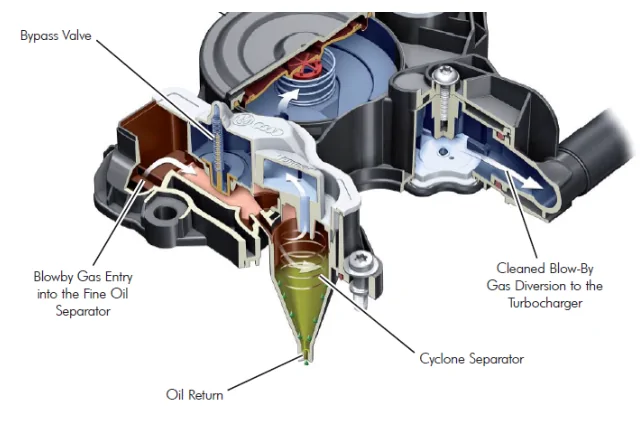
This may be true for this platform, but there are plenty of other platforms that see large amounts of oil in the PCV/CCV system. Regardless of the platform, the OE does actually employ air/oil separators already. Difference is that they usually aren't as efficient as a properly engineered AOS. Take this figure, it's a stock AOS in a PCV system for the VAG platform vehicles.

Ford Ranger Oil Catch Can. Yes or No? Screenshot 2025-08-04 212755
.


Water is a byproduct of the combustion of any hydrocarbon, gasoline being one of them. As you said, water is also a byproduct of ethanol combustion. However, if water were the only vaporized compound in the crankcase, then this theory would hold water, pardon the pun.
Separating the oil from the air was the focus of my statement. The rest of the water vapor and other HC compounds are allowed to continue on for re-combustion. That's how the system is designed to work, even before you add a catch can or AOS.


There are a lot of claims in those two paragraphs but no real data to back them up. Sure, they sound good, but who actually has the research to prove the claims one way or another? Even if every claim is true, my personal preference is to utilize a condensation-based system to remove the VOCs, even if that means I don't catch all the oil. If an AOC system helps you sleep better, by all means, spend the money. It certainly can't hurt.
All of the discussions seem to come down to this. You're going to seek out the truth you desire. All of the information is out there. Countless studies, papers, research data, it's all out there. If it just comes down to a personal preference, there is nothing more to be said.

I think you meant that last comment to be somewhat of an insult to the theory behind condensation-based vapor separating systems, but there's a little more to most catch cans than a thin wall of aluminum. But again, if a soda can catches more VOCs than an AOS system, then send me your empty beer cans, please.
I mean, it's a pretty simple theory, no insult was dealt. I just think you are giving your catch can more credit than it deserves. Like I mentioned before, the temperatures in an engine compartment are elevated above the point where these VOC's will stay a liquid. And no, an AOS won't catch these things, because they are allowed to pass through and be re-injected in the combustion path. Just the way the OE designed them to be.
Sponsored


Top