Sponsored

Is there an engine oil cooler for the Ranger Raptor?

biohazard69

Active Member
First Name
Hector
Joined
Jan 26, 2025
Threads
5
Messages
26
Reaction score
8
Location
Chile
Vehicle(s)
Ranger raptor 2da gen
Hello, given how hot it is in Chile these days, I'm looking for an oil cooler for the engine, as I've seen they only have transmission oil coolers... are there any for the engine?
Sponsored


 

embedded rock

Well-Known Member
Joined
May 6, 2023
Threads
15
Messages
638
Reaction score
672
Location
Earth
Vehicle(s)
One truck, two motorcycles
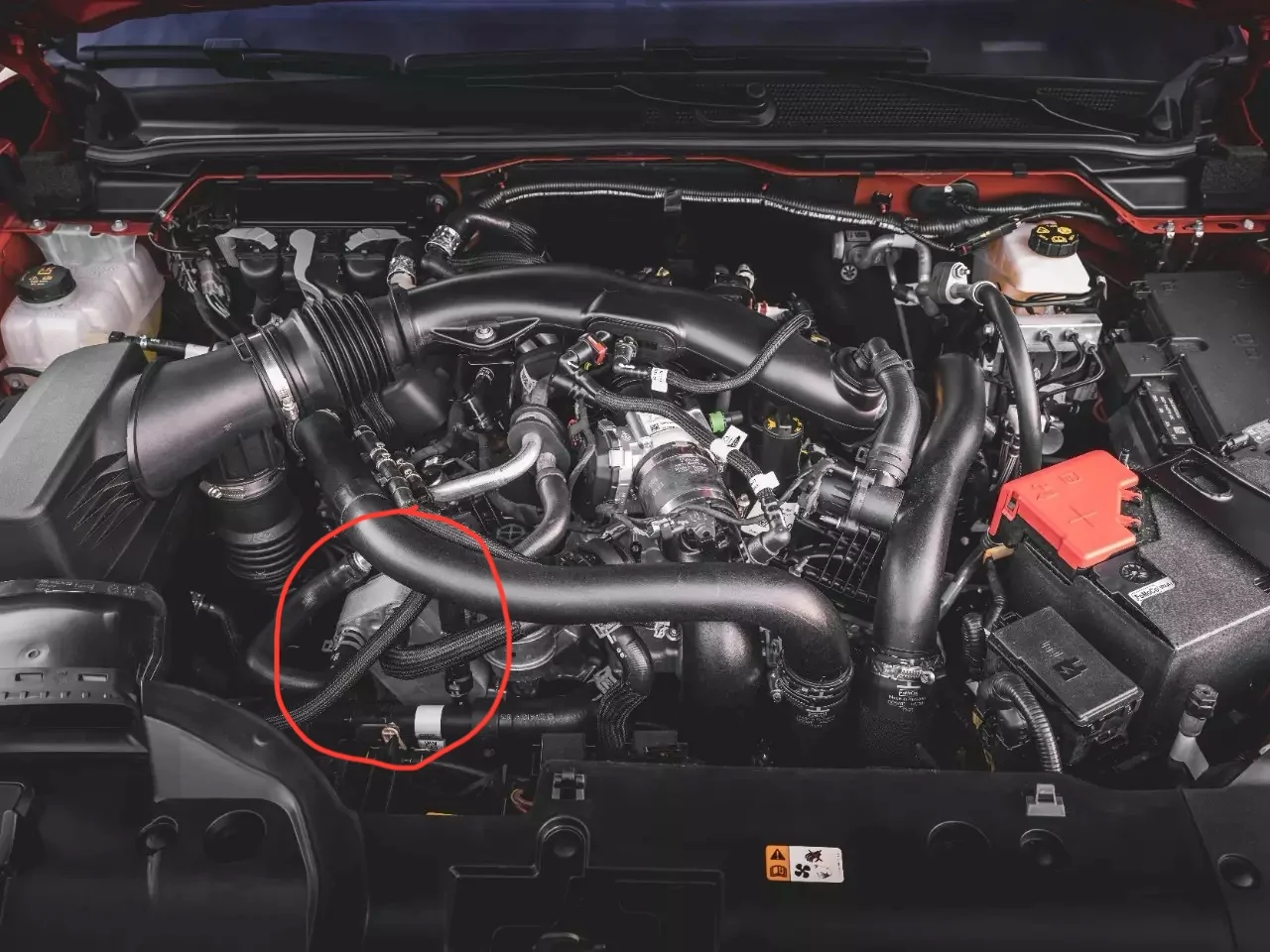
Look for a liquid to liquid cooler on your engine. It'll look like a block of laminated steel plates.
 

some_guy

Well-Known Member
First Name
some
Joined
Oct 18, 2025
Threads
9
Messages
219
Reaction score
203
Location
florida
Vehicle(s)
2025 Ranger Raptor
Occupation
entrepreneur
The radiator cools the water flowing through the engine, which cools the oil flowing through the engine. Typically only diesel engines might have an external oil cooler.
 

Sponsored

Lion77

Well-Known Member
Joined
Feb 27, 2025
Threads
28
Messages
786
Reaction score
1,150
Location
United States
Vehicle(s)
2024 Ranger Raptor
Occupation
Electrical Engineer
If anyone ever upgrades to an Air to oil cooler make sure to get a thermostat controlled one, otherwise you over-cool the oil during warmup and cause wear issues over time or even in very cold climates at low loads, a non-thermostat-controlled air to oil cooler can have negative effects.

As stated above, usually only on turbo diesel engines or track cars (GT350 Mustangs, Corvette 1LE's etc.). They are often needed for sustained hot lapping where heat is the biggest enemy. For drag racing, it's mechanical stress (drive train, clutches, axles, tires, transmission etc.).

Also, the Transmission oil cooler in the RR is of the same liquid to liquid design, just located at the bottom right in front of the serpentine belt, mounted to the frame. So both the transmission and engine oil are water cooled. Overall, for non-racing applications liquid to liquid is usually better and a robust liquid to liquid system with a high-capacity radiator can come close to dedicated air to liquid systems.

You're tying the heat of all of the major vehicle fluids together thermally and oil has higher thermal density than steel! Transmission oil, engine oil and coolant, thereby dramatically increasing the total thermal mass of the highest thermal density material in the vehicle. The other advantage is faster oil-warm-up times that reduce wear and improve overall fuel economy.

In older cars with no oil cooler, the radiator would come up to temp much faster than the oil, so people might think the engine was warmed up when the temp gauge was reading 190~200F, but the oil wasn't and wear issues would occur due to too much frequent throttle on cold oil even with warmed up coolant.

Even our daily driver Mazda's have liquid to liquid oil coolers for the engine oil for reliability and fuel economy (faster warm-up, less cold engine wear).

On my RR, the transmission oil takes the longest to saturate due to its capacity being nearly 2x that of the engine. So, I go by transmission oil temp before any heavy throttle (usually I make sure it's at least 170F, which is 1 viscosity grade lower than when it's at full operating temp of around 200).

Every 30F increase typically thins oil by 1 viscosity grade (or thickens it if -30F temp change). So, at 230F, your 5W-30 becomes equivalent to 5W-20 (track Mustangs typically see oil temps in the 250F range, so 5W-30's are degraded to 5W-10, that's why the GT350 uses 5W-50, to avoid excessive oil thinning under sustained heat, it essentially thins out to what a 5W-30 would be at normal temps).

At 260F your 5W-20 becomes 5W-10.....usually an engine can still run properly and maintain function without catastrophic failure with 1-2 viscosity grades deviation (although not always optimally) as long as the heat is continually managed and the oil is of a good quality synthetic base stock with strong EP additive package (unless it's already a ULV oil, as in you wouldn't want to do that with a 0W-16 or 0W-10 oil, it would thin out too much and not provide adequate film strength).

5W-30 is really an ideal viscosity for modern bearing designs, 5W-20 is also very good, but doesn't provide as much safety margine for high thermal loads. So 5W-20 or 0W-20's are great for Naturall Apsirated 4 cylinders that don't produce the heat loads of a Trubo (like Mazda's Sky-Active 2.5L NA engine or other similar designs) while 5W-30's or 0W-30's are really ideal for Turbo GDI engines like the Ecoboost 2.3L and TT V6's, the Toyota / Lexus 2.4L Turbo in the RX 350's, 4G Tacoma / 4Runner, Mazda Sky-Active G Turbo 2.5L's or 3.0L Inline's in the CX series SUV's etc.
 
Last edited:

embedded rock

Well-Known Member
Joined
May 6, 2023
Threads
15
Messages
638
Reaction score
672
Location
Earth
Vehicle(s)
One truck, two motorcycles
Just an fyi. Former CH-47D mtp. The Chinook 712/714 engines had/have liquid to liquid coolers. They use incoming fuel to cool the engine oil. Always worked.
 

Lion77

Well-Known Member
Joined
Feb 27, 2025
Threads
28
Messages
786
Reaction score
1,150
Location
United States
Vehicle(s)
2024 Ranger Raptor
Occupation
Electrical Engineer
Other than very specific applications, I think liquid to liquid works best. For a track mustang or similar, Air to Liquid with thermostat may be the way to go, but for street vehicles, work vehicles and most military applications, the liquid to liquid is usually more simple as it's tied into the radiator, which is sized to handle all the cooling needs, has fans for low speed applications and massively better surface area.

Air to Liquid's need speed to work properly, hence why I say track cars, or an active fan, but the fans for something that size are not going to be as robust as your radiator fan which is usually pretty heavy duty and reliable. In off-road, a small fan down low would be highly susceptible to seizing up with mud / debris!
Sponsored


Top