
Raptor Family
Well-Known Member
- First Name
- Jeff
- Joined
- Apr 2, 2025
- Threads
- 5
- Messages
- 113
- Reaction score
- 220
- Location
- Dallas, Texas
- Vehicle(s)
- ‘25 Ranger Raptor, ‘97 Jeep Cherokee, ‘24 Lexus NX450h+
- Occupation
- retired
- Thread starter
- #1

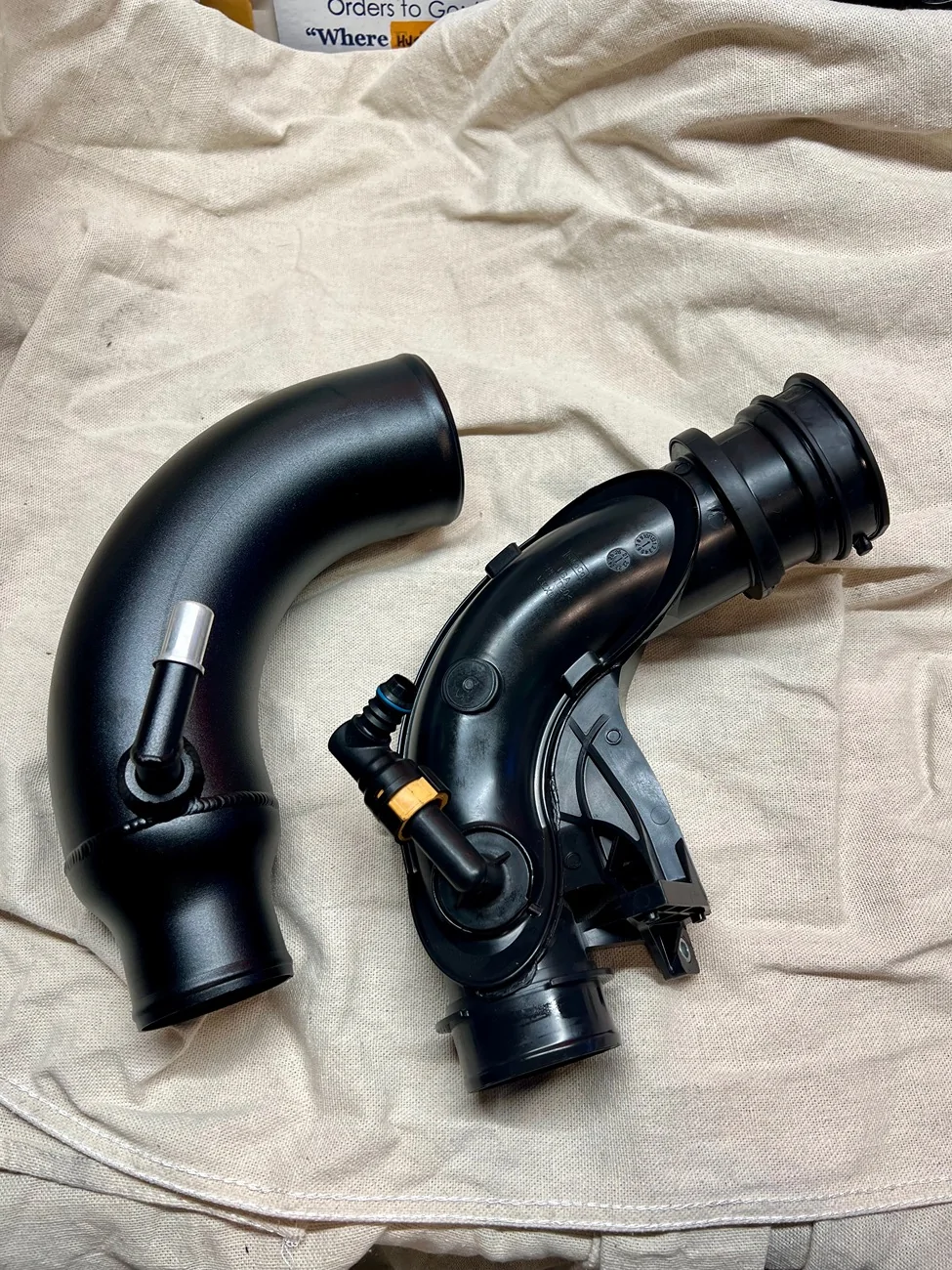
I have seen a lot of questions lately about buying the best Cold Air Intake for our trucks and I think a lot of manufacturer advertising is pushing false issues of needs and wants. We are being convinced that what we have stock from Ford is inferior to these new shinny objects that range in cost from sub $100 for a performance filter element, to $1.5k for Carbon Fiber unit from Indiecarbon (Thailand--where global RRs are manufactured) or an aluminum box from the boys down under (Process West, Fabulous Fab, and others)--and the mid-priced $400-600 plastic rotomolded U.S. units from AFE, S&B, and K&N--there is another U.S. unit called RamAir, being marketed by a vendor on this site (Dirt D)--I have only seen pictures of it, but its design takes a completely different approach to solve some of the deficiencies in the factory system--and it doesn't cost much. So, in this post, I want to look at the factory Ford system, what it does good, what it does bad--and identify any design defects. I want to look at the aftermarket intake units from various manufacturers and see how their design approaches improve upon the original unit---basically, what makes them better than the factory unit--or worse (and the best bang for the buck).
First, what is a Cold Air Intake, and why is it desirable? Similarly, what is Ram Air, and why do we want it as well? We want cold air because every 10 degree decrease in intake air temperature is a 1% increase in horsepower--free horsepower. The extra power is from efficiency created from the denser air; better emissions, better MPG, more power; win, win, win. As an example, in our trucks, we have 405bhp. If we decreased the temperature of the air entering the intake by 10 degrees, we would make about 4.05 more HP. If we dropped temp by 20 degrees; 8.10HP, and so on. Ram Air is free power too. It is the velocity of the air entering the intake and converted into PSI; where every 1 PSI in boost adds 6.8% more HP. One psi of boost is worth about 28hp on a 405bhp Ranger Raptor. Problem is, that Ram Air does not increase boost as much as we think it does. The air velocity at 60mph only produces .06psi of boost. 100mph only produces .18 psi. So at 60mph we multiply 405bhp x .068 (percent of increase)x .06 (psi of boost)=1.65hp. The hp gain is so low, it almost can't be measured. At 100 mph; 405x.068x.18=4.96hp--almost 5 hp. Anything over 112mph doesn't matter as you are driving faster than the speed safety rating of the tires our trucks are equipped with.
Engine compartment temperatures are hot, and over the last 2 decades they have got even hotter. Up until about the mid 1990s most cars ran 180 degree thermostats which began opening around 180 and created about a 185-200 degree normal operating temperature. Not anymore. The thermostats in our trucks begin opening at 197.6 and become fully open at 222.8 degrees. The normal operating temperature is between 190 and 220 with spikes higher under load considered acceptable. You can cook a Texas brisket on that kind of heat. For those of you that have never looked, peer into your front grille. You will see what looks like black Venetian blinds--those are the computer controlled shutters that stop airflow from cooling the radiator and entering the engine compartment. They are designed to bring the temperature up high quickly and keep it there. We do not want to suck this hot air into our air intake--for the opposite reasons mentioned above--every 10 degrees of hotter intake air decreases HP by 1%. And here is the next thing, almost every modern car runs at these hotter temperatures, and virtually all vehicles have some form of cold air intake already as factory--our trucks included. We already have a cold air intake. Our intake path takes cold air from the grill and brings it over the radiator support into the air filter box snorkel. The underside of our hood has a "U" shaped weather stripping that seals this cold air path from hot engine compartment air. Up until this part, all aftermarket CAIs utilize the exact same design with the air path as the factory Ford.
Here is a video that describes the air path better than I can S&B Breakdown of Ranger intake Some of the things I don't like about this video are how he describes the factory air flow through the Ford filter box as bad. The air comes into the box at the top, heads straight down and makes a "U" turn and goes up to the air filter with the filter media facing down. I think this is a good design, any dirt, dust or debris--or even rain will travel with the air down inside the air filter box when the air changes directions making the "U" to head back up, all the heavier particles of dirt, dust, and water fall out of suspension and do not even make it to the air filter. The filter lasts longer and doesn't get moisture saturated. With the filter upside down, all the heavier dirt and debris constantly falls to the bottom of the air filter box, helping keep the filter cleaner. There is a 5mm hole in the bottom that drains out any water and can allow some particles to fall out of the box as well. When he describes the superiority of air flow path being direct to his filter, that is not a bonus--water, dust, and debris have a straight shot at the upper facing pleats that are just little trenches to hold all of the dust, dirt, and and debris--any water in the air, goes straight onto the filter without any mitigation. In the installation, he says you have a choice about putting the side cover on the Air box or leaving it off--he advises to leave it off to get "more air into the engine". I think that is totally wrong--because it no longer is a cold air system with the air filter exposed to the hot engine compartment. In the video, he has the entire factory system laying on the table and it is easy to see the air piping that exits the factory filter box. The Part I want to bring your attention to is the "T" junction feeding the passenger side turbo inlet. It is easier to see when the whole system is laid out on the table. Here is a picture of the "T" Junction in the truck.
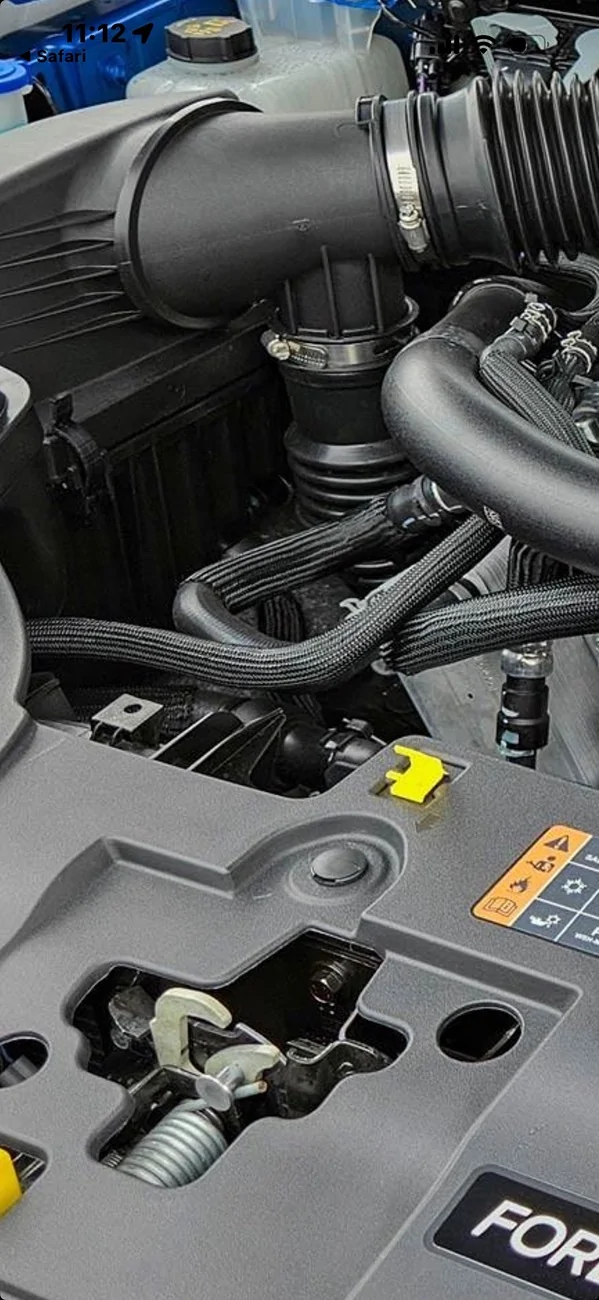
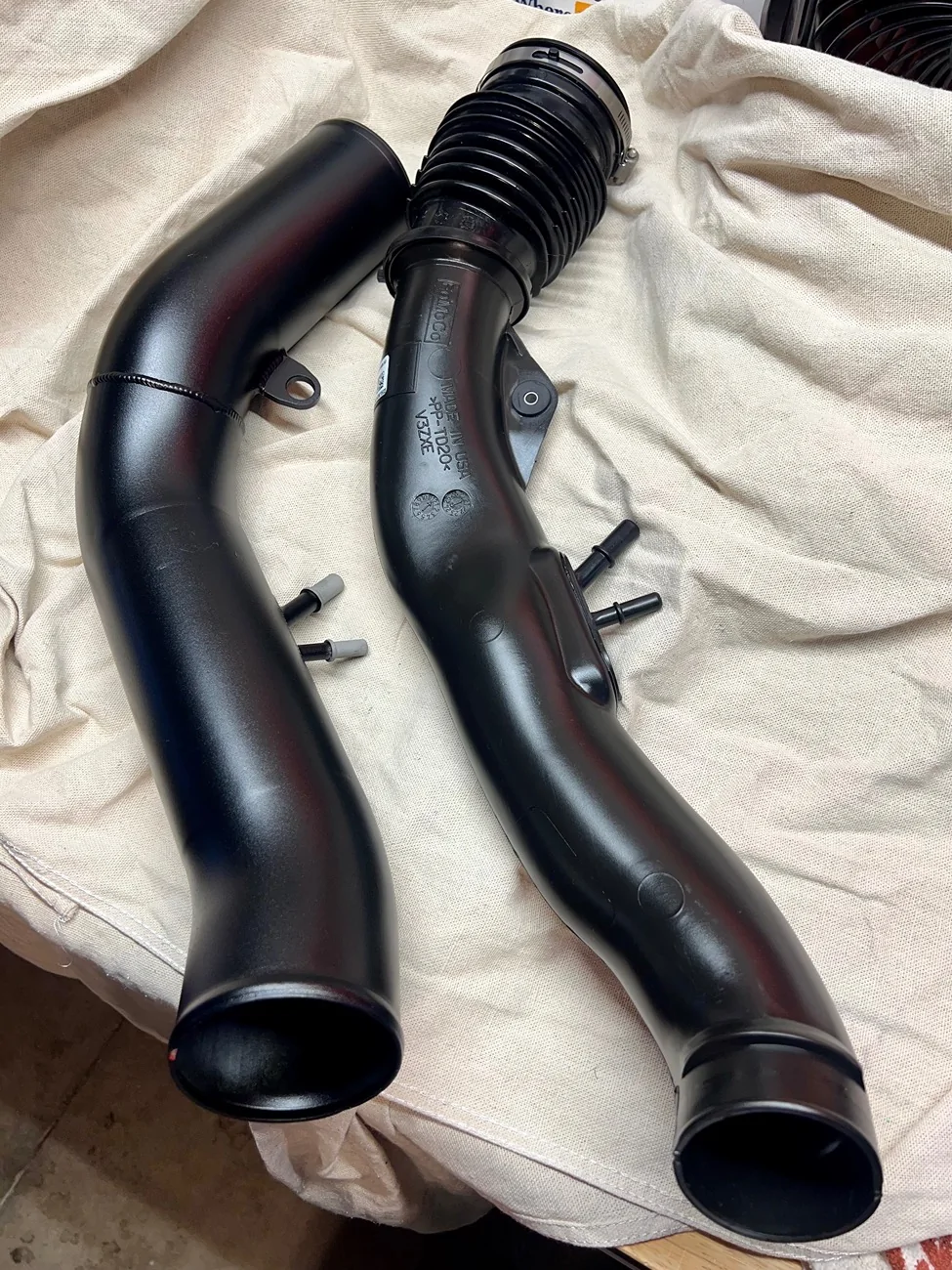
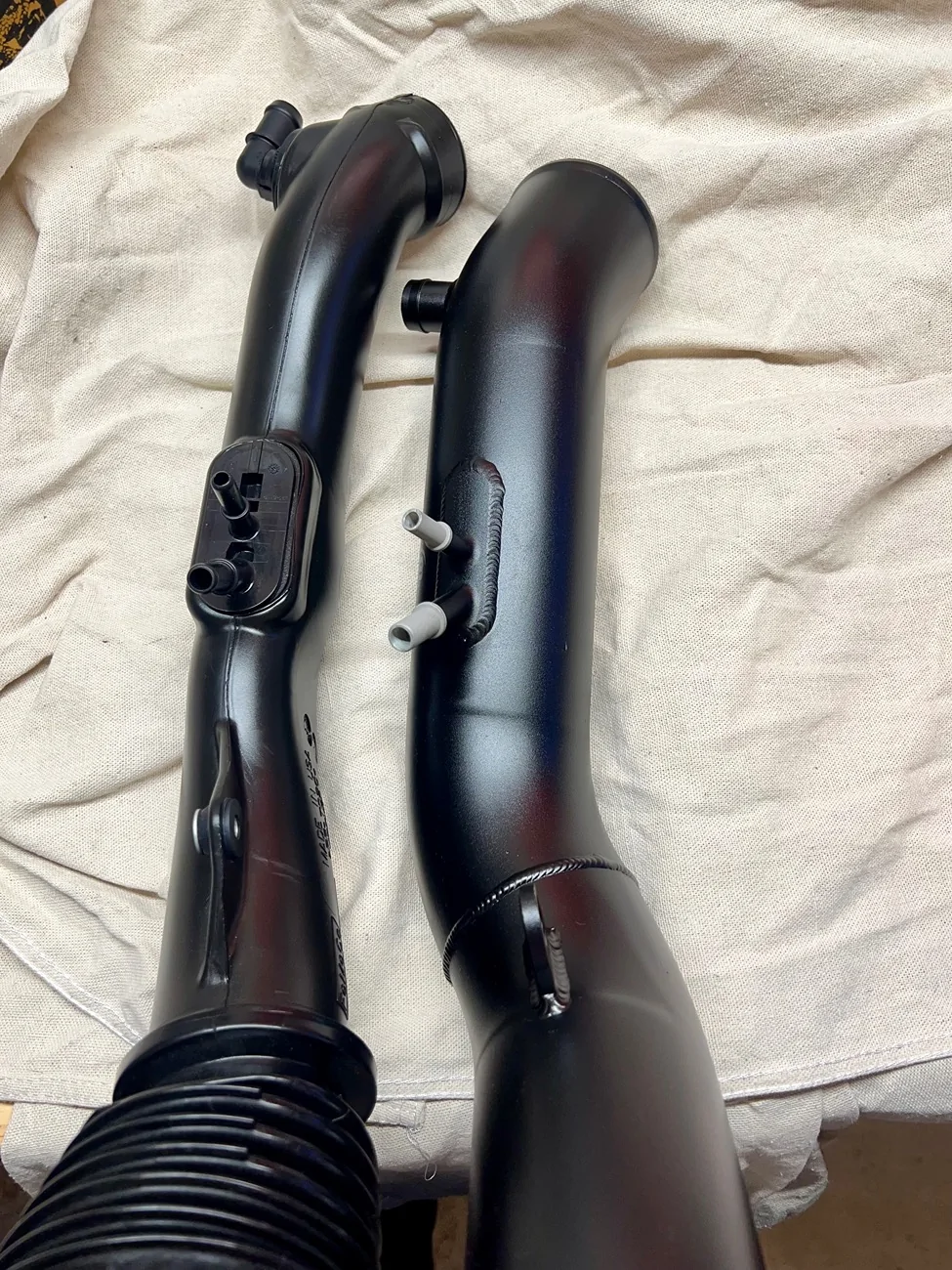
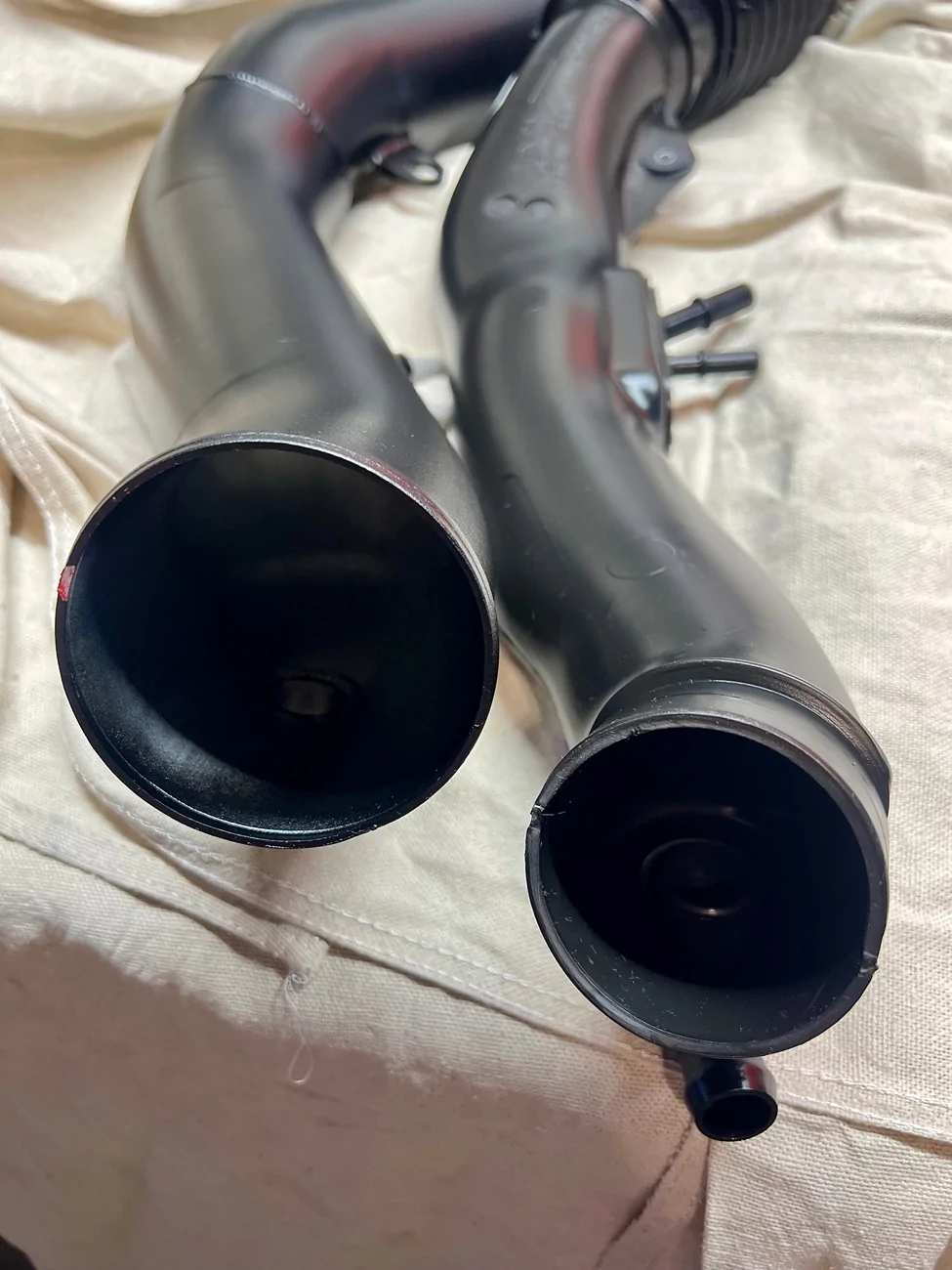
Look at the piping coming out of the air box, it starts out larger at the air box, shrinks to a funnel shape and has a 90 degree junction just as the pipe is shrinking. This I believe is horrible engineering from Ford. Anybody that has ever studied anything to do with fluid dynamics (and yes, air is a fluid), knows that a "T" junction such as this causes a loss of laminar air flow, turbulence, and a loss of pressure (more about pressure later) as does the accordion type bellows, the flattening of the crossover, and short bend radius of the plastic elbow of the drivers side turbo inlet.
Here is a short paper discussing the loss of laminar flow in a 90 degree "T" junction T Junction Loss of Laminar.
here is the primary picture from that article

What is depicted here is what happens to air flow under pressure--it is not exactly the same as air under vacuum, but the picture is a good visual reference of what occurs in 90 degree "T" junctions. The Red, orange, and green are all different layers of laminar air velocities with a lot of velocity loss at the junction where the blue is almost zero. The loss of velocity affects the pressure to the turbo inlets. Our turbos; stock, modified, etc are very sensitive to inlet pressure.
Don't take my word for it, in this video 700hp Monster , Adam from ZFG tuning is talking about the highest Horsepower Ranger Raptor in North America--and possibly the World (Nathan's 714hp Monster), speaks about how sensitive the turbos are to inlet pressures--he is the tuner that makes these things go--and go really fast, I think he knows what the hell he is talking about. If you look really closely at the type of air intake that is being used it is a split system with a separate filter on the left turbo, and one on the right. There is no crossover, no air box, the passenger side filter just lays on the passenger side fender well, and the drivers side air filter lays on the inner fender well just behind the battery. The system is made by FenFab and I think these are prototypes, as I have never seen them for sale on his website. These are not truly CAI, as they are in the engine compartment. They are proof of concept that our turbo inlet pressures are very sensitive and that the factory system is inadequate.
.
Lets look at the different manufacturer systems and how the try to fix the "T" Junction flaw in the Ford design:
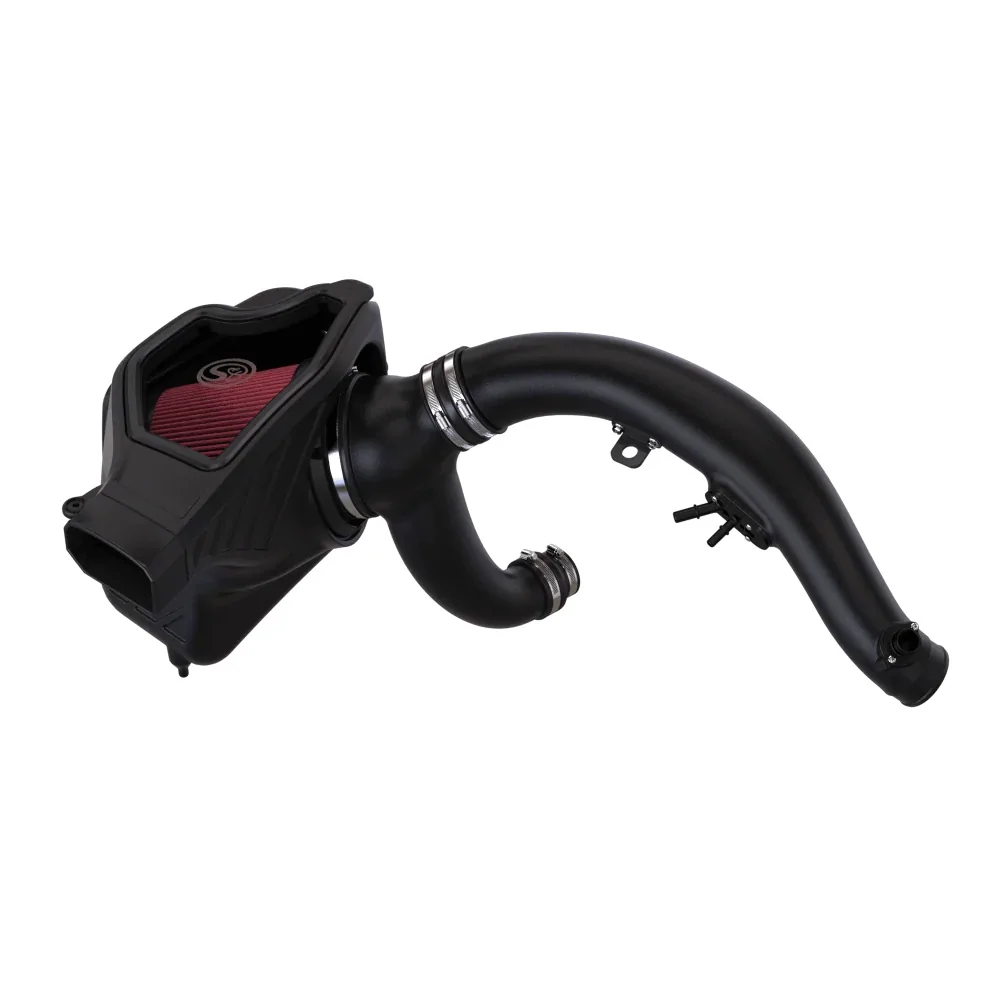
Here is the S&B. They kind of enlarged the base of the funnel (where the air filter is) and located the the passenger side turbo inlet similar to a "T". It is like the inlet side of the "T" is fatter than the two legs. It is an improvement over stock, but I don't think it is optimal. They smoothed out some of the the other stuff and ditched the bellows.
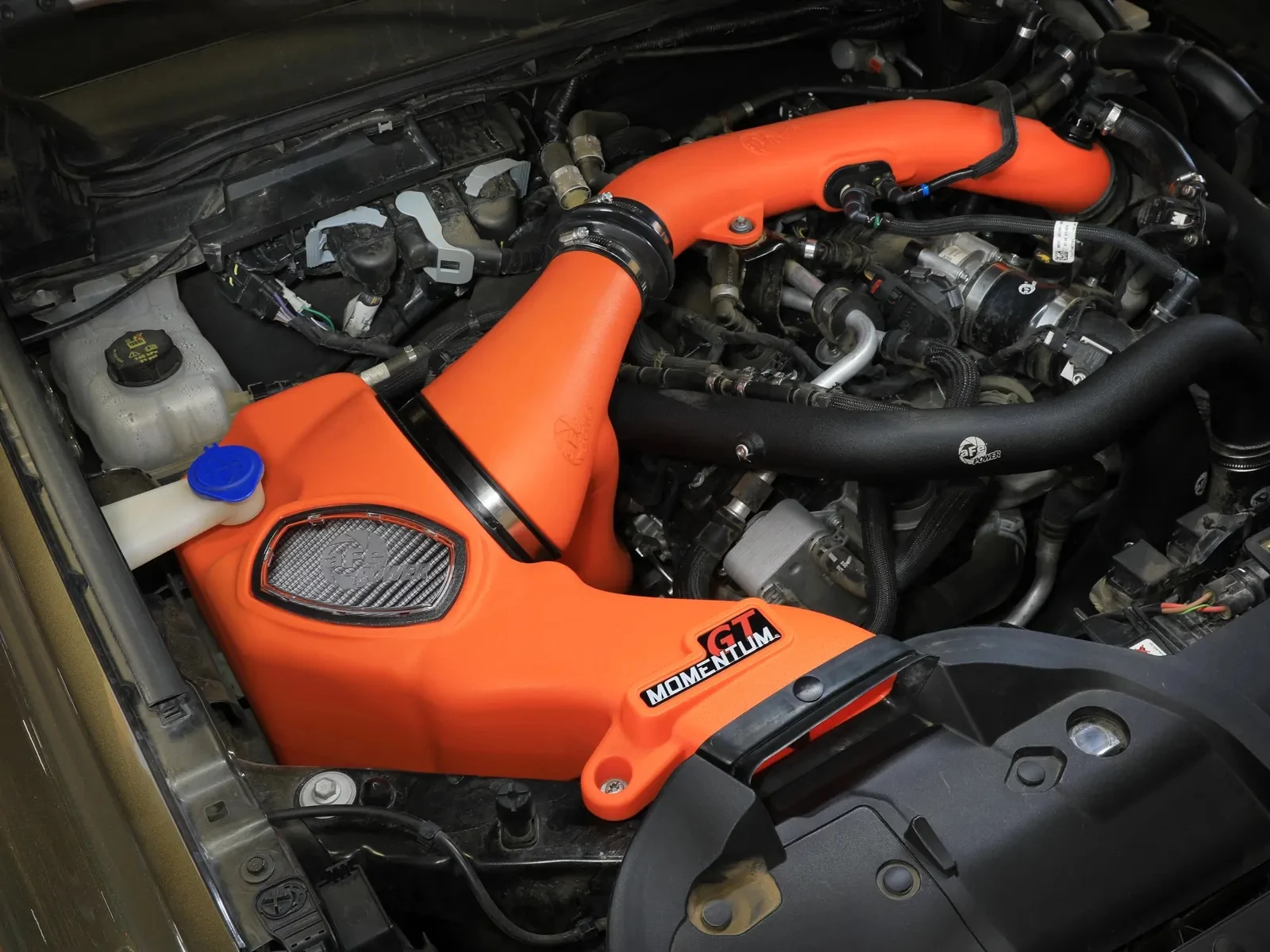
Here is the AFE. It is nice, bright , and colorful--but look at the passenger turbo inlet--it is still a 90 degree"T". They made a big funnel coming directly off the air box (mainly because that is the base of the filter sticking out--same as S&B). Not optimal

Here is the K&N. Out of all the U.S. plastic air intakes, their design looks the best compared to the others with reference to the dreaded "T". They have a smooth looking "Y" which should pose a minimal pressure loss and have more balanced laminar flow. Their crossover pipe is not flattened, and they god rid of the bellows that cause turbulence. I think they claim a 27hp gain.
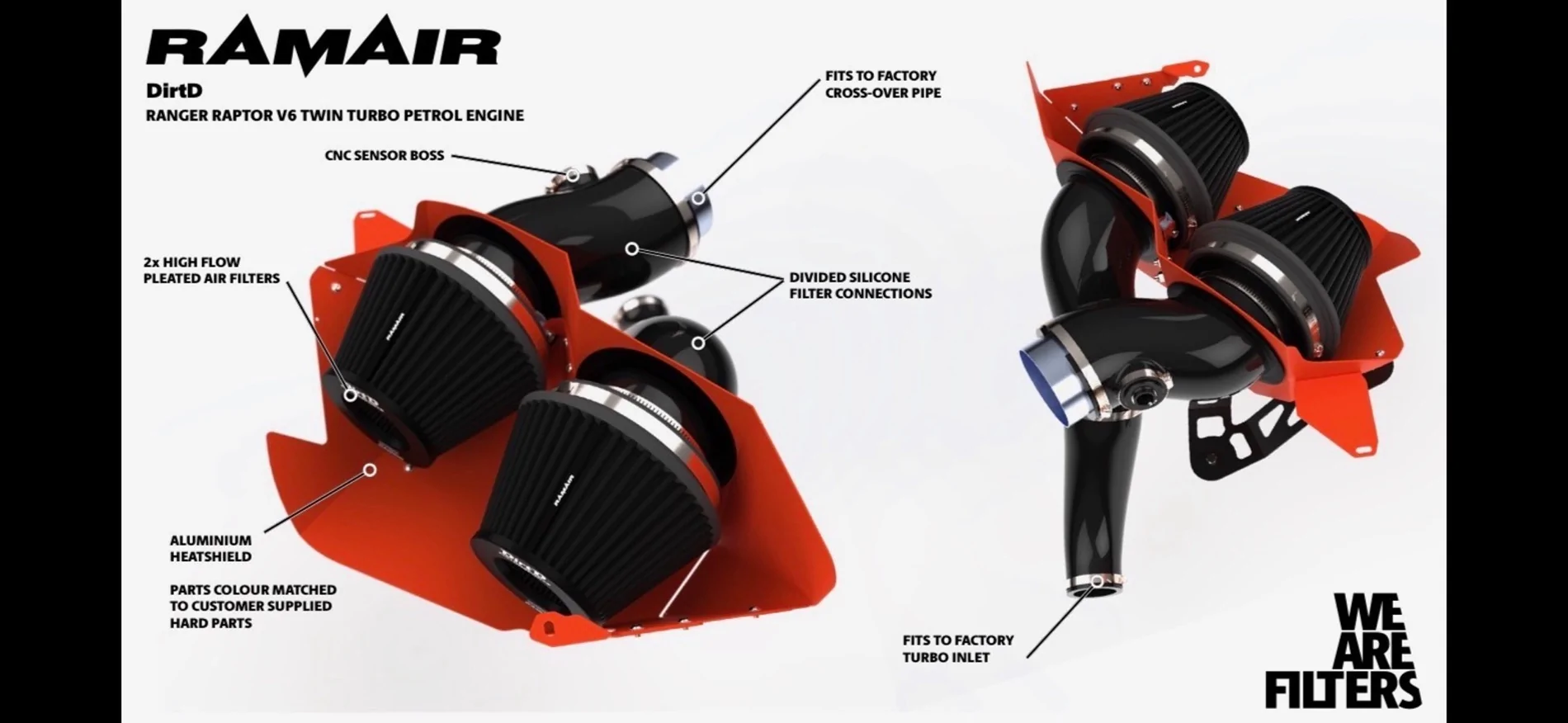
This is the new system from Dirt D. I don't have any experience with it and have only seen the picture. It fixes the "T" problem (as do all dual filter systems) the main difference is this system is less than a third of the cost of the Indiecarbon or the Fabulous Fab dual filter units. It is in the same price range as the plastic U.S. units. I am curious how it attaches, and if it seals to be cold air. This could be best of all worlds--fixes all the flaws of original, and doesn't cost a fortune. Nathan is usually on here, this is his baby, maybe he can chime in.
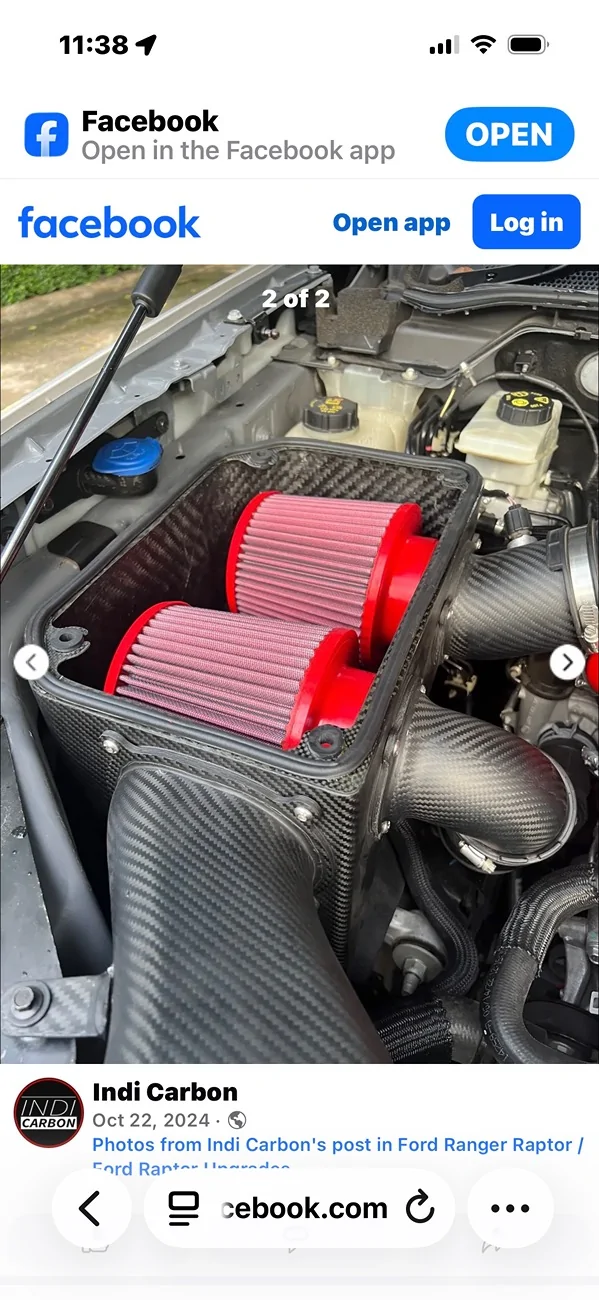
The Indicarbon made in Thailand. Last time I checked it was around $1400. Not sure if or how much Tarrif we have with Thailand. It seems to fix all of the Ford flaws and does it with style--costly style. It is beautiful with the lid on. There is a video out on the installation. One thing I did not like was the mounting of the tab to the radiator support. if you look in the bottom left of the picture, you can see what I am talking about. In the video, he says if the spacing isn't right, put a couple of washers under the tab to take up the space--not to just tighten it under stress--and break it. But, when I saw the video, it appeared as if the tab was at the wrong angle, and if you tightened it down, it would probably break off. If you look at where the tab is glued onto the snorkel inlet, it appears if it has already cracked off. I have other Indicarbon items (Carbon key fob covers, etc) that are extremely high quality. Maybe these were prototypes or early production units--or maybe Im just too picky.
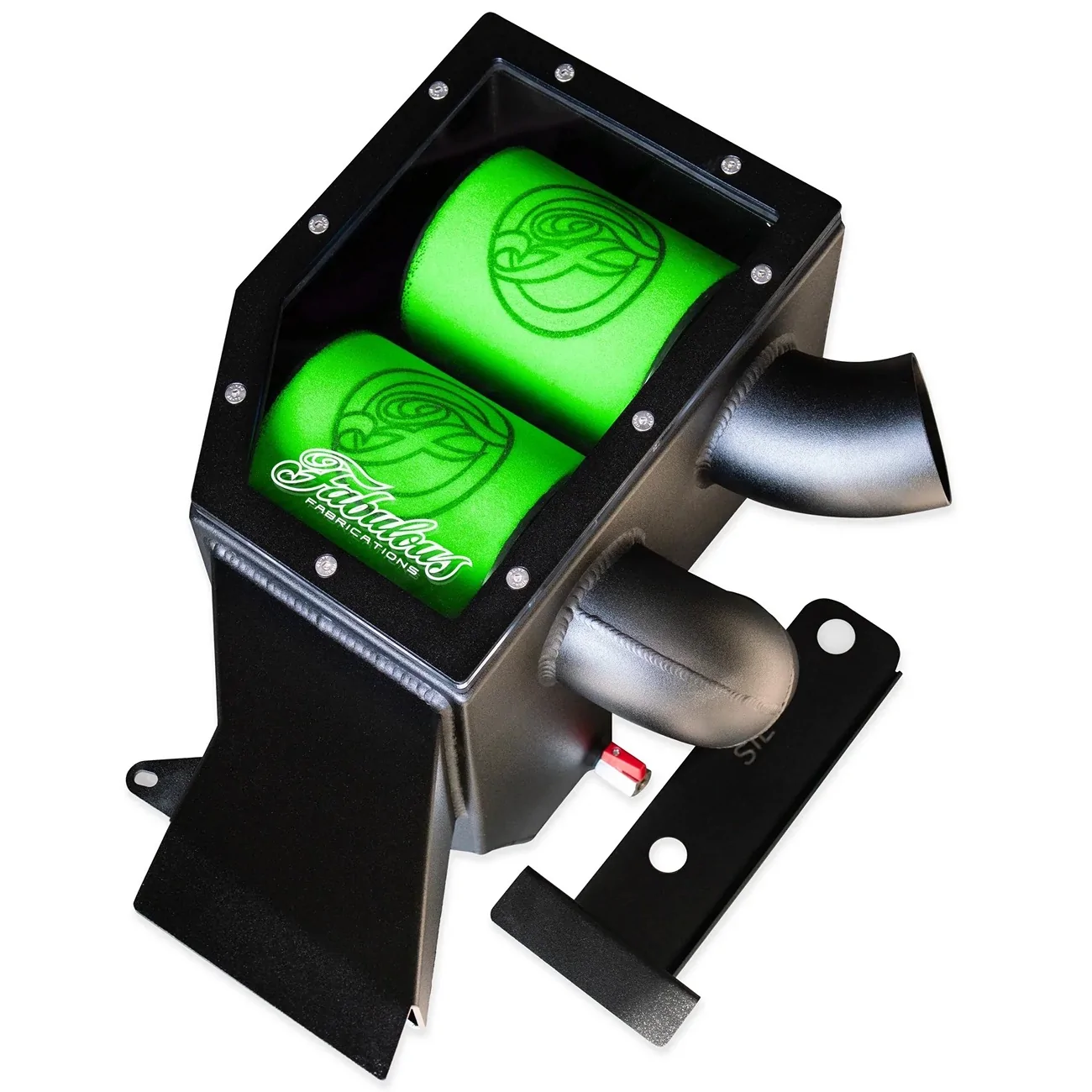
The Fabulous Fab cold air. These boys down under know how to weld! Look at those beautiful Tig welds--that is skill, and a lot of attention to detail. There are a few features of this I like compared to the other Australian CAI, the Process West. First, see all of the stainless screws that hold down the plexiglass lid? What the screws are actually attached to is a metal ring that is placed over the plexiglass and more evenly distributes the load from tightening the screws down. The Process West doesn't have that and there are perfect little "star' cracks all around every screw. See that red handle ball valve? It is in the open position. No other CAI has one that Im aware of. It is for draining the water out of the Air box. When you are just normally cruising around, leave it open so water can drain out. If you are going water fording, close it to prevent water entry from the bottom. Here is the Fabulous CAI Dyno results--10HP gain.
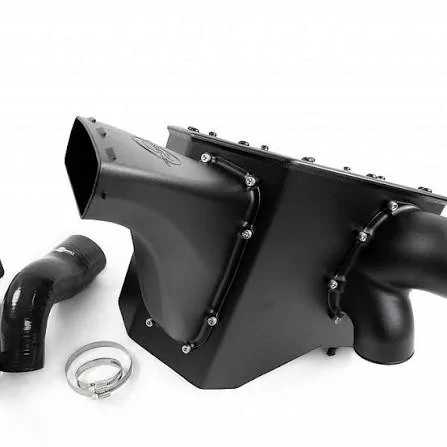
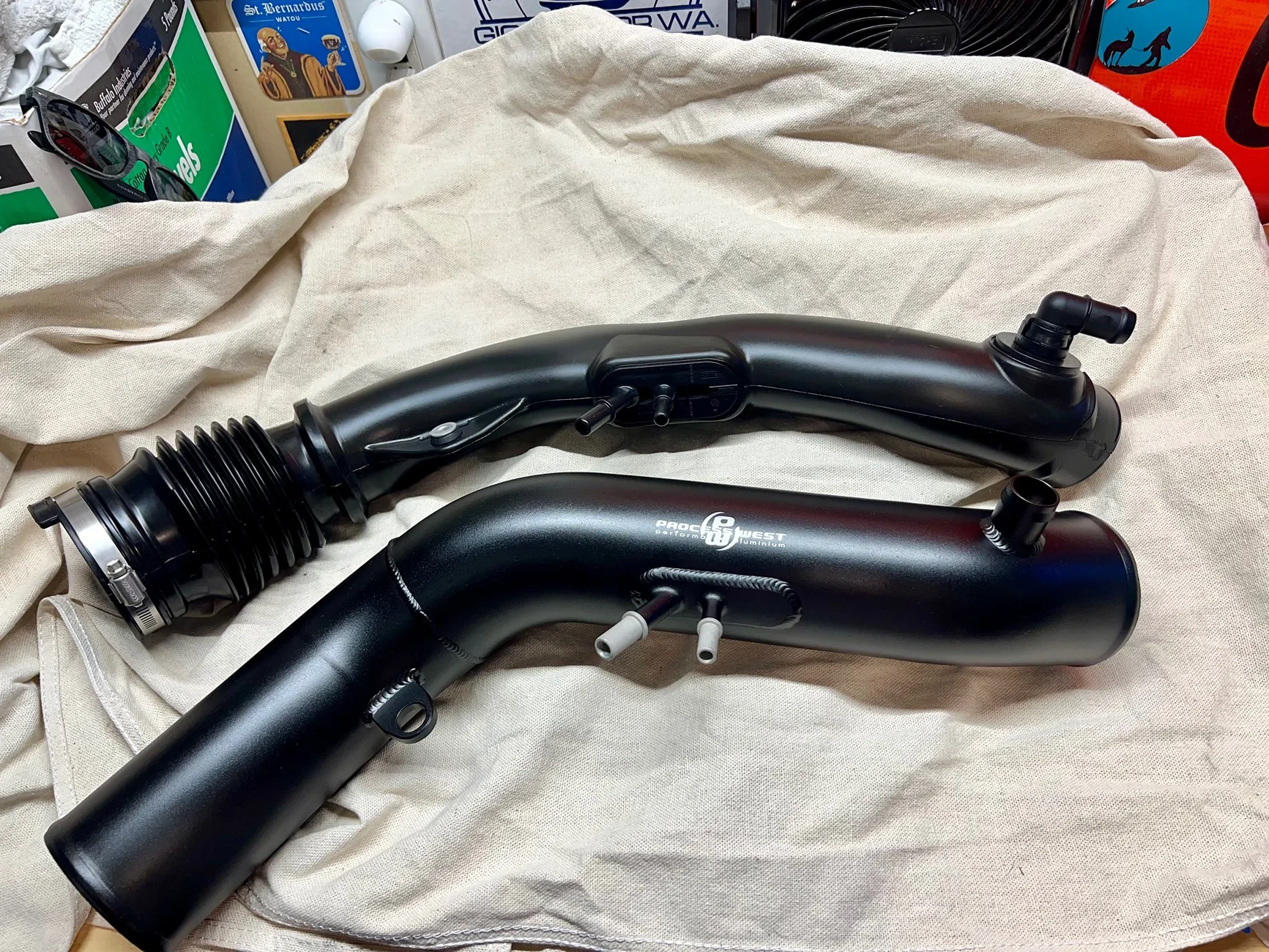
This is the Process West. I chose this picture to show how they handled the dreaded "T" junction. They kind of made a "Y" pipe with different size pipe volumes. I purposely listed this one last. It is the one I have on my truck--and I have a bias. I purchased this in January of 2025 while my truck was on order. At the time, I don't think there was any other option--none of the U.S. plastic ones were out yet. And, I didn't even know of Fabulous Fab or Indicarbon. I got an exceptional deal on it. I bought it from a member on here 3 months old and he sold his truck. it cost about half of what they cost new now, and arrived in the original box, with all papers, instructions, etc. and in flawless new condition. If I had to do it over, knowing what I know now, would I make the same choice? Probably not. I think I would get one of the two filter units--Probably the Fabulous Fab one.
For people thinking about getting a CAI, the following video from Freedom Worx is very useful. He primarily talks about Diesels, but the information transfers. The most important things I think he mentions are scientific studies of the various different brands and types of air filters. Factory vs AFE dry media vs K&N oiled cotton. Also, power lost because of clogged filters, or how about filters being more efficient after the are old? I haven't used oiled cotton filters (K&N style) for years. I ran into a problem with oil contamination of a Mass Airflow Sensor that was damaged when it was cleaned--it was expensive. I also hated cleaning and recharging the dirty filters. Once you get the filter wet to clean, you have to wait for it to dry to recharge it. I didn't like to wait, so I bought another air filter and could just swap them out while one was being cleaned, dried, and recharged--until I never cleaned the first one both were dirty. I switched to performance dry media after that and just throw them away after a year or two. When I saw one of his studies about how poorly K&N filters allow ingestion of dirt and particles Into the engine--it just further reinforces why I never want to run an oiled cotton filter again--watch the bullet demonstration--it might make a believer out of you too. Truth about Cold Air Intakes
I hope this may help somebody, or spurs information that we all may benefit from.
Sponsored