Sponsored

Powertrain maintenance - anyone had it done yet?

josephp732

Well-Known Member
First Name
Joe
Joined
Jun 21, 2025
Threads
11
Messages
257
Reaction score
409
Location
NJ & FL
Vehicle(s)
2025 Ranger Lariat 2.7l EB / 2021 4Runner TRD ORP
That's awesome! A few years ago I would have totally jumped on doing this myself, but I've had some bad luck with vehicles lately and have gotten in over my head or caused more harm than good...

Curious, when disconnecting the transmission lines, do you have to do any sort of bleeding of air after reconnecting them post-fluid change? Thanks for sharing your experience
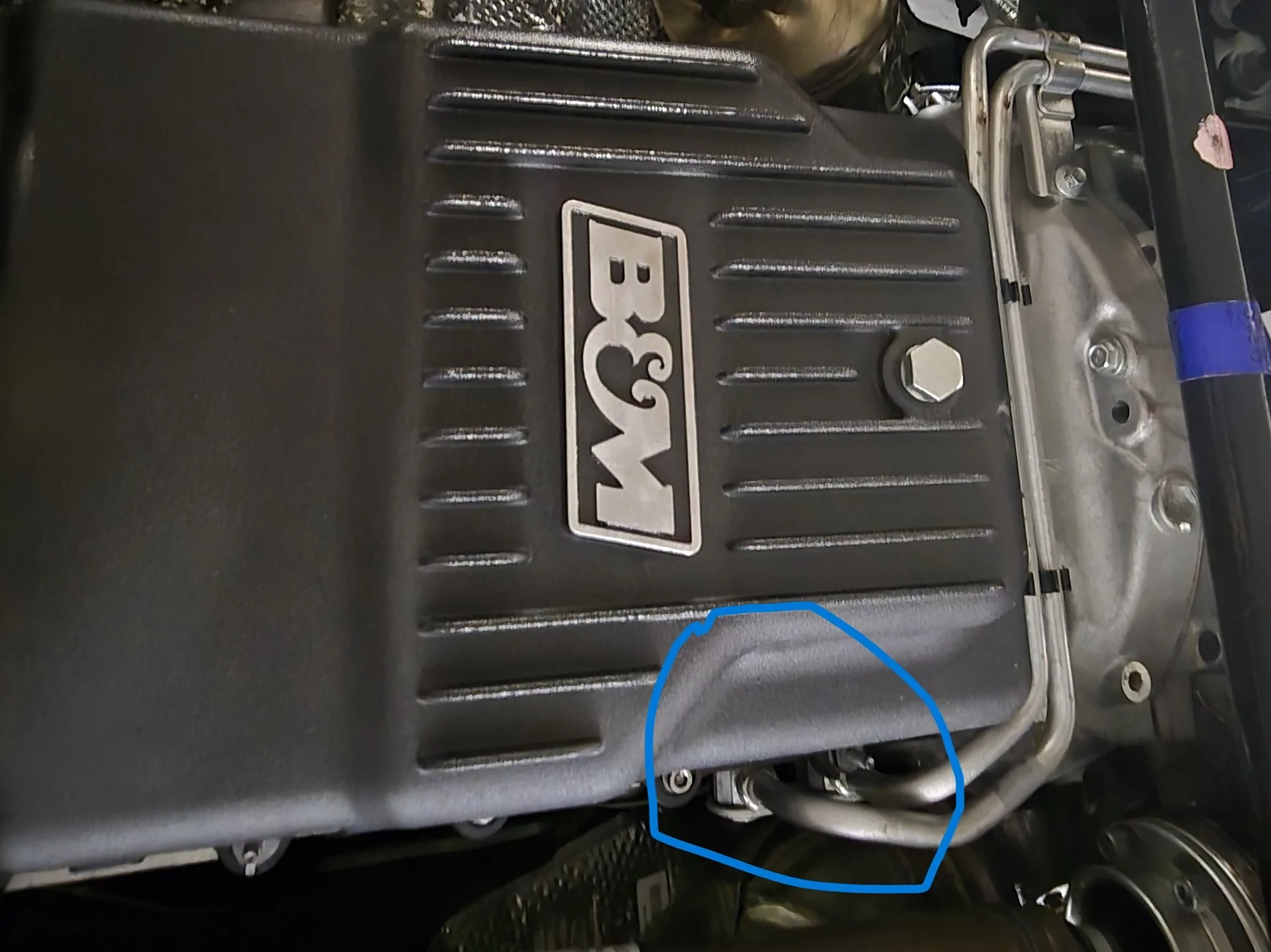
There are two metal transmission lines running along the passenger side of the transmission. There is a bracket on that side that needs to be unbolted. The lines then cross over the front of the transmission pan, running directly along the area where the front pan bolts are located. They curve upward on the driver’s side, where another bracket secures both lines to the transmission with a single bolt. Simply unbolt that bracket and pull the lines out of the transmission. Each line has two O-rings. Very little fluid came out when I removed the lines.
Sponsored


surfstar

Well-Known Member
Joined
Jun 27, 2026
Threads
0
Messages
121
Reaction score
182
Location
CA
Vehicle(s)
2025 Lariat 2.3 FX4
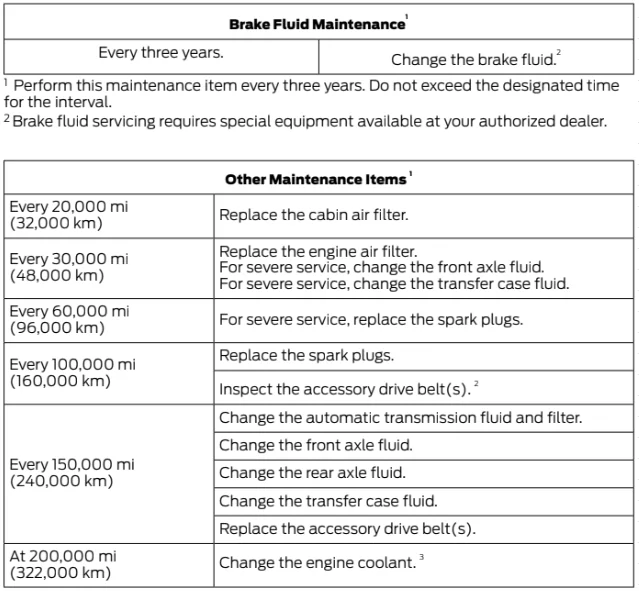
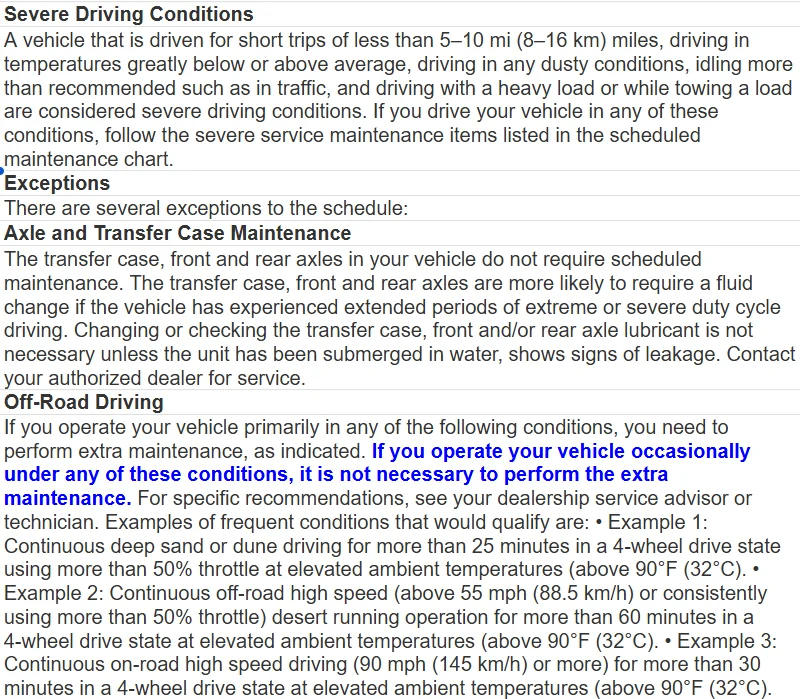
As part of my review of maintenance, I looked at my owner's manual and took a 'snip' and pasted it into my spreadsheet
With occasional towing, I should do the axle and Tcase fluid at 30k, spark plugs at 60k. Not much needed for a long time besides those.

Ford Ranger Powertrain maintenance - anyone had it done yet? Screenshot 2026-10-13 144433

Ford Ranger Powertrain maintenance - anyone had it done yet? Screenshot 2026-10-13 144600
 
OP
OP
alrashid2

alrashid2

Well-Known Member
Joined
May 4, 2026
Threads
58
Messages
527
Reaction score
361
Location
PA
Vehicle(s)
2026 Ford Ranger XLT (2.7L V6)
Always hated the "Severe Conditions" terminology in car owners manuals. Subaru does the same, as I'm sure many others do. What does that even mean? That all sounds like normal driving to me for the average person!
 

emjay24l

Well-Known Member
Joined
Sep 19, 2026
Threads
2
Messages
74
Reaction score
103
Location
SW-VA
Vehicle(s)
2024 Ranger Lariat FX-4
Always hated the "Severe Conditions" terminology in car owners manuals. Subaru does the same, as I'm sure many others do. What does that even mean? That all sounds like normal driving to me for the average person!
Typically it means towing, carrying heavy loads, etc. often.
 

josephp732

Well-Known Member
First Name
Joe
Joined
Jun 21, 2025
Threads
11
Messages
257
Reaction score
409
Location
NJ & FL
Vehicle(s)
2025 Ranger Lariat 2.7l EB / 2021 4Runner TRD ORP
“Severe conditions” in an owner's manual is one of those automotive terms that sounds subjective because, to a degree, it is. But it has a specific purpose: it identifies operating conditions that cause fluids and components to deteriorate faster than they would under the manufacturer's normal-use assumptions.

The frustrating part is that manufacturers often put driving habits that are perfectly ordinary for many people into the severe-service category.

What is generally meant by severe service:
  • Frequent short trips: The engine doesn't stay warm long enough to evaporate moisture and fuel that accumulate in the oil.
  • Stop-and-go traffic: Repeated acceleration, braking and idling increase engine and transmission operating stress.
  • Extended idling: The engine accumulating operating hours without accumulating many miles.
  • Hot or cold climates: Temperature extremes can accelerate fluid degradation or make components work harder.
  • Dusty roads: Dust increases the load on air filtration systems and can contaminate lubricants.
  • Towing, hauling or heavy loading: Higher loads increase heat and stress on the engine, transmission, cooling system and drivetrain.
  • Mountainous terrain: Sustained climbs and descents can increase engine, transmission and brake demands.
  • Repeated low-speed operation: Depending on the vehicle, this can mean less airflow for cooling and more time spent under demanding operating conditions.
Not every manufacturer defines severe service identically. Some classify frequent short trips or extensive idling as severe; others emphasize towing, dust, extreme temperatures or commercial use.

The problem is that severe service is not necessarily severe driving. It can simply mean the vehicle's operating pattern is harder on a particular component than the mileage alone suggests.

And there is another important distinction: severe service can apply differently to different components. A vehicle might need more frequent engine-oil changes because of short trips, more frequent transmission-fluid service because of towing, or more frequent air-filter replacement because of dusty conditions.
 

Sponsored
OP
OP
alrashid2

alrashid2

Well-Known Member
Joined
May 4, 2026
Threads
58
Messages
527
Reaction score
361
Location
PA
Vehicle(s)
2026 Ford Ranger XLT (2.7L V6)
“Severe conditions” in an owner's manual is one of those automotive terms that sounds subjective because, to a degree, it is. But it has a specific purpose: it identifies operating conditions that cause fluids and components to deteriorate faster than they would under the manufacturer's normal-use assumptions.

The frustrating part is that manufacturers often put driving habits that are perfectly ordinary for many people into the severe-service category.

What is generally meant by severe service:
  • Frequent short trips: The engine doesn't stay warm long enough to evaporate moisture and fuel that accumulate in the oil.
  • Stop-and-go traffic: Repeated acceleration, braking and idling increase engine and transmission operating stress.
  • Extended idling: The engine accumulating operating hours without accumulating many miles.
  • Hot or cold climates: Temperature extremes can accelerate fluid degradation or make components work harder.
  • Dusty roads: Dust increases the load on air filtration systems and can contaminate lubricants.
  • Towing, hauling or heavy loading: Higher loads increase heat and stress on the engine, transmission, cooling system and drivetrain.
  • Mountainous terrain: Sustained climbs and descents can increase engine, transmission and brake demands.
  • Repeated low-speed operation: Depending on the vehicle, this can mean less airflow for cooling and more time spent under demanding operating conditions.
Not every manufacturer defines severe service identically. Some classify frequent short trips or extensive idling as severe; others emphasize towing, dust, extreme temperatures or commercial use.

The problem is that severe service is not necessarily severe driving. It can simply mean the vehicle's operating pattern is harder on a particular component than the mileage alone suggests.

And there is another important distinction: severe service can apply differently to different components. A vehicle might need more frequent engine-oil changes because of short trips, more frequent transmission-fluid service because of towing, or more frequent air-filter replacement because of dusty conditions.
Yes, it becomes very confusing.

It's also more confusing when the interval can jump starkly.

Normal operation? Change front diff fluid at 150k miles. "Severe" driving conditions? Change it at 30k!

No in between!
 

emjay24l

Well-Known Member
Joined
Sep 19, 2026
Threads
2
Messages
74
Reaction score
103
Location
SW-VA
Vehicle(s)
2024 Ranger Lariat FX-4
Yes, it becomes very confusing.

It's also more confusing when the interval can jump starkly.

Normal operation? Change front diff fluid at 150k miles. "Severe" driving conditions? Change it at 30k!

No in between!
For many years I have done the following:

Oil changes every 5k miles
Transmission fluid every 60k miles
Transfer case every 60k miles
Brake fluid every 60k miles
Differentials every 100k miles
Coolant every 100k miles
Lube fittings every 30k miles where possible

IMO, many of Ford's recommendations should be considered criminal negligence.
 

Geo8866

Well-Known Member
Joined
Jun 2, 2026
Threads
7
Messages
150
Reaction score
225
Location
Pennsylvania
Vehicle(s)
2025 Ranger Lariat FX4
For many years I have done the following:

Oil changes every 5k miles
Transmission fluid every 60k miles
Transfer case every 60k miles
Brake fluid every 60k miles
Differentials every 100k miles
Coolant every 100k miles
Lube fittings every 30k miles where possible

IMO, many of Ford's recommendations should be considered criminal negligence.
You mentioned "Lube Fittings." Are there any zerks that need lubing on a Ranger?
 

emjay24l

Well-Known Member
Joined
Sep 19, 2026
Threads
2
Messages
74
Reaction score
103
Location
SW-VA
Vehicle(s)
2024 Ranger Lariat FX-4
You mentioned "Lube Fittings." Are there any zerks that need lubing on a Ranger?
There probably aren't any since most newer vehicles don't have them like older vehicles did from the factory. Higher quality replaced ball joints, etc. typically have a grease fitting.
 

Lion77

Well-Known Member
Joined
Feb 27, 2025
Threads
38
Messages
1,142
Reaction score
1,726
Location
United States
Vehicle(s)
2024 Ranger Raptor
Occupation
Electrical Engineer
Right on. I guess I'm just a bit anxious as before this, I had a Subaru with the stupid CVT which had an attached Front Differential.

It had 7 different drain/fill/random plugs on it. One night while under it and doing my maintenance, I filled the front diff from the driver's side plug which is an exact mirror image of the passenger side plug - except that the driver's side, despite being on the Diff side and not on the CVT side, internally drains into the transmission instead of the diff...

Ended up driving for a week with an empty diff and an overfilled, contaminated CVT. It was like the engineers purposefully made it confusing so you couldn't DIY. That spooked me a bit!!
The whole problem is that you bought a subaru in the first place :LOL:. JK.
 

Sponsored

superj

Well-Known Member
First Name
Jason
Joined
Feb 8, 2025
Threads
45
Messages
4,075
Reaction score
3,955
Location
Corpus christi texas
Vehicle(s)
2024 ford ranger, 2019 wrangler, 2018 mazda3
Occupation
Retired
Where i live is considered severe duty because summers are over 100 degrees for so long and its so dusty from the wind and beach sand.

I have 10k till my trans is due again. I just did the diff and I do the air filter every oil change (3k-3500) miles and the cabin filter every other oil change.

But since I got that k&n, its just a clean every other oil change
 

They Call Me Bruce

Well-Known Member
First Name
They
Joined
Oct 14, 2025
Threads
7
Messages
114
Reaction score
128
Location
Uranus
Vehicle(s)
2026 Ranger Lariat
Occupation
Retired Sparky #164
There are two metal transmission lines running along the passenger side of the transmission. There is a bracket on that side that needs to be unbolted. The lines then cross over the front of the transmission pan, running directly along the area where the front pan bolts are located. They curve upward on the driver’s side, where another bracket secures both lines to the transmission with a single bolt. Simply unbolt that bracket and pull the lines out of the transmission. Each line has two O-rings. Very little fluid came out when I removed the lines.
Really the lines aren't threaded into the trans, just push-in, the o-rings seal it and the bracket holds in place?


Top