Sponsored

Post procal tune tips

First Name
Micah (MO)
Joined
Apr 22, 2026
Threads
3
Messages
21
Reaction score
55
Location
SC
Vehicle(s)
2026 Ranger Raptor (Marsh Grey)
Occupation
Retired Sailor, Current gun Smith.
Been looking through the threads and I have not come across this topic. Any veteran tuner advise would be much appreciated!

My question is this. After the tune is Installed, should I put it in sport mode and stomp on it non-stop? Or just drive normal?? I want the max HP, but i'm also after long-haul, fuel efficiency.

Also, I see alot of guys switching back to stock. Why is that? What are the draw backs to the tune?
Sponsored
 

Switzguy

Well-Known Member
Joined
Nov 30, 2025
Threads
2
Messages
87
Reaction score
101
Location
Minnesota
Vehicle(s)
2025 Ranger Raptor, 2018 BMW M240i
Don't stomp on it immediately after flashing it. Drive around moderately for about 30-50 miles so the truck can relearn the shift points & everything. If you want the max power you need to run 93+. If you want to save money the minimum octane you can run is 91 without causing engine damage. You can flash back to stock & run 87 again. This is basically the only reason to do so. Just enjoy the truck in sport mode when you want power & run it in regular mode when you want fuel efficiency.
 

Lion77

Well-Known Member
Joined
Feb 27, 2025
Threads
34
Messages
934
Reaction score
1,360
Location
United States
Vehicle(s)
2024 Ranger Raptor
Occupation
Electrical Engineer
I'm not sure why you say you see a lot of guys switching back to stock, I"ve not see anyone except for one video reviewer commonly known as the Tropher and I think his logic is hilariously flawed.

He, switched back to stock so he could run lower octane than 91, but then complains that even on the stock tune, the truck runs like crap on 87, so then he's running 89 as a compromise to save a few dollars per gallon lower fuel grades while not even making the rated 405 HP on the stock tune.

All turbo engines ONLY make their rated HP on premium even STOCK, 91 or higher is where you make the rated power. According to official Mazda publications for example, my wife's 2018 CX-9 with a 2.5L Skyactive-G Turbo engine only made 227 HP on 87, but the rated 250 HP on 91 or higher. So even on that relatively mild turbo 4, you lost 23 HP on the OE calibration from lower fuel grades.

All OE's for standard mass production turbo engines have them tuned to allow them safely run on grades below 87 here in the US. Why? your average soccer mom or Joe Shmoe often doesn't undedstand the importance of fuel grades in turbo engines or performance engines. They usually just think "I wnat to spend the least amount on gas, 87 is cheaper than 89 or 91", so they fill up on 87. If the engine was tuned for 91 only and higher, your would have a lot of Ford Escapes, F-150's, Explorers etc. with destroyed engines.

Now with Ford Performance, their target market understands fuel grade restrictions and that's where their calibrations are getting the extra power. It is essentially a factory HiPo tune if they eliminated the need to safely run on grades below 91 AND, if anyone tries to run a Pro Cal tuned vehicle on 87 or 89 and you damage it, you voided the warranty and it's on you.

With the ranger Raptor, it's a performance truck, so to get the most HP the Pro Cal has to offer, run 93 octane and use TopTier gas stations to keep the fuel system clean and minimize carbon buildup over the life of the vehicle.

I also suggest using MC full synthetic oil. Without getting into "my favorite oil arguments", most UOA's show MC full synthetics performing as good or in many cases better than aftermarket oils. Any differences were small and just no worth the effort, plus the 3.0L uses a belt driven oil pump, so you want to maintain belt compatibility with the oil for long term reliability and LSPI resistance, MC full synthetics are now GF-7A certified, so they account for LSPI resistance on dirty oil instead of just when the oil is new (better long-term reliability).

Back to your original question, one drive cycle for the PCM is typically 200 to 300 miles. It will fully learn the octane after that time period. You want a variety of driving conditions so it can learn the knock profile and then adapt the timing, do some stop and go, a little bit of cruising, a few WOT pulls etc., but it will take MILES, at least 200, so getting some seat time in is the most important. Then your focus should be on KEEPING the operating conditions ideal through good maintenance so the PCM can more frequently run the most optimal timing profiles (it's completely adaptive for reliability, you dont' want to mess with anything to fool the PCM into running more aggressive timing, best practice is to follow regular maintenance to keep it clean and in good condition with good quality fuels so it can safely utilize its most aggressive timing profiles as often as it can safely do so).

My recommendations:

1. Drive normal, maybe do a few WOT pulls here and there, some stop and go around town, highway merges, back road hooning. Get a variety of driving conditions, but mileage is more the key, I believe 1 full drive cycle is about ~200 - 300 miles before it can complete the learn function.

2. Stick to TopTier fuel stations. AAA did a study on this and found that TopTier fuel stations had about 19x less carbon deposits (by weight, engine tear downs, so this is from physical testing in real use, not caculations / estimations) than non-TopTier fuels.

TopTier is NOT octane rating. So with TopTier fuels, all grades are TopTier, it's based on the detergent packages, purity of the additives and the purity of the fuel itself. You can get the TopTier app on google play store, sure they have it for Apple too and it will tell you what stations comply. Common ones are Shell, Marathon, Sunoco, Costco etc.

3. Stick with factory induction systems, don't go modifying with CAI's, you risk running lean and causing damage without custom tunes. You don't know how well the CAI mfg. accurately modeled flow values and if they are off, sure, leaning it out a bit can get you a few HP, but you risk knock / detonation that can over time cause damage by cracking lands on the pistons = not good. Additionally, high flow filters allow much higher dust contamination = more rapid compression loss, so by 100k...your probably making considerably LESS power from compression loss than any measly gains.

4. Intercoolers are one of the few acceptable additional mods with factory tuning, but you're not gaining power, rather you're just making more consistent power under heavy throttle as they maintain cooler post IC temps due to higher thermal capacity. You also need to do a KAM reset after installing an IC (aka it needs to re-learn kinda like after your first flash the PCM) IF you do an IC.

5. Last, most people don't understand this technology, but if your willing to read about it, AFTER you have at least 5k to 10k miles on the truck, I highly recommend using TriboTEX In-Situ DLC films on the entire powertrain. You WILL notice a significant difference, especially in part-throttle response, from achieving super lubricity. There are multiple benefits to this technology, up to you if you think it's worth it, I've been using it in EVERYTHING gas powered since 2019:

Informational - Science / History Behind In Situ DLC Coatings for ICE and Transmission / Gearbox Applications | Ranger6G - 2024+ Ranger & Raptor Forum, News, Owners, Community (6th Gen)

I also added a few attachments for your viewing pleasure.
 

Attachments

Last edited:

Valydathor

Member
Joined
Jun 28, 2026
Threads
0
Messages
13
Reaction score
13
Location
New Jersey
Vehicle(s)
Ranger
Occupation
Realtor
Been looking through the threads and I have not come across this topic. Any veteran tuner advise would be much appreciated!

My question is this. After the tune is Installed, should I put it in sport mode and stomp on it non-stop? Or just drive normal?? I want the max HP, but i'm also after long-haul, fuel efficiency.

Also, I see alot of guys switching back to stock. Why is that? What are the draw backs to the tune?
Drive normal right after installing the tune
 

Lion77

Well-Known Member
Joined
Feb 27, 2025
Threads
34
Messages
934
Reaction score
1,360
Location
United States
Vehicle(s)
2024 Ranger Raptor
Occupation
Electrical Engineer
Note that with the Pro Cal you MUST run 91 or higher octane, if you run anything below 91 you risk damage since the timing profiles ASSUME minimum of 91 RON rating. You WILL void your warranty if you run the Pro Cal tuned raptor on anything below 91. Higher is ok, so 92~93 octane is even better, especially in hot weather, altitude, hot lapping and towing.

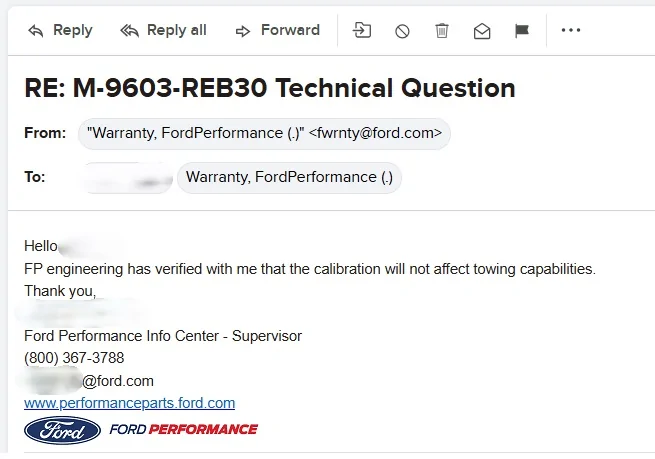
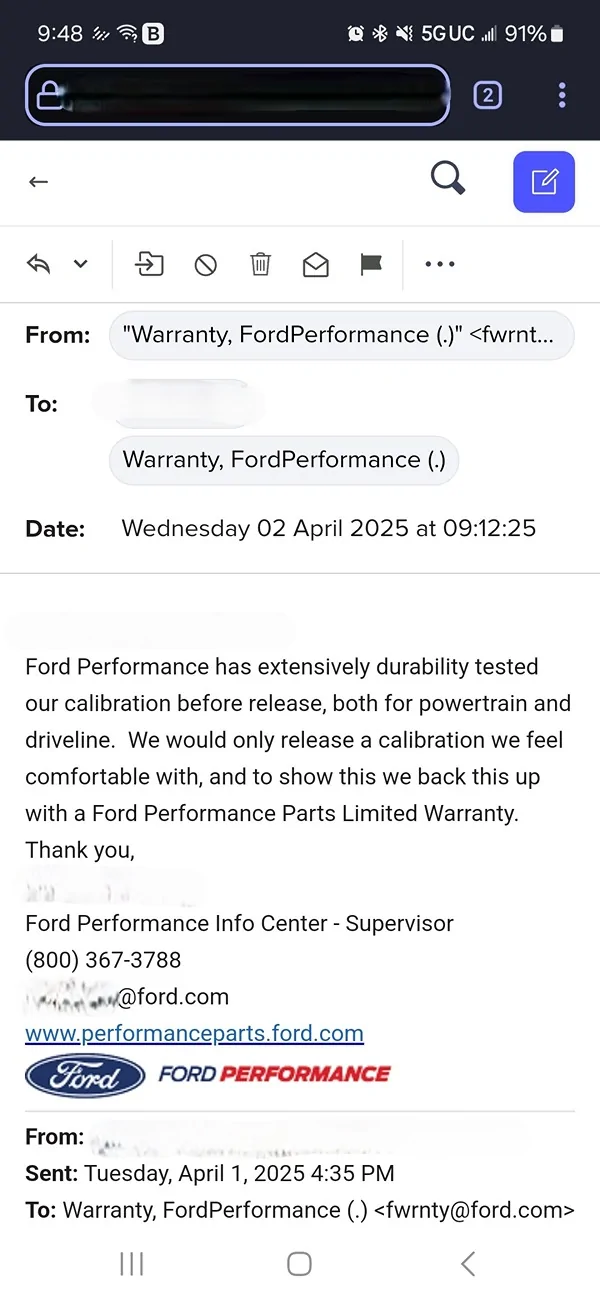
And yes, you still have FULL 5,510 lbs tow rating with the Pro Cal, it does not affect the trucks towing ability which I have directly confirmed with Ford Performance and posted on other threads.

Ford Ranger Post procal tune tips M-9603-REB30_Towing_Capability
Ford Ranger Post procal tune tips Screenshot_20250402_094807_Startpag
 

Sponsored
OP
OP
RrangerUSCG47!
First Name
Micah (MO)
Joined
Apr 22, 2026
Threads
3
Messages
21
Reaction score
55
Location
SC
Vehicle(s)
2026 Ranger Raptor (Marsh Grey)
Occupation
Retired Sailor, Current gun Smith.
Don't stomp on it immediately after flashing it. Drive around moderately for about 30-50 miles so the truck can relearn the shift points & everything. If you want the max power you need to run 93+. If you want to save money the minimum octane you can run is 91 without causing engine damage. You can flash back to stock & run 87 again. This is basically the only reason to do so. Just enjoy the truck in sport mode when you want power & run it in regular mode when you want fuel efficiency.
Ha! Well, guess I should have posted this yesterday 🙄. Had it installed, and all the way to work this AM I was NOT driving normal.....🤣
 
OP
OP
RrangerUSCG47!
First Name
Micah (MO)
Joined
Apr 22, 2026
Threads
3
Messages
21
Reaction score
55
Location
SC
Vehicle(s)
2026 Ranger Raptor (Marsh Grey)
Occupation
Retired Sailor, Current gun Smith.
I'm not sure why you say you see a lot of guys switching back to stock, I"ve not see anyone except for one video reviewer commonly known as the Tropher and I think his logic is hilariously flawed.

He, switched back to stock so he could run lower octane than 91, but then complains that even on the stock tune, the truck runs like crap on 87, so then he's running 89 as a compromise to save a few dollars per gallon lower fuel grades while not even making the rated 405 HP on the stock tune.

All turbo engines ONLY make their rated HP on premium even STOCK, 91 or higher is where you make the rated power. According to official Mazda publications for example, my wife's 2018 CX-9 with a 2.5L Skyactive-G Turbo engine only made 227 HP on 87, but the rated 250 HP on 91 or higher. So even on that relatively mild turbo 4, you lost 23 HP on the OE calibration from lower fuel grades.

All OE's for standard mass production turbo engines have them tuned to allow them safely run on grades below 87 here in the US. Why? your average soccer mom or Joe Shmoe often doesn't undedstand the importance of fuel grades in turbo engines or performance engines. They usually just think "I wnat to spend the least amount on gas, 87 is cheaper than 89 or 91", so they fill up on 87. If the engine was tuned for 91 only and higher, your would have a lot of Ford Escapes, F-150's, Explorers etc. with destroyed engines.

Now with Ford Performance, their target market understands fuel grade restrictions and that's where their calibrations are getting the extra power. It is essentially a factory HiPo tune if they eliminated the need to safely run on grades below 91 AND, if anyone tries to run a Pro Cal tuned vehicle on 87 or 89 and you damage it, you voided the warranty and it's on you.

With the ranger Raptor, it's a performance truck, so to get the most HP the Pro Cal has to offer, run 93 octane and use TopTier gas stations to keep the fuel system clean and minimize carbon buildup over the life of the vehicle.

I also suggest using MC full synthetic oil. Without getting into "my favorite oil arguments", most UOA's show MC full synthetics performing as good or in many cases better than aftermarket oils. Any differences were small and just no worth the effort, plus the 3.0L uses a belt driven oil pump, so you want to maintain belt compatibility with the oil for long term reliability and LSPI resistance, MC full synthetics are now GF-7A certified, so they account for LSPI resistance on dirty oil instead of just when the oil is new (better long-term reliability).

Back to your original question, one drive cycle for the PCM is typically 200 to 300 miles. It will fully learn the octane after that time period. You want a variety of driving conditions so it can learn the knock profile and then adapt the timing, do some stop and go, a little bit of cruising, a few WOT pulls etc., but it will take MILES, at least 200, so getting some seat time in is the most important. Then your focus should be on KEEPING the operating conditions ideal through good maintenance so the PCM can more frequently run the most optimal timing profiles (it's completely adaptive for reliability, you dont' want to mess with anything to fool the PCM into running more aggressive timing, best practice is to follow regular maintenance to keep it clean and in good condition with good quality fuels so it can safely utilize its most aggressive timing profiles as often as it can safely do so).

My recommendations:

1. Drive normal, maybe do a few WOT pulls here and there, some stop and go around town, highway merges, back road hooning. Get a variety of driving conditions, but mileage is more the key, I believe 1 full drive cycle is about ~200 - 300 miles before it can complete the learn function.

2. Stick to TopTier fuel stations. AAA did a study on this and found that TopTier fuel stations had about 19x less carbon deposits (by weight, engine tear downs, so this is from physical testing in real use, not caculations / estimations) than non-TopTier fuels.

TopTier is NOT octane rating. So with TopTier fuels, all grades are TopTier, it's based on the detergent packages, purity of the additives and the purity of the fuel itself. You can get the TopTier app on google play store, sure they have it for Apple too and it will tell you what stations comply. Common ones are Shell, Marathon, Sunoco, Costco etc.

3. Stick with factory induction systems, don't go modifying with CAI's, you risk running lean and causing damage without custom tunes. You don't know how well the CAI mfg. accurately modeled flow values and if they are off, sure, leaning it out a bit can get you a few HP, but you risk knock / detonation that can over time cause damage by cracking lands on the pistons = not good. Additionally, high flow filters allow much higher dust contamination = more rapid compression loss, so by 100k...your probably making considerably LESS power from compression loss than any measly gains.

4. Intercoolers are one of the few acceptable additional mods with factory tuning, but you're not gaining power, rather you're just making more consistent power under heavy throttle as they maintain cooler post IC temps due to higher thermal capacity. You also need to do a KAM reset after installing an IC (aka it needs to re-learn kinda like after your first flash the PCM) IF you do an IC.

5. Last, most people don't understand this technology, but if your willing to read about it, AFTER you have at least 5k to 10k miles on the truck, I highly recommend using TriboTEX In-Situ DLC films on the entire powertrain. You WILL notice a significant difference, especially in part-throttle response, from achieving super lubricity. There are multiple benefits to this technology, up to you if you think it's worth it, I've been using it in EVERYTHING gas powered since 2019:

Informational - Science / History Behind In Situ DLC Coatings for ICE and Transmission / Gearbox Applications | Ranger6G - 2024+ Ranger & Raptor Forum, News, Owners, Community (6th Gen)

I also added a few attachments for your viewing pleasure.
I'm on board with most everything you posted. All this truck has been fed is Shell V-power 93. And Penzoil Ultra Platinum. I'm interested to read up and learn about your point #5!

Thanks!
 
OP
OP
RrangerUSCG47!
First Name
Micah (MO)
Joined
Apr 22, 2026
Threads
3
Messages
21
Reaction score
55
Location
SC
Vehicle(s)
2026 Ranger Raptor (Marsh Grey)
Occupation
Retired Sailor, Current gun Smith.
I'm not sure why you say you see a lot of guys switching back to stock, I"ve not see anyone except for one video reviewer commonly known as the Tropher and I think his logic is hilariously flawed.

He, switched back to stock so he could run lower octane than 91, but then complains that even on the stock tune, the truck runs like crap on 87, so then he's running 89 as a compromise to save a few dollars per gallon lower fuel grades while not even making the rated 405 HP on the stock tune.

All turbo engines ONLY make their rated HP on premium even STOCK, 91 or higher is where you make the rated power. According to official Mazda publications for example, my wife's 2018 CX-9 with a 2.5L Skyactive-G Turbo engine only made 227 HP on 87, but the rated 250 HP on 91 or higher. So even on that relatively mild turbo 4, you lost 23 HP on the OE calibration from lower fuel grades.

All OE's for standard mass production turbo engines have them tuned to allow them safely run on grades below 87 here in the US. Why? your average soccer mom or Joe Shmoe often doesn't undedstand the importance of fuel grades in turbo engines or performance engines. They usually just think "I wnat to spend the least amount on gas, 87 is cheaper than 89 or 91", so they fill up on 87. If the engine was tuned for 91 only and higher, your would have a lot of Ford Escapes, F-150's, Explorers etc. with destroyed engines.

Now with Ford Performance, their target market understands fuel grade restrictions and that's where their calibrations are getting the extra power. It is essentially a factory HiPo tune if they eliminated the need to safely run on grades below 91 AND, if anyone tries to run a Pro Cal tuned vehicle on 87 or 89 and you damage it, you voided the warranty and it's on you.

With the ranger Raptor, it's a performance truck, so to get the most HP the Pro Cal has to offer, run 93 octane and use TopTier gas stations to keep the fuel system clean and minimize carbon buildup over the life of the vehicle.

I also suggest using MC full synthetic oil. Without getting into "my favorite oil arguments", most UOA's show MC full synthetics performing as good or in many cases better than aftermarket oils. Any differences were small and just no worth the effort, plus the 3.0L uses a belt driven oil pump, so you want to maintain belt compatibility with the oil for long term reliability and LSPI resistance, MC full synthetics are now GF-7A certified, so they account for LSPI resistance on dirty oil instead of just when the oil is new (better long-term reliability).

Back to your original question, one drive cycle for the PCM is typically 200 to 300 miles. It will fully learn the octane after that time period. You want a variety of driving conditions so it can learn the knock profile and then adapt the timing, do some stop and go, a little bit of cruising, a few WOT pulls etc., but it will take MILES, at least 200, so getting some seat time in is the most important. Then your focus should be on KEEPING the operating conditions ideal through good maintenance so the PCM can more frequently run the most optimal timing profiles (it's completely adaptive for reliability, you dont' want to mess with anything to fool the PCM into running more aggressive timing, best practice is to follow regular maintenance to keep it clean and in good condition with good quality fuels so it can safely utilize its most aggressive timing profiles as often as it can safely do so).

My recommendations:

1. Drive normal, maybe do a few WOT pulls here and there, some stop and go around town, highway merges, back road hooning. Get a variety of driving conditions, but mileage is more the key, I believe 1 full drive cycle is about ~200 - 300 miles before it can complete the learn function.

2. Stick to TopTier fuel stations. AAA did a study on this and found that TopTier fuel stations had about 19x less carbon deposits (by weight, engine tear downs, so this is from physical testing in real use, not caculations / estimations) than non-TopTier fuels.

TopTier is NOT octane rating. So with TopTier fuels, all grades are TopTier, it's based on the detergent packages, purity of the additives and the purity of the fuel itself. You can get the TopTier app on google play store, sure they have it for Apple too and it will tell you what stations comply. Common ones are Shell, Marathon, Sunoco, Costco etc.

3. Stick with factory induction systems, don't go modifying with CAI's, you risk running lean and causing damage without custom tunes. You don't know how well the CAI mfg. accurately modeled flow values and if they are off, sure, leaning it out a bit can get you a few HP, but you risk knock / detonation that can over time cause damage by cracking lands on the pistons = not good. Additionally, high flow filters allow much higher dust contamination = more rapid compression loss, so by 100k...your probably making considerably LESS power from compression loss than any measly gains.

4. Intercoolers are one of the few acceptable additional mods with factory tuning, but you're not gaining power, rather you're just making more consistent power under heavy throttle as they maintain cooler post IC temps due to higher thermal capacity. You also need to do a KAM reset after installing an IC (aka it needs to re-learn kinda like after your first flash the PCM) IF you do an IC.

5. Last, most people don't understand this technology, but if your willing to read about it, AFTER you have at least 5k to 10k miles on the truck, I highly recommend using TriboTEX In-Situ DLC films on the entire powertrain. You WILL notice a significant difference, especially in part-throttle response, from achieving super lubricity. There are multiple benefits to this technology, up to you if you think it's worth it, I've been using it in EVERYTHING gas powered since 2019:

Informational - Science / History Behind In Situ DLC Coatings for ICE and Transmission / Gearbox Applications | Ranger6G - 2024+ Ranger & Raptor Forum, News, Owners, Community (6th Gen)

I also added a few attachments for your viewing pleasure.
Just crossed 4k miles, so I will be looking into that.
 

Watchdog62

Well-Known Member
First Name
Todd
Joined
Mar 6, 2026
Threads
2
Messages
192
Reaction score
274
Location
NOVA
Vehicle(s)
2025 Ranger Raptor
Occupation
Chef
Been looking through the threads and I have not come across this topic. Any veteran tuner advise would be much appreciated!

My question is this. After the tune is Installed, should I put it in sport mode and stomp on it non-stop? Or just drive normal?? I want the max HP, but i'm also after long-haul, fuel efficiency.

Also, I see alot of guys switching back to stock. Why is that? What are the draw backs to the tune?
Give it a couple hundred miles for tranny to adapt.
Make sure it is 91 octane top tier gas or better. I run Sunoco 93.
Sport mode for getting rowdy as higher rpm/ boost will suck gas. I get 10-12 mpg in sports mode.
My R setting is sport exhaust , all wheel drive, sport steering, firm suspension, baja exhaust and get 16.5 city and 20 hwy.
Enjoy your extra hp/ torque !
 

Sponsored

Lion77

Well-Known Member
Joined
Feb 27, 2025
Threads
34
Messages
934
Reaction score
1,360
Location
United States
Vehicle(s)
2024 Ranger Raptor
Occupation
Electrical Engineer
This is awesome!! After Lions77's super detailed post, this made me laugh!
That made me laugh too lol. Most people appreciate my excessive amounts of detail because I typically cover the details that matter, although sometimes those one liner's are just right!
 

Lion77

Well-Known Member
Joined
Feb 27, 2025
Threads
34
Messages
934
Reaction score
1,360
Location
United States
Vehicle(s)
2024 Ranger Raptor
Occupation
Electrical Engineer
I'm on board with most everything you posted. All this truck has been fed is Shell V-power 93. And Penzoil Ultra Platinum. I'm interested to read up and learn about your point #5!

Thanks!
That 2016 GT was my first car I used PUP 5W-30 + TriboTEX DLC. A few times I managed 27~30 MPG from a Stage 2 Power Pack tuned 5.0L while cruising on the highway on super sticky Pilot Sport 4S tires (275/35R19 square setup).

My only caution is when using the transmission formula in the 10R60, avoid towing / drag racing etc. until it wears in. I've never seen or experienced myself a single instance of it wearing onto the torque lock clutches, but in the first 500 miles, just drive normally, because it's semi-permanent and you don't want to generate large amounts of heat / friction on the torque lock clutches during the wear in phase.

It forms via heat and pressure only on locations of wear (i.e., friction surfaces). Its formation is very slow, and, in a transmission, the lifespan is around 60~80k miles, so it is absolutely semi-permanent, but will once in a while need re-applied as it wears down like and film.

Note that DLC films are NOT new, your truck already has parts with factory applied DLC films, TriboTEX is the first and only In Situ DLC film, meaning it forms in process of use, where factory DLC films are all vapor deposition only at time of mfg. and once they wear out, you would have to take the parts out of the vehicle to re-apply the film, this is what makes In Situ DLC films so powerful in terms of friction and wear because they are self-forming during operation and only use the oil as a carrier.

BTW I've use it in my Raptor, wife's 2018 CX-9, Mazda 3, daughter's Prius, parents using it in their 2015 F-150 with over 100k miles etc. There well over 50k cars in the reviews now (in addition to the extensive testing and validation which is on the thread if you read into it far enough). Other than that, once you read through the thread you can decide for yourself.

BTW I did a UOA on my Mazda 3 recently which I used TriboTEX and I run 10k oil invervals with the factory oil and filter. Because of the TriboTEX, my last UOA showed my oil in the same condition at 10k miles as typical Mazda 3 with only 6k miles on the oil (i.e., the additive packages in the oil are not being used up as fast because the wear conditions are better than normal). Anyway, enjoy!

Maintenance and quality fuels and oils are really the key for long term performance with the Pro Cal.
 

BigBassDaddy407

Well-Known Member
Joined
Aug 14, 2025
Threads
8
Messages
69
Reaction score
82
Location
USA
Vehicle(s)
2025 Ranger XLT 4x4
Don't stomp on it immediately after flashing it. Drive around moderately for about 30-50 miles so the truck can relearn the shift points & everything. If you want the max power you need to run 93+. If you want to save money the minimum octane you can run is 91 without causing engine damage. You can flash back to stock & run 87 again. This is basically the only reason to do so. Just enjoy the truck in sport mode when you want power & run it in regular mode when you want fuel efficiency.
If you needed to run sub 91 octane, could you and not WOT while running it?
 

Switzguy

Well-Known Member
Joined
Nov 30, 2025
Threads
2
Messages
87
Reaction score
101
Location
Minnesota
Vehicle(s)
2025 Ranger Raptor, 2018 BMW M240i
Great question and here's what I got from a google search:


Yes, you can run 87 or 89 octane fuel in an emergency, but you must modify your driving to protect the engine. The Ford Performance ProCal tune explicitly requires a minimum of 91 octane. However, Ford’s factory engine computer (PCM) retains its safety logic and knock sensors even after being flashed.
If you are stuck at a remote gas station with no premium, fill up only what you need to reach a station with premium fuel and follow these strict rules:

Emergency Driving Rules
  • Stay completely out of boost: Do not push the gas pedal past roughly one-quarter throttle. Keep an eye on your boost gauge and ensure the needle stays at or below zero (vacuum).
  • Use Normal or Eco mode: Switch out of Sport or Baja mode immediately. You want the least aggressive throttle mapping and shift schedule possible.
  • Avoid heavy engine loads: Do not tow anything, haul heavy cargo, or climb steep hills while low-octane fuel is in the tank.
  • Do not lug the engine: Low-RPM, high-load situations (like forcing the truck to stay in 10th gear while going up a slight incline) provoke engine knock very easily. Let the transmission downshift freely to keep the RPMs in a relaxed mid-range.

How the Truck Protects Itself
The moment the PCM senses the lower detonation resistance of 87 octane, the knock sensors will fire. The computer will immediately pull ignition timing and lower target boost to prevent destructive pre-detonation (engine knock).
Because the computer has to physically detect the knock before it can pull timing to protect itself, you should not rely on this safety net for regular driving. Prolonged detonation will eventually fatigue internal engine components.
Once you locate a high-quality gas station, top off the tank with 93 octane as soon as there is room to dilute the lower-grade fuel.

So I really wouldn't recommend it unless it's an emergency and you can find another station with premium fuel.
 
OP
OP
RrangerUSCG47!
First Name
Micah (MO)
Joined
Apr 22, 2026
Threads
3
Messages
21
Reaction score
55
Location
SC
Vehicle(s)
2026 Ranger Raptor (Marsh Grey)
Occupation
Retired Sailor, Current gun Smith.
That 2016 GT was my first car I used PUP 5W-30 + TriboTEX DLC. A few times I managed 27~30 MPG from a Stage 2 Power Pack tuned 5.0L while cruising on the highway on super sticky Pilot Sport 4S tires (275/35R19 square setup).

My only caution is when using the transmission formula in the 10R60, avoid towing / drag racing etc. until it wears in. I've never seen or experienced myself a single instance of it wearing onto the torque lock clutches, but in the first 500 miles, just drive normally, because it's semi-permanent and you don't want to generate large amounts of heat / friction on the torque lock clutches during the wear in phase.

It forms via heat and pressure only on locations of wear (i.e., friction surfaces). Its formation is very slow, and, in a transmission, the lifespan is around 60~80k miles, so it is absolutely semi-permanent, but will once in a while need re-applied as it wears down like and film.

Note that DLC films are NOT new, your truck already has parts with factory applied DLC films, TriboTEX is the first and only In Situ DLC film, meaning it forms in process of use, where factory DLC films are all vapor deposition only at time of mfg. and once they wear out, you would have to take the parts out of the vehicle to re-apply the film, this is what makes In Situ DLC films so powerful in terms of friction and wear because they are self-forming during operation and only use the oil as a carrier.

BTW I've use it in my Raptor, wife's 2018 CX-9, Mazda 3, daughter's Prius, parents using it in their 2015 F-150 with over 100k miles etc. There well over 50k cars in the reviews now (in addition to the extensive testing and validation which is on the thread if you read into it far enough). Other than that, once you read through the thread you can decide for yourself.

BTW I did a UOA on my Mazda 3 recently which I used TriboTEX and I run 10k oil invervals with the factory oil and filter. Because of the TriboTEX, my last UOA showed my oil in the same condition at 10k miles as typical Mazda 3 with only 6k miles on the oil (i.e., the additive packages in the oil are not being used up as fast because the wear conditions are better than normal). Anyway, enjoy!

Maintenance and quality fuels and oils are really the key for long term performance with the Pro Cal.
I'm very familiar with DLC. All three of our gun models use it on the black slides. Awhile back I got to meet a tech from one our vendors who used DLC to coat 3d printed clutch plates in aircraft/helicopters. He swears by it.

Haven't read your material yet. I will this weekend though.
Sponsored


Top