daytoncarter
Well-Known Member
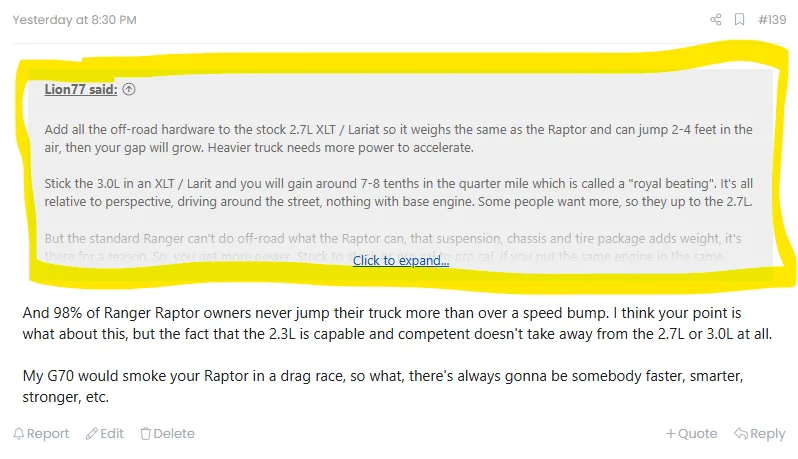
It’s pretty ironic we're debating three great engine choices when most midsized buyers are stuck with one. But look at those times—a 0.3s quarter-mile gap is what? A truck length? That "massive advantage" doesn’t translate because the 2.3L’s 200lb weight advantage helps it off the line while the V6 is limited by traction and torque management. The computers effectively sync them until the end where the V6 finally fights wind drag to eke out a tiny lead. How is hitting the limiter 2.2 seconds faster an advantage? Taking from a sports car metaphor, it's fun to drive a slow car fast, so I guess the boat-like handling does make for a trill at 100mph.
Honestly, I'm just curious why Ford bothers certifying three separate architectures for one platform. It seems like a logistics nightmare compared to offering the 2.3L and one V6 block (like the 3.0L) with two different tunes—especially since the Ford tune pushes the 2.3L MPC to 350 HP. The V6s clearly have the most towing and tuning headroom, and that diesel-derived block tech is cool hardware, but for street driving, the gap is mostly theoretical.
Honestly, I'm just curious why Ford bothers certifying three separate architectures for one platform. It seems like a logistics nightmare compared to offering the 2.3L and one V6 block (like the 3.0L) with two different tunes—especially since the Ford tune pushes the 2.3L MPC to 350 HP. The V6s clearly have the most towing and tuning headroom, and that diesel-derived block tech is cool hardware, but for street driving, the gap is mostly theoretical.
Sponsored