Sponsored

stuartmunto

Well-Known Member
First Name
Stuart
Joined
Aug 25, 2024
Threads
21
Messages
566
Reaction score
947
Location
Perth, Western Australia
Vehicle(s)
2023 Ford Ranger Raptor
Occupation
Engineer
Thanks for the infor on his gas used. I didn't watch the whole video

IC? internal combustion?

You have a much better understanding of these engines than I do. I still don't understand why his intake valves look so bad. With these engines the intake valves just let air in, and the gas is sprayed in separately correct?
IC = intercooler
Sponsored

 
Last edited:

pablo94sc

Well-Known Member
Joined
Oct 27, 2023
Threads
41
Messages
1,075
Reaction score
1,085
Location
TN
Vehicle(s)
Focus
Thanks for the infor on his gas used. I didn't watch the whole video

IC? internal combustion?

You have a much better understanding of these engines than I do. I still don't understand why his intake valves look so bad. With these engines the intake valves just let air in, and the gas is sprayed in separately correct?
IC = intercooler
 

Tom W8JI

Active Member
First Name
Tom
Joined
Jul 1, 2025
Threads
2
Messages
34
Reaction score
41
Location
Macon GA
Vehicle(s)
2025 Ranger Lariat V6
Occupation
Electrical engineer
I don't think that small amount of intake sludge means anything. It certainly cannot come from fuel in a direct injection engine. It is not a byproduct of combustion.

It is almost certainly a small collection of oil and dirt from upstream. Turbos weep a tiny bit of oil into the compressor, seals are not perfect. Also, do not use a wetted filter. Use a good OEM type filter. That is probably just a thin meaningless coating of dirt and oil that baked mostly dry onto the intake valve in stagnant air areas.

That is nothing or next to nothing to do with the oil or fuel types. It is probably just normal oil leaked from turbo seals that is collecting dirt and crap that gets by the air filter.

The valves on my boney 1989 direct injection diesel Yanmar tractor with a wet air filter look a whole lot worse than that. Oil from the filter makes the valve look like hell since nothing washes it off. I fixed it by selling my bore scope to a friend. Now that I can't see it, I think it runs better.
 
OP
OP
KayaPayaPigDog

KayaPayaPigDog

Well-Known Member
First Name
Kyle
Joined
Mar 27, 2024
Threads
26
Messages
234
Reaction score
509
Location
US
Website
www.youtube.com
Vehicle(s)
2024 Ranger Raptor Shelter Green
Occupation
US Navy
What gas & octane do you use?

What oil due you use? How often have you changed your oil?
Always fill up at Shell or Exxon with 93. Have fun Motorcraft full synthetic from first oil change at 1000 miles and change every 5000
 

JrHDRanger

Well-Known Member
First Name
Josh
Joined
Oct 21, 2024
Threads
16
Messages
256
Reaction score
344
Location
Indiana
Vehicle(s)
2025 Ranger Raptor
I recently put on a Boomba Racing intake manifold spacer which gave me an opportunity to get a good look at the valves. I’m at 30,000 miles. I had the UPR single catch can for the first 10,000 miles but took it off because I had a hose leak so 20,000 miles without it. Like you I have the FP tune and have only ran 93 octane since I bought it, top tier usually except in a pinch. I had dealer oil change at 1,000, 10,000 and 20,000 miles with Motorcraft full synthetic and in between changed it myself with Penzoil Ultra Platinum. I also have the Ronin drain plug that I completely remove every other oil change and clean the magnet. I’ve been using an IndiCarbon intake with BMC filters for the last 25,000 miles. I watched your video when it posted on YouTube the other day and saw your gunk you looked at with your scope and it looks considerably worse than mine. I do have some buildup but not like that. You’ve got more miles than me so that’s maybe where I’m headed, but doesn’t seem to me that the catch can while it does catch oil really does much of anything. I’m planning on doing the walnut blasting myself in the next few months, I’ve done a bunch of research and not that big a deal as long as the valves are fully sealed. I’ll be curious to see how the treatment you had done went in your next video.
 
Last edited:

Sponsored

Locust13CT

Well-Known Member
First Name
Tom
Joined
Jan 30, 2025
Threads
7
Messages
128
Reaction score
159
Location
CT
Vehicle(s)
2024 Ranger Raptor
Occupation
Aircraft Inspector
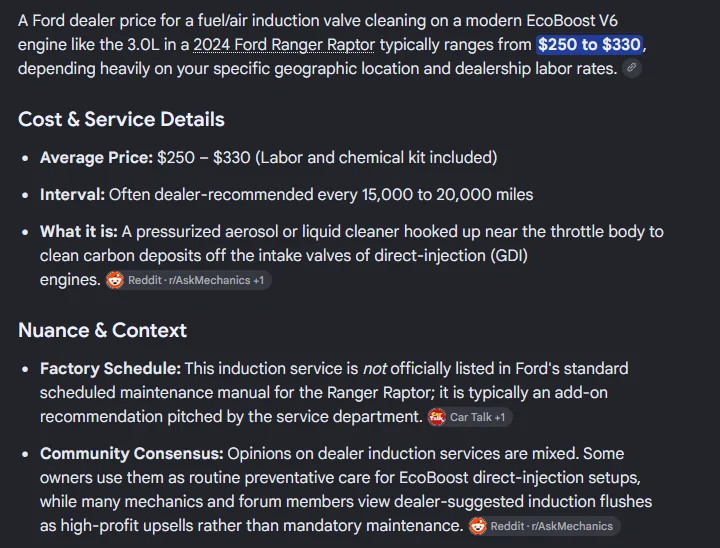
does this seem accurate? Just asking for my future self....


Ford Ranger Carbon buildup after 34,000 miles with single valve catch can (scope view) 1787052040292-uo
ing
 
OP
OP
KayaPayaPigDog

KayaPayaPigDog

Well-Known Member
First Name
Kyle
Joined
Mar 27, 2024
Threads
26
Messages
234
Reaction score
509
Location
US
Website
www.youtube.com
Vehicle(s)
2024 Ranger Raptor Shelter Green
Occupation
US Navy
I recently put on a Boomba Racing intake manifold spacer which gave me an opportunity to get a good look at the valves. I’m at 30,000 miles. I had the UPR single catch can for the first 10,000 miles but took it off because I had a hose leak so 20,000 miles without it. Like you I have the FP tune and have only ran 93 octane since I bought it, top tier usually except in a pinch. I had dealer oil change at 1,000, 10,000 and 20,000 miles with Motorcraft full synthetic and in between changed it myself with Penzoil Ultra Platinum. I also have the Ronin drain plug that I completely remove every other oil change and clean the magnet. I’ve been using an IndiCarbon intake with BMC filters for the last 25,000 miles. I watched your video when it posted on YouTube the other day and saw your gunk you looked at with your scope and it looks considerably worse than mine. I do have some buildup but not like that. You’ve got more miles than me so that’s maybe where I’m headed, but doesn’t seem to me that the catch can while it does catch oil really does much of anything. I’m planning on doing the walnut blasting myself in the next few months, I’ve done a bunch of research and not that big a deal as long as the valves are fully sealed. I’ll be curious to see how the treatment you had done went in your next video.
That is interesting and i think i am going to invest in a walnut blaster as well just because i have 3 vehicles that are all direct injection and the cost of 3 intake cleaning services is going to be 900 bucks if i go the BG Platinum route and a walnut blaster on the cheap end is only 300-400 and a relatively decent one is in the 800-1000 dollar range. i will also have to upgrade my compressor as i only have a basic pancake compressor for small air tools. Overall i think it will be a good thing to have on hand for this very reason. That said, i am still going to go thru with the two follow up videos. How involved was taking hte intake off? there is no coolant running t hrough it from what i have seen and read so it shoudl be pretty simple with regards to moving some wires, disconnecting some sensors and pulling it off, did you replace the gasket / seal or just reuse it?

Cheers,
Kyle
 
OP
OP
KayaPayaPigDog

KayaPayaPigDog

Well-Known Member
First Name
Kyle
Joined
Mar 27, 2024
Threads
26
Messages
234
Reaction score
509
Location
US
Website
www.youtube.com
Vehicle(s)
2024 Ranger Raptor Shelter Green
Occupation
US Navy
does this seem accurate? Just asking for my future self....


1787052040292-uo.webp
ing
the price looks about right, i just paid $321 for the service at my local auto mechanic, dealer is similar price. in my opinion, 300 bucks every 20,000 miles is a lot to be honest and the more i think about it, i think a walnut blast ever 80,000 to 100,000 miles for around $800-1000 will be less expensive and get it back down to bare metal and do a better job. I'm still excited to see how well this servce does for my truck but i think i'm going to end up going the walnut blast route just for the sake of saving money in the long run. That said, i may also look at buying the BG equipment to do the chemical service myself it it really does do a good job. More to follow.

Cheers,
Kyle
 

JrHDRanger

Well-Known Member
First Name
Josh
Joined
Oct 21, 2024
Threads
16
Messages
256
Reaction score
344
Location
Indiana
Vehicle(s)
2025 Ranger Raptor
That is interesting and i think i am going to invest in a walnut blaster as well just because i have 3 vehicles that are all direct injection and the cost of 3 intake cleaning services is going to be 900 bucks if i go the BG Platinum route and a walnut blaster on the cheap end is only 300-400 and a relatively decent one is in the 800-1000 dollar range. i will also have to upgrade my compressor as i only have a basic pancake compressor for small air tools. Overall i think it will be a good thing to have on hand for this very reason. That said, i am still going to go thru with the two follow up videos. How involved was taking hte intake off? there is no coolant running t hrough it from what i have seen and read so it shoudl be pretty simple with regards to moving some wires, disconnecting some sensors and pulling it off, did you replace the gasket / seal or just reuse it?

Cheers,
Kyle
Taking the intake off was very easy. The gasket is part of the intake. Not something that needs to be replaced. There are some videos on YouTube that show doing the Boomba spacer on I believe a Bronco Raptor, but it’s a mirror of that doing it on the RR. Check that out and it will make it very clear.
 

JrHDRanger

Well-Known Member
First Name
Josh
Joined
Oct 21, 2024
Threads
16
Messages
256
Reaction score
344
Location
Indiana
Vehicle(s)
2025 Ranger Raptor
That is interesting and i think i am going to invest in a walnut blaster as well just because i have 3 vehicles that are all direct injection and the cost of 3 intake cleaning services is going to be 900 bucks if i go the BG Platinum route and a walnut blaster on the cheap end is only 300-400 and a relatively decent one is in the 800-1000 dollar range. i will also have to upgrade my compressor as i only have a basic pancake compressor for small air tools. Overall i think it will be a good thing to have on hand for this very reason. That said, i am still going to go thru with the two follow up videos. How involved was taking hte intake off? there is no coolant running t hrough it from what i have seen and read so it shoudl be pretty simple with regards to moving some wires, disconnecting some sensors and pulling it off, did you replace the gasket / seal or just reuse it?

Cheers,
Kyle
Here is the link to the video I was mentioning.
Boomba Intake Spacer Install
 

Sponsored
OP
OP
KayaPayaPigDog

KayaPayaPigDog

Well-Known Member
First Name
Kyle
Joined
Mar 27, 2024
Threads
26
Messages
234
Reaction score
509
Location
US
Website
www.youtube.com
Vehicle(s)
2024 Ranger Raptor Shelter Green
Occupation
US Navy
OP
OP
KayaPayaPigDog

KayaPayaPigDog

Well-Known Member
First Name
Kyle
Joined
Mar 27, 2024
Threads
26
Messages
234
Reaction score
509
Location
US
Website
www.youtube.com
Vehicle(s)
2024 Ranger Raptor Shelter Green
Occupation
US Navy
Sounds about the same as spraying seafoam through the intake. Only the aerosol seafoam costs ~$10.
not sure i would say it's 'about the same' but the concept is similar, the chemicals are extremely different.
 

Sharpie223

Well-Known Member
Joined
Apr 22, 2026
Threads
2
Messages
46
Reaction score
54
Location
E.Wa
Vehicle(s)
In-between atm
not sure i would say it's 'about the same' but the concept is similar, the chemicals are extremely different.

Probably a mix of PEA (techron) and some alcohol solvents. They may be a little more advanced than seafoam but still likely something you can purchase yourself (just not their specific proprietary blend). Due to the non metallic components of the intake manifold, the solvents can only be so strong. My understanding is they also run this for a couple hours vs the 5 minutes that a can of seafoam (aerosol) may last. But if done frequently enough, you shouldn't need to run it for 3 hours to clean the intake. Cold solvent spray on hot carbon build up will make quick work of cleaning.
 

AugPal

Well-Known Member
First Name
Augie
Joined
Nov 8, 2024
Threads
25
Messages
348
Reaction score
281
Location
Chicago
Vehicle(s)
2024 Ford Ranger XLT 2018 Ford Fiesta 2026 Jeep Grand Cherokee
Occupation
Retired IBEW
does this seem accurate? Just asking for my future self....


1787052040292-uo.webp
ing
Just my opinion. If this cleaning is needed every 15K to 20K miles, there is something seriously wrong with the build of the engine.
Sponsored


Top