Sponsored

Rabbit9

Well-Known Member
First Name
Russell
Joined
Jun 9, 2024
Threads
8
Messages
152
Reaction score
212
Location
SC
Vehicle(s)
2024 Ranger Raptor
Occupation
Analyst @ .Gov
Having played with turbo cars for twenty years now, there's always a trade-off. That big increase in volume will add lag to pressurize the system. Good for big power, not good for throttle response.
Agreed, I split the difference and bought the COBB intercooler. As I understand it, the 3L Ecoboost engine is already sensitive to high IAT’s, so with the new factory performance tune, I don’t expect that situation to get any better, and I don’t want to have the computer changing the timing and lose all of the added power.
Sponsored


nikhsub1

Well-Known Member
First Name
Scott
Joined
May 14, 2024
Threads
1
Messages
111
Reaction score
105
Location
Los Angeles
Vehicle(s)
2018 Raptor
Agreed, I split the difference and bought the COBB intercooler. As I understand it, the 3L Ecoboost engine is already sensitive to high IAT’s, so with the new factory performance tune, I don’t expect that situation to get any better, and I don’t want to have the computer changing the timing and lose all of the added power.
All turbos are sensitive to high IATs... the 3.0 is no different - and the OE IC sucks donkey dung.
 

richrail

Member
First Name
Richard
Joined
Nov 29, 2023
Threads
2
Messages
15
Reaction score
4
Location
Toronto
Vehicle(s)
2023 Ford Ranger Raptor
Occupation
Self employed
Since the factory intercooler seems to perform pretty poorly, I'd love to compile a list of all the available Intercooler options for the Ranger Raptor.

If we could post where they're available from (preferably within the US), how much $, and what kind of performance they offer, I'll put a list together.

Whether or not the vehicle has to be modified would be good info to include as well.

Thanks!

Cobb:
Modification required? No
23% more efficient
53% larger volume
Cost: $1,025

Process West Stage 1:
Modification required? No
Increase in volume/efficiency: ?? (claimed to be the largest option on the market that doesn't require modification)
Cost: $1,170

Process West Stage 2:
Modification required? Yes
Increase in volume/efficiency: ??( Claimed to be the largest available on the market for the next gen Ranger Raptor)
Cost: $1,495

Wagner:
Modification required? NO
69% Increase in volume
Cost: $690

Dynomotive:
Modification required? Unclear
87.5% larger core. 80% larger end tanks.
Cost: $1,950
Process West website states that for the stage 1 intercooler, the factory intercooler shutter system is removed.
 
OP
OP
AlpineBike

AlpineBike

Banned
Banned
First Name
Andrew
Joined
Mar 29, 2024
Threads
3
Messages
425
Reaction score
534
Location
Waitsfield, VT
Vehicle(s)
2024 Ranger Raptor
Process West website states that for the stage 1 intercooler, the factory intercooler shutter system is removed.
I must have missed that.
Will change modification required from no to yes.

Thanks!
 

pablo94sc

Well-Known Member
Joined
Oct 27, 2023
Threads
34
Messages
882
Reaction score
840
Location
TN
Vehicle(s)
Focus
I'm glad to see at least Cobb is trying to address one of the most important specs when replacing the IC - how much more efficient is it going to be. The other is flow rate, as we don't want to introduce more restrictions into the system. Volume, unless we're talking flow, is a useless figure.

Ex: the parallel flow condenser in my tbird is probably half the volume of the original, yet something like 20% more efficient.

My point is, until the others follow Cobb's lead, we might as well consider their offerings no better than stock.
 

Sponsored
OP
OP
AlpineBike

AlpineBike

Banned
Banned
First Name
Andrew
Joined
Mar 29, 2024
Threads
3
Messages
425
Reaction score
534
Location
Waitsfield, VT
Vehicle(s)
2024 Ranger Raptor
I'm glad to see at least Cobb is trying to address one of the most important specs when replacing the IC - how much more efficient is it going to be. The other is flow rate, as we don't want to introduce more restrictions into the system. Volume, unless we're talking flow, is a useless figure.

Ex: the parallel flow condenser in my tbird is probably half the volume of the original, yet something like 20% more efficient.

My point is, until the others follow Cobb's lead, we might as well consider their offerings no better than stock.
I agree with your point about flow being crucial. If an intercooler has more volume than stock but is more flow restrictive, the total increase in performance/efficiency might not be worth it.
But I do disagree with your comment about volume being a useless figure. If you increase the volume of the charged air side of the system then you therefore inversely increase the amount of time it takes the turbos to build any given boost pressure.
Also, the more you compress air, the less affect a given restriction will have to flow.

Ideal gas law: PV=nRT
 

MAV

Well-Known Member
Joined
Dec 6, 2023
Threads
9
Messages
269
Reaction score
381
Location
Arkansas
Vehicle(s)
2024 Ranger Raptor
Serious question: what exactly is the problem with the stock intercooler on basically ALL Ford Ecoboost engines? Everyone points out that aftermarket ICs flow better, reduce air charge temps better, and all that, but is the flow rate, volume, and efficiency of the factory IC really so bad for the factory engine? Seems like this is one of those components that needs to be upgraded if you're also upgrading other parts of the engine, but by itself, is it really needed?

Again, I'm not arguing that it's not - I'm legitimately looking for an education here.
 

pablo94sc

Well-Known Member
Joined
Oct 27, 2023
Threads
34
Messages
882
Reaction score
840
Location
TN
Vehicle(s)
Focus
Using a better IC on a stock engine is a good idea because keeping the ACT (air charge temp) down means you can run more timing advance without worrying about detonation. This is especially handy when it's hot out, you're asking the truck to do truck stuff (like tow), or you have to use lower octane gas. Bonus, it also helps keep ACT more consistent and helps prevent heat soak. Basically, you get more (consistent) power, better fuel economy, and less likelihood of damaging something long-term.
 

MAV

Well-Known Member
Joined
Dec 6, 2023
Threads
9
Messages
269
Reaction score
381
Location
Arkansas
Vehicle(s)
2024 Ranger Raptor
But what's considered a high ACT, especially in summer when ambient temps are approaching 100* anyway? My ACT never got above the 120s all summer. Is it realistic to expect aftermarket ICs to get it much lower than that?
 

a77cj7

Well-Known Member
First Name
Chris
Joined
Jul 25, 2023
Threads
4
Messages
146
Reaction score
258
Location
Sturgis, SD
Vehicle(s)
98 Ranger
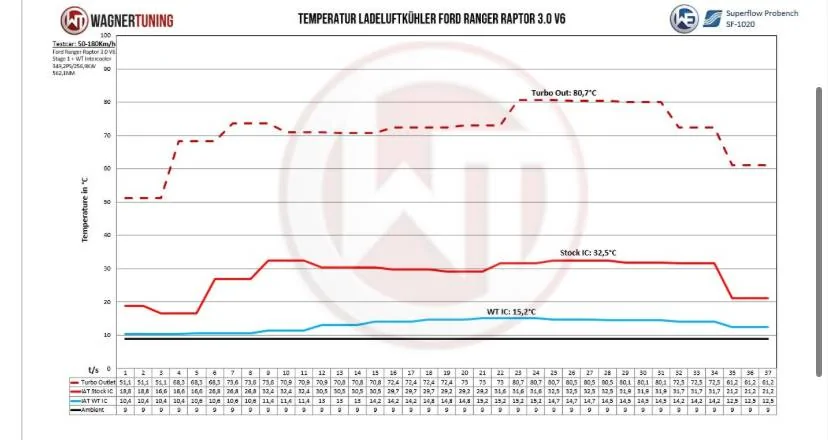
I’ll be picking up the wagner when available. Especially since I will be running the ford performance tune.
From their graph, it fixes the rapid spike under wot, and while does climb a bit, seems like a good compromise.
Ford Ranger Ranger Raptor Intercooler List Thread IMG_1614


I’m going this route for the lower cost, and to avoid the potential added lag tradeoff from volume of process west stage two.
 

Sponsored

Phade

Member
First Name
Brad
Joined
Jun 28, 2024
Threads
2
Messages
18
Reaction score
9
Location
WNY
Vehicle(s)
2024 Ranger Raptor
Is the location of the IC also an issue on these trucks?

My FI knowledge is 20 years old at this point back when I was a young buck in my tuner days with SRTs, STIs, etc. I’m equally concerned about the introduction of lag with these aftermarket ICs. This truck feels like it spools pretty quick so that spike isn’t a surprise. But I also feel like the quick spool is purpose built given what this truck is designed to do with a lot of on / off gas and brake action Baja style.

Heck I remember modification being a monster IC where we had to remove the front core support/bumper on cars. Eventually I think Spearco found a way to make a thicker lower profile IC that you didn’t have to remove the bumper and still got “90%” of the real world gains.

Those that ran the larger ICs most often ended up switching to larger turbos too. T3/T4 hybrids and other monsters that could suck a small cat or dog into another dimension. I feel like nobody here has talked about replacing these much. So I am assuming they can handle the abuse?
 

nikhsub1

Well-Known Member
First Name
Scott
Joined
May 14, 2024
Threads
1
Messages
111
Reaction score
105
Location
Los Angeles
Vehicle(s)
2018 Raptor
Serious question: what exactly is the problem with the stock intercooler on basically ALL Ford Ecoboost engines? Everyone points out that aftermarket ICs flow better, reduce air charge temps better, and all that, but is the flow rate, volume, and efficiency of the factory IC really so bad for the factory engine? Seems like this is one of those components that needs to be upgraded if you're also upgrading other parts of the engine, but by itself, is it really needed?

Again, I'm not arguing that it's not - I'm legitimately looking for an education here.
The OEM ford ICs are utter garbage. They are the cheapest IC I have ever seen in my life. Flimsy tube/fin with plastic end tanks. If you held one you would not believe how light they are. Just overall a poor unit. Bar/plate is really the way to go due to their robustness - they are significantly more durable than tube/fin. Since I have no specs on flow rates and pressure drop on the OEM IC I can't comment, but that isn't the factor that makes it a bad IC. It is the size and materials used.

Heat exchangers are most efficient when the deltas are the greatest. What this means is the point of hot air entering the IC is where the IC is most efficient. As the air cools across the IC, the cooler the air gets in the IC the less efficient the system is. This is true in any heat exchanger. Another way to think about this is a taller intercooler would be more efficient than a longer intercooler of the same internal volume.
 

MAV

Well-Known Member
Joined
Dec 6, 2023
Threads
9
Messages
269
Reaction score
381
Location
Arkansas
Vehicle(s)
2024 Ranger Raptor
The OEM ford ICs are utter garbage. They are the cheapest IC I have ever seen in my life. Flimsy tube/fin with plastic end tanks. If you held one you would not believe how light they are. Just overall a poor unit.
Right, so I need to replace mine with an aftermarket because if I don't, it will spontaneously combust or something? I do get what you're saying, but I don't think there's an epidemic of OEM Ford Ecoboost IC failures, or we'd know about it.

Heat exchangers are most efficient when the deltas are the greatest. What this means is the point of hot air entering the IC is where the IC is most efficient. As the air cools across the IC, the cooler the air gets in the IC the less efficient the system is. This is true in any heat exchanger. Another way to think about this is a taller intercooler would be more efficient than a longer intercooler of the same internal volume.
But unless you're willing to relocate the entire unit, isn't any IC constrained by the space available in the vehicle? How do aftermarket ICs solve this problem? Also, wouldn't the "flimsy" tube/fins of the OEM unit actually help it exchange heat faster?

I just can't yet understand how upgrading the OEM IC without also modifying other parts of the engine (i.e. bigger turbos) that can take advantage of the benefits is money well spent.
 

nikhsub1

Well-Known Member
First Name
Scott
Joined
May 14, 2024
Threads
1
Messages
111
Reaction score
105
Location
Los Angeles
Vehicle(s)
2018 Raptor
Right, so I need to replace mine with an aftermarket because if I don't, it will spontaneously combust or something? I do get what you're saying, but I don't think there's an epidemic of OEM Ford Ecoboost IC failures, or we'd know about it.


But unless you're willing to relocate the entire unit, isn't any IC constrained by the space available in the vehicle? How do aftermarket ICs solve this problem? Also, wouldn't the "flimsy" tube/fins of the OEM unit actually help it exchange heat faster?

I just can't yet understand how upgrading the OEM IC without also modifying other parts of the engine (i.e. bigger turbos) that can take advantage of the benefits is money well spent.
No you can leave the stock IC but on a single dyno run, timing and boost will get pulled due to high IATs on a stock vehicle. A quality IC can do many back to back runs with close to ambient IATs and no timing being pulled etc. A better IC is always going to help due to keeping IATs lower.
 
OP
OP
AlpineBike

AlpineBike

Banned
Banned
First Name
Andrew
Joined
Mar 29, 2024
Threads
3
Messages
425
Reaction score
534
Location
Waitsfield, VT
Vehicle(s)
2024 Ranger Raptor
Right, so I need to replace mine with an aftermarket because if I don't, it will spontaneously combust or something? I do get what you're saying, but I don't think there's an epidemic of OEM Ford Ecoboost IC failures, or we'd know about it.


But unless you're willing to relocate the entire unit, isn't any IC constrained by the space available in the vehicle? How do aftermarket ICs solve this problem? Also, wouldn't the "flimsy" tube/fins of the OEM unit actually help it exchange heat faster?

I just can't yet understand how upgrading the OEM IC without also modifying other parts of the engine (i.e. bigger turbos) that can take advantage of the benefits is money well spent.
Intercoolers don’t add power to FI engines.
They add consistency amongst varying ambient temps.
As stated above, within a single dyno run, you will see timing being pulled because of the high charge air temps.
A more efficient intercooler will eliminate/mitigate this and allow your engine to make max power for longer and across a variety of ambient conditions.
Sponsored


Top