Sponsored

RR 3.0 Wet Belt Driven Oil Pump - issues in future?

daytoncarter

Well-Known Member
First Name
Dayton
Joined
Sep 26, 2025
Threads
9
Messages
397
Reaction score
562
Location
USA
Vehicle(s)
2021 Genesis G70 SP 3.3T, 2025 Ranger Lariat
Yes, i have nothing to people that calls to a hammer, a door.
Here's the good thing, even if we're right you probably have 10-15 years before the belt needs to be serviced so just get a piggybank write on it "oil pump belt" and drop in $20 each month. 😂
Sponsored


Jason B

Well-Known Member
First Name
Jason
Joined
Apr 27, 2023
Threads
1
Messages
1,185
Reaction score
1,263
Location
Louisiana
Vehicle(s)
2024 Ranger XLT FX4
Occupation
machinist
Means Nothing. Point is the belt will fail where a Chain would not. belts have already been proven to fail see 1L, always amazes me just how ready people are to pucker up thier little lipswhen some entity claims authority. just like Germany '37 or the MAGAts now. Get a logo and some people will run through glass to kiss your a... really separates the independent thinkers from the enslaved.
Typical leftist response. Resort to name calling when losing an argument or you can't get people to see things your way.
 

Lion77

Well-Known Member
Joined
Feb 27, 2025
Threads
28
Messages
789
Reaction score
1,150
Location
United States
Vehicle(s)
2024 Ranger Raptor
Occupation
Electrical Engineer
@daytoncarter I've towed many miles with both. 2.3L in a 2022 Ranger and a 2.7L in a 2024. The 2.7 is hands down better at towing. For the record I'm towing a 1940 Ford on an 18 Ft car trailer as well as a 19' camper.
When you get into any hills, the 2.7 is much better at both pulling and engine braking.
Your experiences make perfect sense. It's not just peak numbers. People forget about AREA UNDER THE CURVE. You can have two engines one only makes 20 or 30hp more peak but does it over an extra 1,500 to 2,000 RPM of its operation.

The real-world difference in use is going to be far more noticeable with the engine that has a broad torque curve (even though the peak numbers suggest little difference). As you mentioned, other factors like engine braking etc. also factor in, there is no replacement for displacement!

It really just depends on what people want. The base engines can do it, but not as well, especially if your more regularly towing closer to max, the V6's make sense.
 

Lion77

Well-Known Member
Joined
Feb 27, 2025
Threads
28
Messages
789
Reaction score
1,150
Location
United States
Vehicle(s)
2024 Ranger Raptor
Occupation
Electrical Engineer
Here's what I think, at the end of the day, an oil pump chain will last longer than an oil pump belt. BUT the oil pump belt will last as long or slightly longer than the other major components in the engine based on all testing by engineering from several companies (GM, Ford, Honda, BMW, Mercedes etc.) and real-world examples like the list of high mileage 2.7L F-150's just in my area seem to bear that out.

So, if an oil pump chain could theoretically last 500k miles but your piston rings are shot at 250~300k....WHATS THE POINT? If an oil pump chain can last 500k miles but your timing chains won't and the guides will wear out well before then, again, what's the point?

At that point, you're looking at a re-build, possibly boring the block or a whole new engine. I only care if all the major components last the same amount of time, not that one lasts 2x longer than other parts which still require a re-build and that's really been my point, good enough!
 

daytoncarter

Well-Known Member
First Name
Dayton
Joined
Sep 26, 2025
Threads
9
Messages
397
Reaction score
562
Location
USA
Vehicle(s)
2021 Genesis G70 SP 3.3T, 2025 Ranger Lariat
Your experiences make perfect sense. It's not just peak numbers. People forget about AREA UNDER THE CURVE. You can have two engines one only makes 20 or 30hp more peak but does it over an extra 1,500 to 2,000 RPM of its operation.
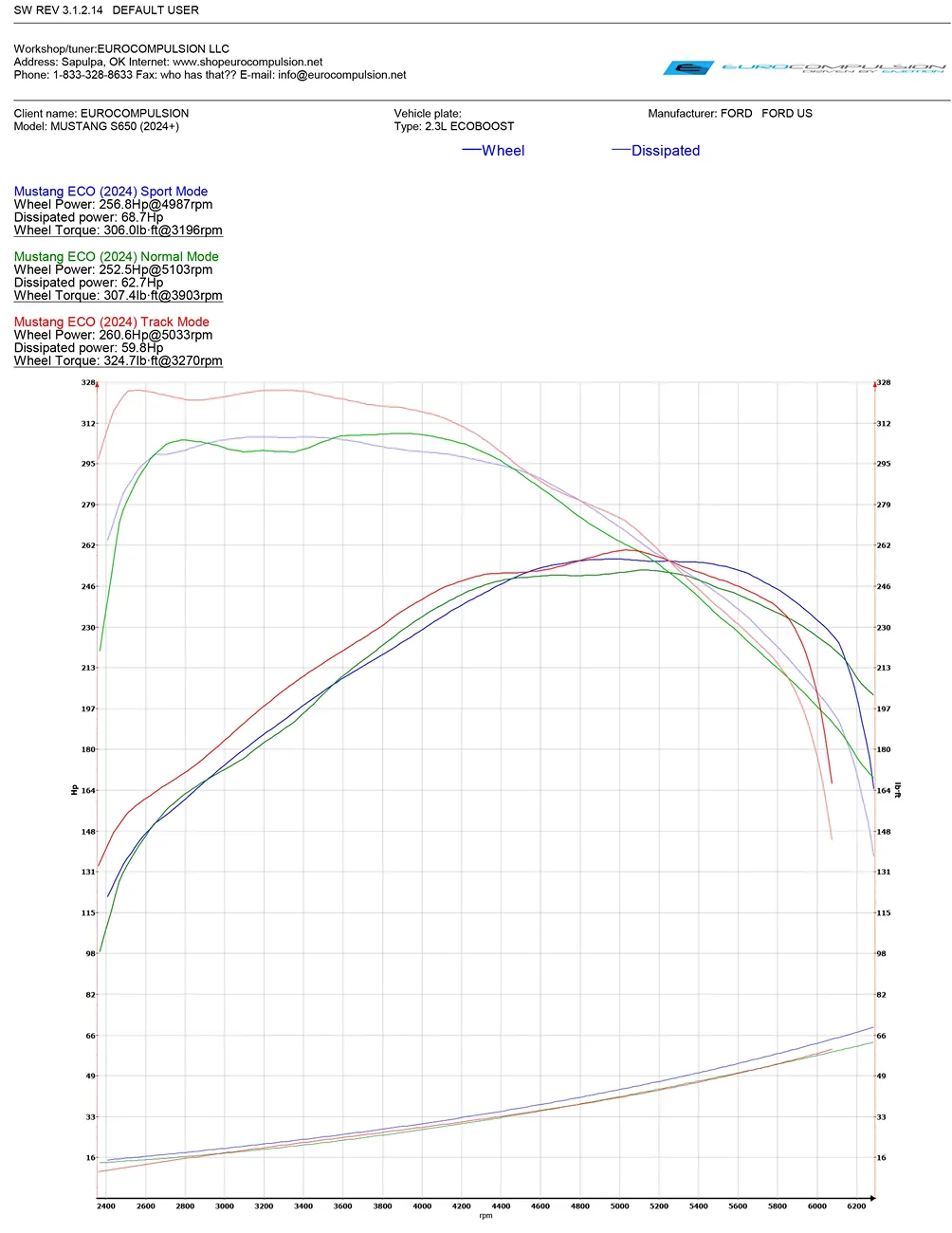
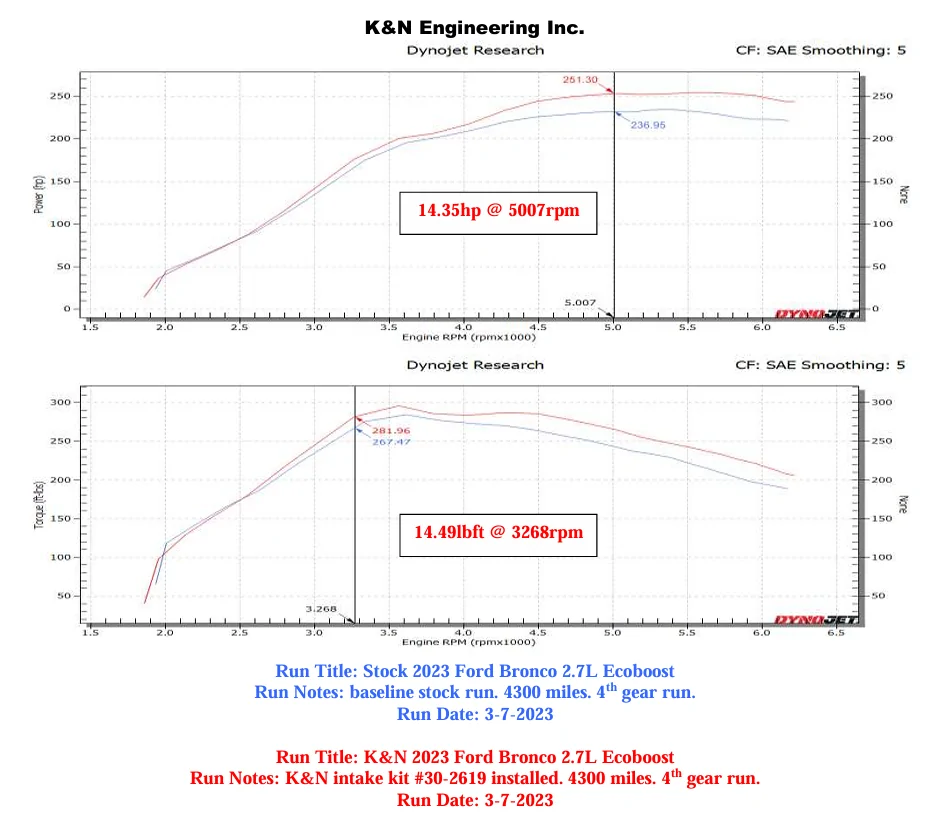
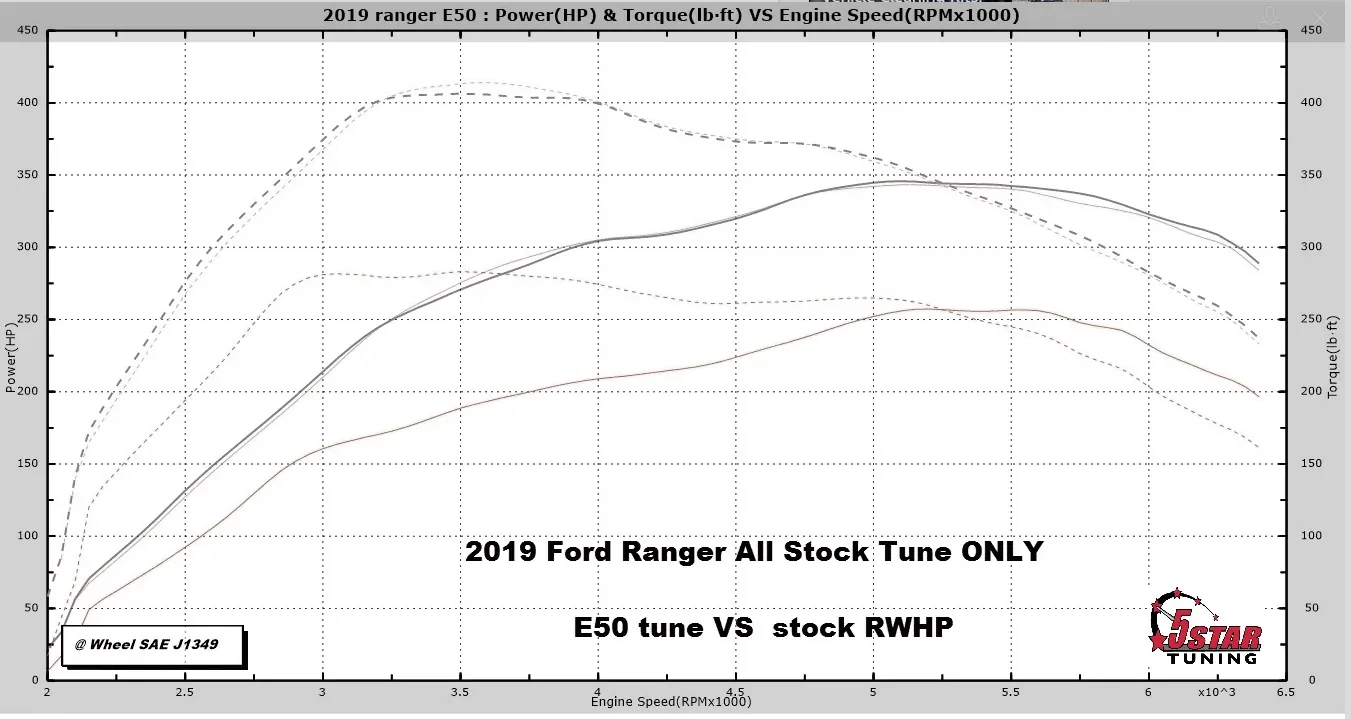
Hard to do apples to apples until someone dynos a new 2.3L and 2.7L but here's the 2.3L MPC Mustang vs. 2.7L gen 2 F-150. These are wheel horsepower. Now ignoring specific numbers, but focusing on the torque curves as you mentioned -

Ford Ranger RR 3.0 Wet Belt Driven Oil Pump - issues in future? 1768494862594-p4


Ford Ranger RR 3.0 Wet Belt Driven Oil Pump - issues in future? 1768494877036-lk


1. Ramp-Up Work (2,400 – 3,200 RPM)
By measuring the Total Work performed as the engines accelerate toward their peak, we can see how they actually feel on the road.

2.3L EcoBoost: Delivers a Delayed Surge. The power starts softer and rushes in quickly right before the peak.

2.7L EcoBoost: Delivers an Immediate Push. The power arrives instantly and builds steadily.

The Delta: Despite the 2.7L feeling "stronger" earlier in the rev range, it produces only ~8% more total driving force than the 2.3L during this acceleration phase. The 2.3L effectively catches up, delivering nearly the same amount of total energy to the wheels.

2. Peak RPM Synchronization
2.3L Peak: ~3,200 RPM

2.7L Peak: ~3,270 RPM

Conclusion: The engines are effectively synchronized. Both are tuned to deliver their maximum pulling power at the exact same engine speed.

3. High RPM Performance (>5,000 RPM)
2.3L EcoBoost: The power fades early. After the peak, the pulling force drops off steeply. By 5,800 RPM, it has lost nearly 40% of its strength (retaining ~62%), signaling the driver to shift gears.

2.7L EcoBoost: The power holds on. The pulling force fades very slowly. By 5,800 RPM, it still retains ~76% of its strength, allowing the driver to hold the gear longer without losing momentum.
 

Sponsored

Lion77

Well-Known Member
Joined
Feb 27, 2025
Threads
28
Messages
789
Reaction score
1,150
Location
United States
Vehicle(s)
2024 Ranger Raptor
Occupation
Electrical Engineer
2.3L vs 2.7L power curves / dyno chart comparisons | Bronco6G - 2021+ Ford Bronco & Bronco Raptor Forum, News, Blog & Owners Community

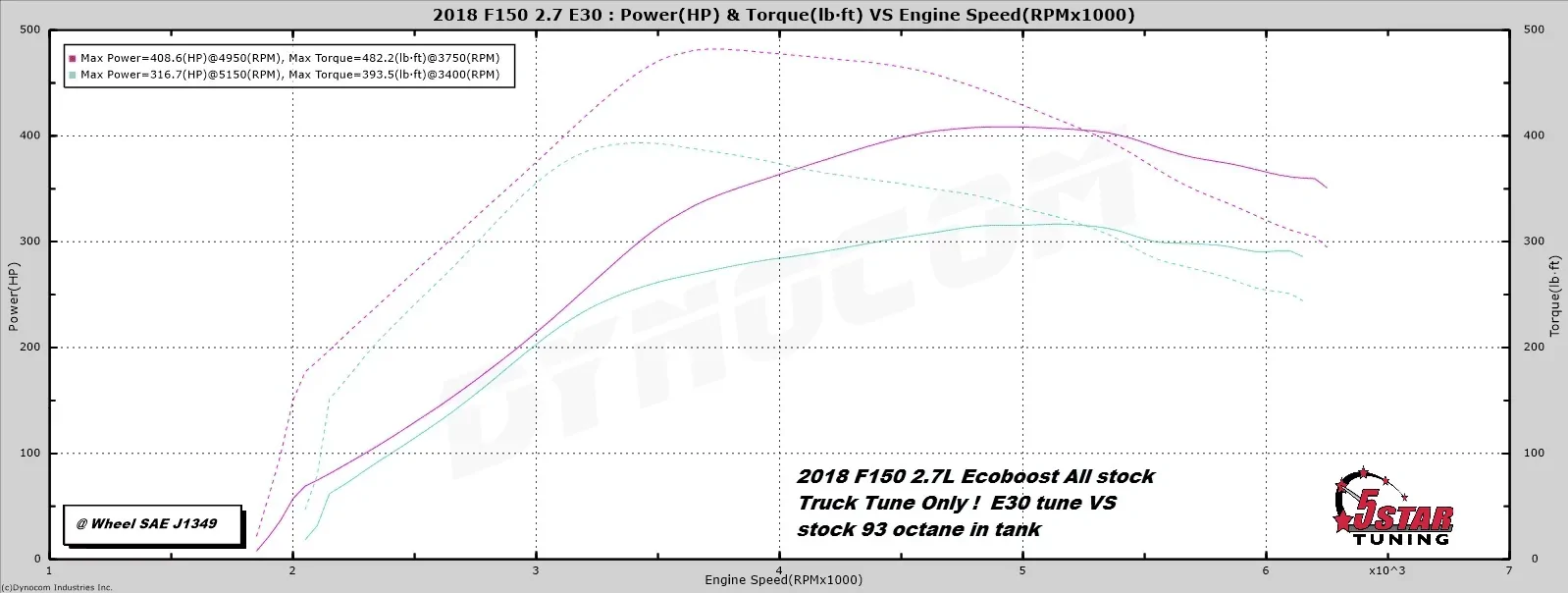
19' Ranger 2.3L vs. 19 F-150, more comparable as it's truck vs. truck, 19 rangers also had the same 10R80 transmission as the F-150's because the 10R60 was still in development.

Look at the stock curves, the 2.7L is pushing 50 HP more at the wheels on it stock curve vs. the 2.3L AND over a lot more of the RPM range where the 2.3L is very peaky and then fades fast. Just look at the stock vs. stock curves.

Ford Ranger RR 3.0 Wet Belt Driven Oil Pump - issues in future? 1768504198968-o9

Ford Ranger RR 3.0 Wet Belt Driven Oil Pump - issues in future? 1768504221531-jj


Stock 2.3L is only pushing out 155hp @ 3k vs. the 200hp from the 2.7L at the same RPM. By 4k the 2.7L is netting about 280~290 WHP and the 2.3L is only at 210 WHP. That isn't nothing.

By ~5k the 2.3L hits about 250 WHP and the 2.7L is netting about 305 WHP. Again, 55 HP isn't nothing or small. And in the mid-range, it's 80~90 hp difference. Power is work being done, hence why if you were to hold a perfectly flat torque curve, power would be linear as RPM climbs.

Look at TFL's towing tests with 4 cylinders vs. the 2.7L V6 and then compare that to the 3.0L V6 and then the 3.0L V6 with a Pro Cal. I have no issue with the 2.3L EB, it's a great little engine, I had that engine in my 2015 Mustang Ecoboost, then upgraded to a 2016 GT PP 5.0L and then Stage 2 Power Pack on the 5.0.

The 2.3L could not even come close to a stock 5.0L, let alone one with a stage 2 power pack, which ironically also made 455 HP like my Pro Cal tuned Raptor. The 2.7L V6 is a legitimate upgrade for towing performance.

Towing is usually limited by vehicle stability (braking, cornering, sway control etc) and cooling systems / thermals. Not engine power. That's why the Ranger Raptor can only tow 5,500 lbs despite having a higher output engine and beefier axle and drivetrain. The softer off-road suspension and tires don't allow for the stability or braking performance to safely manage more weight.
 
Last edited:

daytoncarter

Well-Known Member
First Name
Dayton
Joined
Sep 26, 2025
Threads
9
Messages
397
Reaction score
562
Location
USA
Vehicle(s)
2021 Genesis G70 SP 3.3T, 2025 Ranger Lariat
The powertrain on the Mustang is completely different than on the bronco. Tire size, weight, wheel weight, final drive ratios etc. As stated, you would have to look at two trucks just with different engines to make it comparable and on the same day.
I’m not sure where the disconnect is, so I will try to be precise. You previously made the specific point: "It's not just peak numbers. People forget about AREA UNDER THE CURVE."

As noted above the two engines are in different vehicles, therefore you can ignore absolute numbers. However, none of these things: "[t]ire size, weight, wheel weight, final drive ratios" would change what a torque and hp curve would look like.

So with that in mind I'm not sure how having "two trucks just with different engines and on the same day" would offer any more information on your point about the area under the curve and not just peak numbers.
 

Lion77

Well-Known Member
Joined
Feb 27, 2025
Threads
28
Messages
789
Reaction score
1,150
Location
United States
Vehicle(s)
2024 Ranger Raptor
Occupation
Electrical Engineer
Does Wheel Weight Really Matter? 7 Shocking Facts for 2025

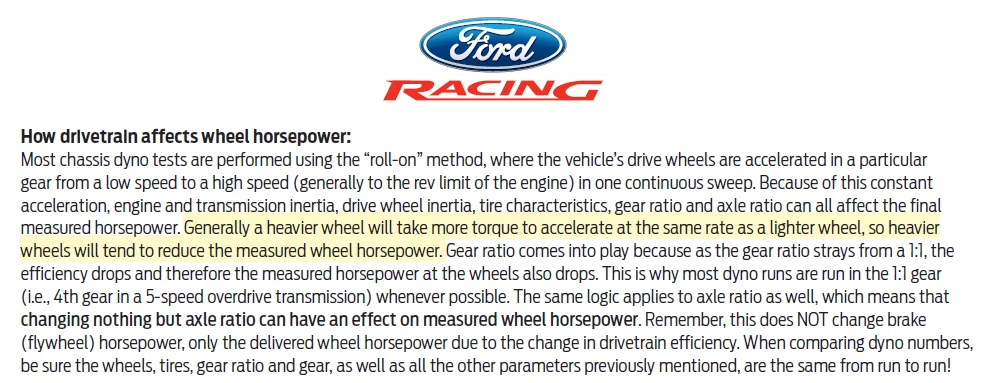
And straight from Ford Performance:

Ford Ranger RR 3.0 Wet Belt Driven Oil Pump - issues in future? 1768505509760-d


Those factors ABSOLUTELY affect final WHP numbers! Ask any tuner, performance shop or hot rod builder. The effective WHP is a combination of the power at the crank - all parasitic losses. If you want to directly compare engine outputs, an engine dyno would be best, but that's not practical unless you're an engine builder or OE mfg. doing dev. work.

BTW, I attached the document from FP for anyone interested, it's a great read. The link provided also gives some additional info. The next best thing to an engine dyno is similar vehicles with similar powertrains, tires sizes and weights on the same dyno on the same day (or at least same dyno and different days with SAE corrections), but we're getting off topic here.

The original thread was about the 2.7 / 3.0L wet belts of doom that Indiana Jones must escape in his 2.3L powered Ranger. I think that conversation has run its course, so maybe we should move this discussion to a separate thread or discontinue it all together.

At the end of the day, there is a meaningful difference in performance between the 2.3L and the 2.7L just like there is between the 2.7L and its squared HO 3.0L cousin. Weather that performance differences matter to you, how you use and drive the truck and where you live is an individual thing, but to say the differences are meaningless or nearly non-existent is FUD. If you live in the mountains and tow, the 2.7L is going to be a better choice because it's going to be easier to drive in traffic or when merging or pulling up steep grades, the power matters there.

On a big flat open highway with 50% tow? 2.3L will do just fine. Mostly empty truck or just haulin' stuff in the bed? 2.3L will do just fine. Can it tow up-hill at max? Sure, but can it do it where it's not very hard to drive because its responsiveness is just GONE and now accelerates slower than a Prius firing on only 3 cylinders? That's why the 2.7L exists. There's situations where the added power doesn't matter and then there's situations where it does. You don't need it until you NEED it.

The 2.3L is a great engine, so is the 2.7L and the 3.0L each in their own ways. The first is geared towards balancing cost, fuel economy and reliability, while the middle kid is set up as the all-around performer, maybe not the most economical or the absolute fastest, but a true jack of all trades with a little hot rod built in.

The big brother 3.0L is the hoonigan version for those of us who like to launch their trucks 2-4 feet into the air JUST BECAUSE, or because you LIKE the feeling of your a** being pinned into the seat when you stomp it. Yep, that's my engine. And even that wasn't enough, so I tuned it with a Pro Cal for another 50 HP and 106 lb-ft JUST BECUASE the performance is what I'm after.

Maybe the difference between a 2.7L Lariat and the 3.0L Raptor doesn't matter to you, or between the 2.3L and the 2.7L. Options exist for a reason, it's not just how MUCH it can do, it's HOW WELL IT CAN TOW!

TFL has proven beyond a doubt that the 2.7L will do a better job in non-ideal situations than the 2.3L. Look at their brake testing, their up-hill run in the mountains etc. The differences matter, but everyone has to decide weather those differences matter to THEM.
 

Attachments

Last edited:

Aemonn

Well-Known Member
Joined
Jul 8, 2024
Threads
2
Messages
205
Reaction score
266
Location
USA
Vehicle(s)
Ranger Raptor
I’m not sure where the disconnect is, so I will try to be precise. You previously made the specific point: "It's not just peak numbers. People forget about AREA UNDER THE CURVE."

As noted above the two engines are in different vehicles, therefore you can ignore absolute numbers. However, none of these things: "[t]ire size, weight, wheel weight, final drive ratios" would change what a torque and hp curve would look like.

So with that in mind I'm not sure how having "two trucks just with different engines and on the same day" would offer any more information on your point about the area under the curve and not just peak numbers.
I think he was simply saying that your 2.3 ranger is perfectly fine for towing, and rated to tow the same as the 2.7 due to chassis limitations. So if we're speaking just capability, they both work. But his previous post pointed out that there are tangible benefits to the 2.7 that go beyond just being capable in a binary sense.

There is a measurable and discernible difference in the experience beyond the advertised payload and tow weight rating numbers.

The videos he references are a good watch. The TFL tow torture tests are great and can show differences between engines and trucks, even when their capability specs line up exactly.
 

daytoncarter

Well-Known Member
First Name
Dayton
Joined
Sep 26, 2025
Threads
9
Messages
397
Reaction score
562
Location
USA
Vehicle(s)
2021 Genesis G70 SP 3.3T, 2025 Ranger Lariat
@Lion77 that wheel weight article is a total distraction and completely out of context. You were the one who brought up "Area Under the Curve," yet now that we are actually looking at those curves, you’re pivoting to drivetrain losses to try and dismiss the data.

Here is the issue with your logic:

Drivetrain losses and wheel weights change the final numbers on the dyno (WHP), but they do not change the characteristics of how the engine produces power. A heavier wheel might lower the whole curve on the graph, but it doesn't shift where the peak torque happens and it doesn't make the 2.3L fall off early at 5,000 RPM. Those are engine behaviors dictated by displacement and turbo sizing.

You said the 2.7L had a "1,500 to 2,000 RPM" advantage in its powerband. The charts show that isn't the case. Instead of addressing the actual shape of the power delivery (the AUC you asked for), you're now claiming the charts are invalid because of wheel weight. If we followed your logic, we could never compare the characteristics of any two engines unless they were on the exact same tires and wheels.

As noted in the article you quoted, "measured horsepower" drops as the gear ratio strays from 1:1 or as wheel weight increases. This is a consistent loss across the sweep. It does not rewrite the engine’s power profile. The 2.3L loses steam at high RPMs because of backpressure and turbo limits, not because of what rims are on the truck.

You can't call for a discussion about the Area Under the Curve and then try to disqualify the data with a "wheel weight" diversion once it's proven the delivery curves aren't as different as you claimed. You're moving the goalposts and trying to frame my reply as off-topic because the technical data doesn't match your original point.
 

Sponsored

Lion77

Well-Known Member
Joined
Feb 27, 2025
Threads
28
Messages
789
Reaction score
1,150
Location
United States
Vehicle(s)
2024 Ranger Raptor
Occupation
Electrical Engineer
So you can tell people that your Ford engine is bulletproof, then? LOL :crackup:
Nope, just the belt...you have a bullet proof oil pump belt in case a 9mm bounces around in side your crank case :crackup:

But you'll need some "hard plates" to handle long guns :rockon:
 
Last edited:

Lion77

Well-Known Member
Joined
Feb 27, 2025
Threads
28
Messages
789
Reaction score
1,150
Location
United States
Vehicle(s)
2024 Ranger Raptor
Occupation
Electrical Engineer
I’m not sure where the disconnect is, so I will try to be precise. You previously made the specific point: "It's not just peak numbers. People forget about AREA UNDER THE CURVE."

As noted above the two engines are in different vehicles, therefore you can ignore absolute numbers. However, none of these things: "[t]ire size, weight, wheel weight, final drive ratios" would change what a torque and hp curve would look like.

So with that in mind I'm not sure how having "two trucks just with different engines and on the same day" would offer any more information on your point about the area under the curve and not just peak numbers.
Doesn't change the shape, it changes the magnitude across the range, so the entire curve will read higher or lower depending on the vehicle its in. Think of it like an offset due to parasitic losses.

You compared the most ideal case for the 2.3L against the worst case for the 2.7L. That same 2.3L will dyno lower across the range if you throw it in a truck powertrain with bigger heavier wheels. What is hard to understand about that?

You are trying to compare a 2.3L in a Mustang to a 2.7L in a Bronco and then say the 2.3L outputd only 8% less power which is not true. Truck vs. Truck like I provided, its 29% at 3k RPM, 33% at 4k RPM and 33% at 5k RPM. Truck vs. Truck, two engines, same dyno, same 10R80 transmission, similar tire / wheel sizes etc. Yah, there's a difference and its not miniscule like you claim.

Thats fine you got the 2.3L Ranger. Its a nice truck, but the 2.7L offers a real step up in performance when towing, especially in non-ideal conditions. It also offers better acceleration.

Clearly that stuff doesnt matter enough to you, thats fine, but let's not pretend its irrelevant and claim the 2.3L makes only 8% less power than the 2.7L by comparing a 2.3L Mustang dyno run agaisnt a truck with the 2.7L where parasitic losses mask some of the real differences.

Go dyno your 2.3L Ranger agaisnt that 2.3L Mustang...my bets in the Mustang showing considerably more power under the curve because it has a lot less parasitic losses :sunglasses:. It all adds up. Ford Performance gave a great explanation and it lines up exactly with what im trying to articulate. But hey, if you want to think the 2.7L is pointless to justify your buying a 2.3L, go ahead.

 
Last edited:

BriSco

Well-Known Member
First Name
Brian
Joined
Mar 25, 2024
Threads
8
Messages
266
Reaction score
272
Location
Kansas
Vehicle(s)
'24 Ranger XLT, 2.7L V6
Occupation
Retired
But hey, if you want to think the 2.7L is pointless to justify your buying a 2.3L, go ahead.

The 2.3L crowd are just sour grapes trying to justify their shortcomings.
We used to call it little-dick syndrome.:shock::shock:
 

Hootbro

Well-Known Member
Joined
Jun 5, 2024
Threads
10
Messages
433
Reaction score
427
Location
Delaware
Vehicle(s)
2024 Ranger STX 4X4
The 2.3L crowd are just sour grapes trying to justify their shortcomings.
We used to call it little-dick syndrome.:shock::shock:
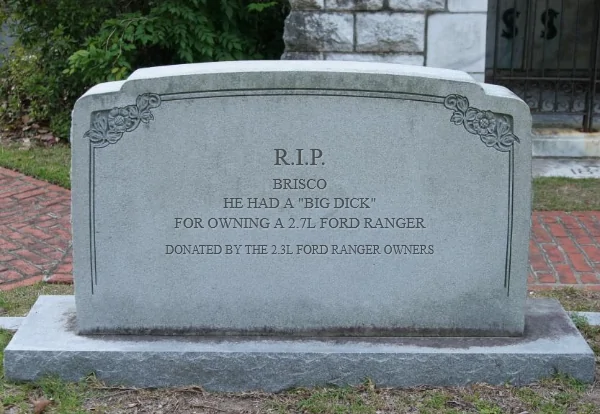
They are not going to write on your Tombstone you had a Big Dick for having a 2.7L.

Ford Ranger RR 3.0 Wet Belt Driven Oil Pump - issues in future? tombston
Sponsored

 
Last edited:


Top