Sponsored

Couple simple Ford Performance Tune questions

Joejr

Well-Known Member
First Name
Joe
Joined
May 4, 2024
Threads
0
Messages
103
Reaction score
100
Location
West Chester PA
Vehicle(s)
2024 Ranger Raptor
Installed the tune on my truck on Saturday. It is very easy to do yourself. No need to spend the money having dealer install it. I've noticed the throttle response is better right away. Can't wait to see how much better truck can be after some drive time for new tune to learn.
Sponsored
 

Lion77

Well-Known Member
Joined
Feb 27, 2025
Threads
28
Messages
789
Reaction score
1,158
Location
United States
Vehicle(s)
2024 Ranger Raptor
Occupation
Electrical Engineer
Just for reference, the Magnussen Moss law does not cover aftermarket modifications. The law was intended to stop OE's from voiding warranties over using OE equivalent parts. Aka, suppose your use a Denso equivalent spark plug instead of the Ford MoCo OE plug (even if it's actually made by Denso), then your ecoboost goes ecoboom. In the past, Ford may have tried to blame the "aftermarket OE equivalent" to deny a warranty claim. That is VERY different from installing an aftermarket CAI that is NOT an OE equivalent (aka power adder) which affects airflow into the engine where it may not accurately read flow to the PCM, forcing a lean condition that could cause heavy knock or possibly even pre-ignition. That would be a warranty denial.

It was never intended to cover tuning modifications, CAI's, exhaust, suspension mods nor does it legally do so. Regarding the Ford Performance modifications, they are considered aftermarket, but because Ford Performance is actually a division of Ford Moto Co., they offer supplemental warranty when installed by a Ford certified tech or any ASE certified tech for 36k / 3yrs, which is the same as the factory new vehicle warranty.

Ford Performance parts, when installed by Ford certified or ASE certified techs does NOT void the standard powertrain warranty either EXCEPT in the instance where the modification is known to be the cause of the failure.

So, if your cam phasor fails at 50k, it's not likely the Ford Performance cal would be looked at as the cause because it has been a common issue with Ecoboost V6's for over a decade. If you snap an axle however, I will argue that some dealerships MAY be more critical that the added torque may have cause the failure IF your past the 36k / 3yr supplemental FP warranty and relying solely on the 5yr / 60k powertrain warranty, so there is some risk.

Prior to that, it would likely be covered unless you're doing stupid stuff like launching at 5k RPM while brake boosting in 2WD on 35" tires...ahem.
 

Lion77

Well-Known Member
Joined
Feb 27, 2025
Threads
28
Messages
789
Reaction score
1,158
Location
United States
Vehicle(s)
2024 Ranger Raptor
Occupation
Electrical Engineer
Also, the transmission in the RR is a variation of the 10R60, but it is a different part than the other Rangers, and it literally costs 2x the price of the 10R60 that goes in the 2.7L for example, and if you go by the marketing interviews from when it came out that is due to it having 4A but also due to it being revised to handle increased power. How true is that? No clue, but they are confident enough in it that they will sell you a tune and install it for you. I will also wager that we see the truck's power increase over its lifespan with the same transmission.
Can you link some of the info? Some have quoted my former posts digging into the 10R60 issue, I still stand by my findings that IF it even relates to input torque, it's more likely to be in lb-ft than nm given the fact that completely stock F-350's torque output exceeds the stock transmission rating in nm and the historical understanding of various Ford transmissions.

I suspect it doesn't have anything to do with input torque at all and may be related to the bell housing size. Input torque is then rated on a use case by use case basis and changes are made internally for different applications, which is why you have different PN's for 10R60's depending on the vehicle and why the 10R60 in the RR costs 2x as much.

It's also a known fact that there are different versions of the old 4R70W that have upgrades to increased power in some applications. The 6R80 is a good case example:

Ford 6R transmission - Wikipedia

There is literally no official Ford documents anyone can find that give the full meaning of the naming nomenclature, aside from the obvious first number being related to the number of forward gears, the R being RWD mounting orientation. As for the second number, pure speculations!

I'm at a point where I think it's pretty safe to say, not all 10R60's are built the same and the "60" doesn't likely have anything to do with an input torque specification and is more likely related to a dimension for fitment.

Comparing 4R70W, 6R80, and 10R80 Transmissions (Silver Bullet Part 2)

The 6R80 was developed long before the Ecboost engines existed, in fact it was historically paired with the 4.6L 3valve that made around 290 lb-ft of torque.

So nearly 30 years ago, people want to imply Ford was making transmissions with 2.5x the torque capacity, but not they are making them with less than half the safety margin?

It just doesn't make sense, so it most likely doesn't even relate to input torque, especially since it's known that Ford sometimes uses the same name, different PN, but then say some versions have upgraded internals. How can they have upgraded internals to handle more torque but have the same torque rating?

Why is the motor output torque to transmission input torque all over the map year to year, vehicle to vehicle? I'll bet it is dimensional, maybe bell housing diameter or bell housing bolt pattern related? Not sure, just not really convinced it has anything to do with input torque.
 

Lion77

Well-Known Member
Joined
Feb 27, 2025
Threads
28
Messages
789
Reaction score
1,158
Location
United States
Vehicle(s)
2024 Ranger Raptor
Occupation
Electrical Engineer
By the way, this makes even LESS sense now that the 2025 is out:

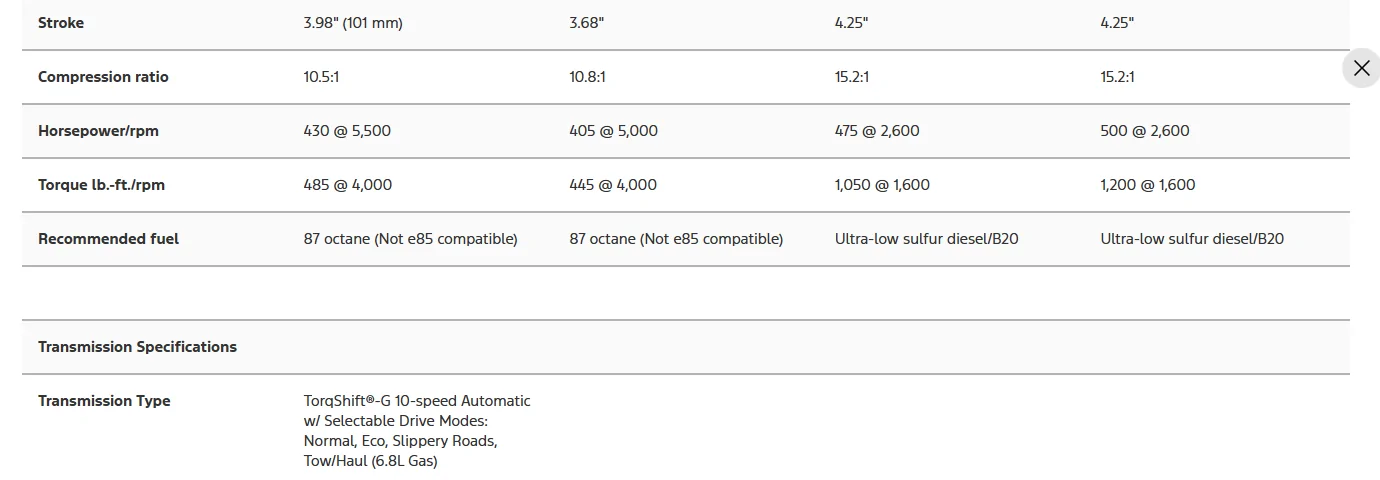
2025 Ford Super Duty® Truck | Pricing, Photos, Specs & More | Ford.com

1,200 lb-ft of torque from the 6.7L PowerStroke for 2026.


Horsepower (SAE net @rpm)
6.8L 2V DEVCT NA PFI V8 Gas engine (horsepower = 405 @ 5,000 rpm)
7.3L 2V DEVCT NA PFI Gas engine (horsepower = 430 @ 5,500 rpm)
6.7L 4V OHV Power Stroke® V8 Turbo Diesel B20 engine (horsepower = 475 @ 2,600 rpm)
6.7L High Output Power Stroke® V8 Turbo Diesel B20 engine (horsepower = 500 @ 2,600 rpm)
Torque (lb-ft @rpm)
6.8L 2V DEVCT NA PFI V8 Gas engine (torque = 445 @ 4,000 rpm)
7.3L 2V DEVCT NA PFI Gas engine (torque = 485 @ 4,000 rpm)
6.7L Power Stroke® V8 Turbo Diesel B20 engine (torque = 1,050 @ 1,600 rpm)
6.7L High Output Power Stroke® V8 Turbo Diesel B20 engine (torque = 1,200 @ 1,600 rpm)

So, if it's in NM, then Ford is making factory heavy diesel trucks where the engine's output torque now exceeds the transmission max torque by 168 lb-ft....that argument is STUPID. SO supposedly, the 6.7L HO exceeds the 10R140's input torque by a whopping 14%!!! That's the opposite of a safety margine...

At best, it's a lb-ft rating. Most likely it has NOTHING to do with input torque ratings and is dimensional. All versions of the F-350 use the same 10R140 (but how knows how it differs internally from model to model for each application):

Ford Ranger Couple simple Ford Performance Tune questions 1754484818505-hi


I think we can throw the internet claims of nm out the window at this point. At best it's lb-ft, most likely it's not related to torque at all. And for the love don't rely on wikipedia, if you look at their sources, most of it is car magazines who rely on assumptions, many of which are incorrect.

For reference, 1,400 nm = 1,032 lb-ft.
 

superj

Well-Known Member
First Name
Jason
Joined
Feb 8, 2025
Threads
40
Messages
3,485
Reaction score
3,204
Location
Corpus christi texas
Vehicle(s)
2004 ford ranger, 2024 ford ranger
Occupation
Aircraft examiner
that explanation makes alot more sense than the one about hp or tq rating. 60 could be 60mm which could be the diameter of hte pump mounting location in the case, or something odd like a bearing diameter. it could even just be a magical number someone came up
 

Sponsored

Lion77

Well-Known Member
Joined
Feb 27, 2025
Threads
28
Messages
789
Reaction score
1,158
Location
United States
Vehicle(s)
2024 Ranger Raptor
Occupation
Electrical Engineer
Agreed. It could literally be anything, maybe even related to a particular manufacturing location or just some Ford internal naming nomenclature they came up with back in the 80's / 90's. There is zero credible evidence from an actual Ford document that identifies what that number means, and the body of evidence seems to strongly imply it has nothing to do with an input torque spec.

Anyone got the difference in PN's for the regular ranger tranny and the Raptors (assuming they are different)?
 

Lion77

Well-Known Member
Joined
Feb 27, 2025
Threads
28
Messages
789
Reaction score
1,158
Location
United States
Vehicle(s)
2024 Ranger Raptor
Occupation
Electrical Engineer
Just out of sheer morbid curiosity, I imported the data from Steeda's dyno, so it's one of the few comparison points we have of before and after on the same truck under relatively similar conditions, same dyno etc.

Note that they are in Florida, so it is very hot and humid and any engine is NOT going to make maximum potential power like on a 60F cool dry fall night at the drag strip, but I do think it's representative of "average summer conditions" across many of the states (including my own state).

IF your concerned about transmission durability, making less the max power is actually better for 10R60 longevity and we know the Pro Cal has OE-like testing and tuning, so it is going to always operate within the safe region for given conditions, meaning that 90% of the time you're NOT making MAX potential power, but rather some percentage of that (like 85~90% of what it can make under ideal weather).

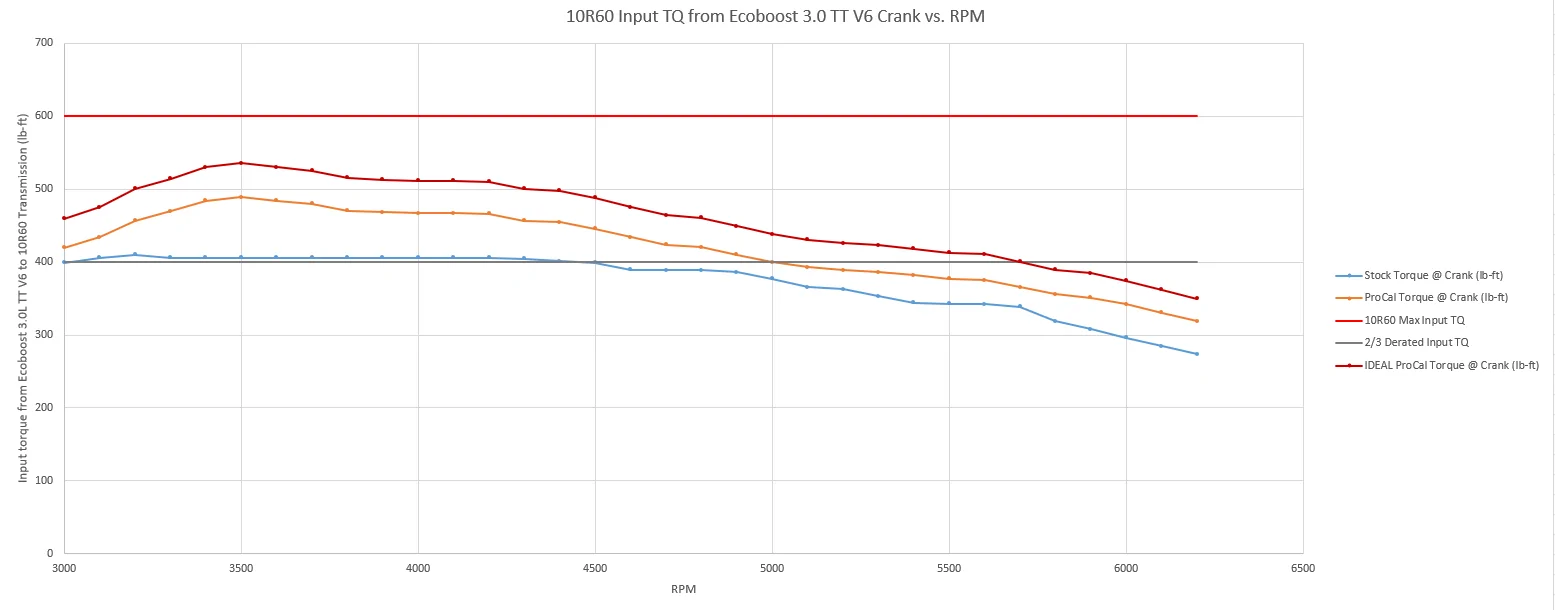
Yes, I did include the POSSIBLE meaning of the "60" in the 10R60 naming as a 600 lb-ft input torque spec just as a reference point, even though it is unlikely to actually mean that.

Ford Ranger Couple simple Ford Performance Tune questions 1754571736584-s1


BLUE line is Stock

ORANGE line is ProCal after the 1 week learn

DARK RED line is an extrapolation from the real data of the approximate "ideal" max it would make with the Pro Cal after the "learn" period

The STRAIGHT RED line is the hypothetical 600 lb-ft input torque that the 10R60 supposedly is rated for (MAX)

The STRAIGHT GREY line is 2/3 derating on the input spec (high reliability range)

Notes: at WOT, the PCM is going to shift between 6,000 and 6,200 RPM (up to red-line), so the torque input worst case at the next gear is going to be around 5,000 RPM. Even with the Pro Cal, when doing WOT pulls, the input torque to the 10R60 is still BELOW the 2/3 derated high reliability range!

I cannot think of a case where your WOT making MAX torque and shift at 4,500 RPM so your starting torque in the next gear up is at peak torque (aka 3,500 RPM). You're NOT making anywhere near max torque at partial throttle, where it may sometimes shift around 4~4.5k RPM (aka light throttle), typical driving conditions.

Maybe if you manually shift it (force it), but the PCM likely has torque limiting strategies, aka it will torque limit momentarily until the lockup occurs, then de-limit.

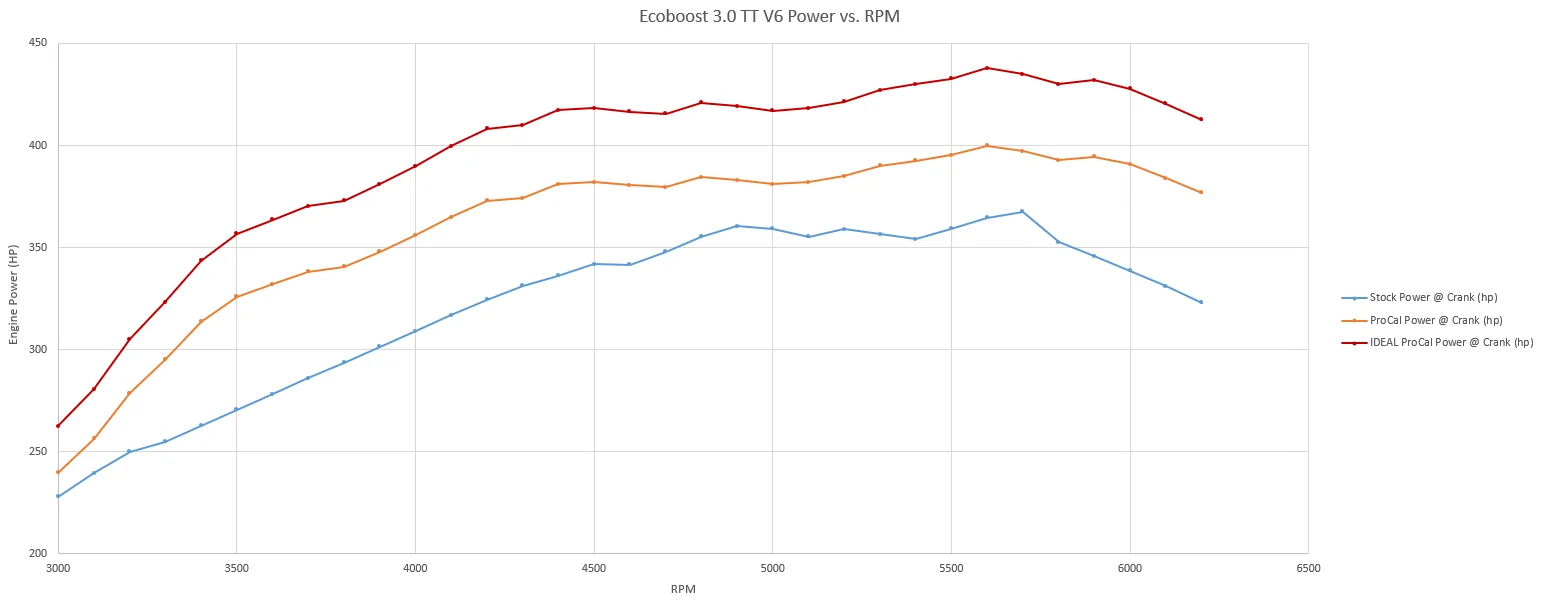
Ford Ranger Couple simple Ford Performance Tune questions 1754572115198-e2


These are the calculated HP numbers from Steeda's actual dyno numbers imported into excel, except the dark red line, which again is a hypothetical extrapolation from the real world numbers of a "theoretical MAX" based on Ford Performance specs.

Now you know why the shift strategy at WOT and especially in Sport or Baja tries to keep the EB V6 in the 5,000 to 6,000 RPM range, that's where max power is and it's VERY linear since the torque roll-off slope is rather shallow (aka it holds torque decently well as RPM increases).

Power is work being done, power is generated by pulses of torque like a PWM (Pulse Width Modulation). The average of the pulses (duty cycle and frequency) is what makes power. When people say you "need torque for towing", what they really mean is "you need power down in the lower RPM range" where you normally don't have it with NA engines.

Below 3k RPM, Stock and Pro-Cal are identical, there's no difference in power / torque below 3k, so I did not bother to include that.
 

Attachments

Jason B

Well-Known Member
First Name
Jason
Joined
Apr 27, 2023
Threads
1
Messages
1,187
Reaction score
1,266
Location
Louisiana
Vehicle(s)
2024 Ranger XLT FX4
Occupation
machinist
Looks that chart is from a Raptor. Any difference in the 10R60 in a Raptor vs standard Ranger?
Sponsored


Top