
Sponsored

To CAI or Not to CAI, Everyone's Question

Alaska_Wolf

Well-Known Member
First Name
Gary
Joined
Feb 20, 2023
Threads
4
Messages
102
Reaction score
131
Location
From Eagle River, AK.
Vehicle(s)
2025 Ford Ranger Lariat FX4 2.7L; 2025 King Ranch F150 Powerboost FX4
Occupation
USAF Retired
Been reading a lot of the discussions on here about CAIs. There's been a lot of how this brand is better than that brand, and how manufacturer A says theirs is so much better than brands B, C, X, Y and Z. And how this manufacturer submitted a Dyno that categorically "proves beyond a show of a doubt", yada yada yada, blah blah blah; a lot of marketing hype, but no actual science based fact. For many years (decades) I've run Ford F - series vehicles and I've always done what made sense to me, and what I learned going through auto shop classes, and its worked. When my old 95 EB 351 Bronco (REAL Bronco) hit 180K miles, I let my friend Ralph (Ford Master mechanic, GM Mr Goodwrench Master mechanic, Toyota Master mechanic, & and NASCAR Master mechanic) tear into it, mostly out of a sense of curiosity as I had been maintaining it the same way for a long time, Mobil 1 and Volant CAI running Donaldson Powercore 99.99% air filters. Ralph found no visually discernible and only minor measurable wear in the 351. The oil quality, and most importantly the air filter quality were what was most important, that Volant CAI was primarily installed to hold the Donaldson Powercore. Donaldsons are as some of you know used in Kenworths, Macks, Freightliners, and heavy CAT equipment, all with 1,000,000 engines. I've already put the Volant CAI with the Powercore on our new F 150 Powerboost.

Anyway, the true strength behing any CAI is NOT the CAI, but the quality of the filter inside the CAI. I found a video by Jamon at Freedom Worx that addresses the actual marketing, and more importantly, the science behind CAIs. Its sure to piss off some people, maybe, but it should also make people think about what's really important about CAIs, probably. Anyway Jamon is worth listening to, and he's also a lot of fun to listen to, mostly. The TRUTH About Cold Air Intakes
Sponsored

 
Last edited:

OP
OP
Alaska_Wolf

Alaska_Wolf

Well-Known Member
First Name
Gary
Joined
Feb 20, 2023
Threads
4
Messages
102
Reaction score
131
Location
From Eagle River, AK.
Vehicle(s)
2025 Ford Ranger Lariat FX4 2.7L; 2025 King Ranch F150 Powerboost FX4
Occupation
USAF Retired
CAI are snake oil. There, saved everyone a click.
Well you should let Ford know since they install CAIs on most vehicles now, including Raptors and Shelbys.
 

stuartmunto

Well-Known Member
First Name
Stuart
Joined
Aug 25, 2024
Threads
21
Messages
547
Reaction score
901
Location
Perth, Western Australia
Vehicle(s)
2023 Ford Ranger Raptor
Occupation
Engineer
Well you should let Ford know since they install CAIs on most vehicles now, including Raptors and Shelbys.
Cold air intakes definitely work - much better than a hot restricted intake. But we’re not talking stock air boxes here. We’re talking aftermarket intakes. And all aftermarket intakes aren’t going to do much unless you’re tuning for that particular air intake. Luckily for us Ford’s stock airbox is already a very decent CAI

Sure, you might get 1% increase in power or even slightly better back to back 0-60 pulls potentially due to cooler intake temps. But at that point the inter cooler will matter more. Again, an aftermarket CAI is a supporting mod. If you’re not changing intercoolers, charge pipes, ECU tuning then it’s just not worth the $$$
 

Sponsored
OP
OP
Alaska_Wolf

Alaska_Wolf

Well-Known Member
First Name
Gary
Joined
Feb 20, 2023
Threads
4
Messages
102
Reaction score
131
Location
From Eagle River, AK.
Vehicle(s)
2025 Ford Ranger Lariat FX4 2.7L; 2025 King Ranch F150 Powerboost FX4
Occupation
USAF Retired
Sure, you might get 1% increase in power or even slightly better back to back 0-60 pulls potentially due to cooler intake temps. But at that point the inter cooler will matter more. Again, an aftermarket CAI is a supporting mod. If you’re not changing intercoolers, charge pipes, ECU tuning then it’s just not worth the $$$
Well if you listened to it you missed the entire point of a very good article. :thumbsup:
 
Last edited:

BigBassDaddy407

Well-Known Member
Joined
Aug 14, 2025
Threads
8
Messages
69
Reaction score
82
Location
USA
Vehicle(s)
2025 Ranger XLT 4x4
Honestly, I wouldn't mind installing one for the induction sound. Waiting to hear back from people who go aftermarket CAI to see if there is any noticeable difference. I have the 2.7L. I like the sound of turbos, sue me.
 
OP
OP
Alaska_Wolf

Alaska_Wolf

Well-Known Member
First Name
Gary
Joined
Feb 20, 2023
Threads
4
Messages
102
Reaction score
131
Location
From Eagle River, AK.
Vehicle(s)
2025 Ford Ranger Lariat FX4 2.7L; 2025 King Ranch F150 Powerboost FX4
Occupation
USAF Retired
Bit hard to listen (?) to an article when the link to said article doesn’t work mate
Odd, working fine for me, but I renewed the URL. It really is a good article.
 

STEVE_K

Well-Known Member
First Name
Steve
Joined
Jun 27, 2026
Threads
2
Messages
48
Reaction score
53
Location
Snohomish, WA
Vehicle(s)
2026 Ranger Raptor, 2003 Jeep Wranger SE TJ, 2001 Subaru Forester
Now I need to eat some bacon and clean some guns after watching that video.

Some good info in there. I’ve always been too cheap to buy a CAI system, or just preferred to spend the money on something else. :LOL:
 

Sponsored

Onceaneagle

Well-Known Member
First Name
Walter
Joined
Aug 12, 2025
Threads
8
Messages
604
Reaction score
785
Location
Kansas
Vehicle(s)
2025 Ranger Lariat
Occupation
US Army Retired
So can someone explain how a particular filter can be less restrictive to allow more air flow to "increase performance" while at the same time preventing the bad stuff from getting through the filter and into the engine? Are these filters so scientifically engineered that the filter pores can do that? And how does "cold air," which seems to me to be any air not yet warmed by the engine, exist in the Arizona desert heat or any State with high temps and high humidity in Summer? I see more smoke and mirrors than actual science and engineering, so that's why I am asking.
 

Sauce

Well-Known Member
Joined
Apr 30, 2025
Threads
46
Messages
521
Reaction score
443
Location
Northeast
Vehicle(s)
2025 Ranger XLT FX4
So can someone explain how a particular filter can be less restrictive to allow more air flow to "increase performance" while at the same time preventing the bad stuff from getting through the filter and into the engine? Are these filters so scientifically engineered that the filter pores can do that? And how does "cold air," which seems to me to be any air not yet warmed by the engine, exist in the Arizona desert heat or any State with high temps and high humidity in Summer? I see more smoke and mirrors than actual science and engineering, so that's why I am asking.
Im a novice with this stuff, but my laymans understanding is that it is a function of having a larger filter. More surface area to draw through makes it less restrictive even if the membrane offers the same or better filtration.

I think the real punchline though is that for an aftermarket CAI to be effective it needs to address the bottleneck in the system and most of them might offer better flow at some point, but if that point isn't the bottleneck then it isn't really doing anything.
 

Sharpie223

Member
Joined
Apr 22, 2026
Threads
1
Messages
11
Reaction score
12
Location
E.Wa
Vehicle(s)
In-between atm
There used to be a time where a COLD air intake was a notable difference from a factory intake, not so much anymore. Though some marketed as cold air intakes these days are really short ram intakes that are pulling in warmer air than stock unless you also create a barrier from the engine heated air.

What really matters is a HIGH FLOW intake. This can be done while maintaining the same level of filtration, and piping can be made to be a velocity stack instead of sharp transitions, designed for laminar flow with less impedance than stock. Won't make much of a difference unless you have other supporting mods and even then only at large throttle angles.

That said, other forums, generally for higher (perceived) performance vehicles, have done side by side intake dyno tests. Some do make a difference even in otherwise stock vehicles. I wish we had that here, but, you know...money.
 

Lion77

Well-Known Member
Joined
Feb 27, 2025
Threads
32
Messages
895
Reaction score
1,304
Location
United States
Vehicle(s)
2024 Ranger Raptor
Occupation
Electrical Engineer
One big caveot is the filter quality. Cloth filters and dry type filters typically have about 1/3 of the dust capacity of OE paper filters and their flow characteristics are not linear, rather exponential.

So they flow better for a short period of them, then rapidly clog up and become MORE restrictive than paper filters which have a very linear and slow clog rate. Then there's the filtration quality, I've seen some testing that showed K&N's allowing up to 12x the fine dust contamination of OE paper filters.

Upper cylinder group wear (particularly the piston rings) is directly proportional to the dust contamination! So, I have contended for some time that aftermarket CAIs are for track cars, which is a clean environment, very low miles, but not suitable for street cars and especially off-road.

So, is ~7-10 hp, if that, really worth loosing ring seal by 70~100k? How much HP are you going to lose from compression loss vs. what you gained by the CAI? I think most of us should focus a lot more on making consistent and reliable power over the life of vehicle than chasing a couple of situation specific HP you can barely notice.

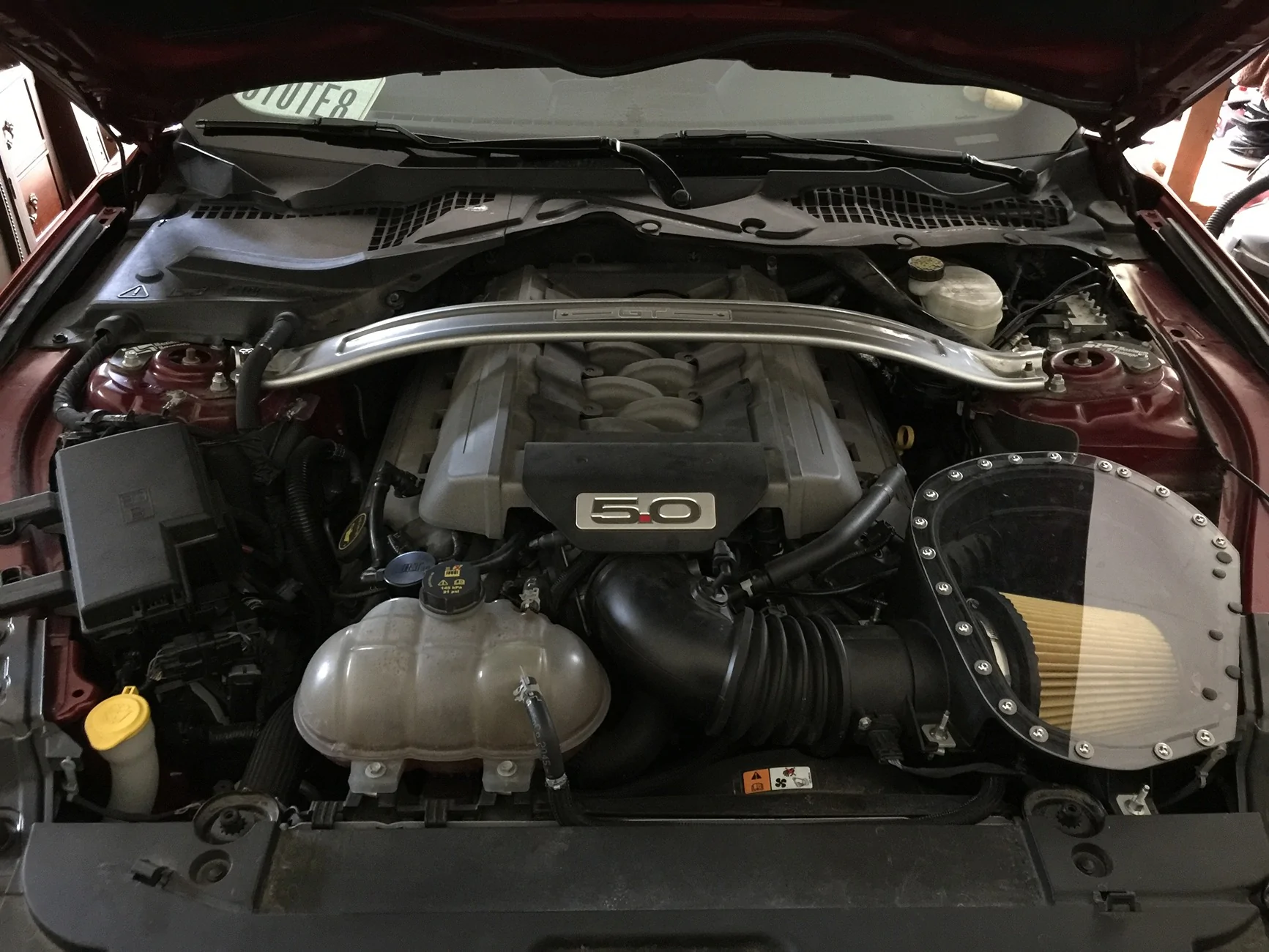
Hence for Ford Performance uses conical paper filters in the GT350 and Stage 2 Power Pack I had on my 2016 Mustang GT which used the GT350 throttle body and air induction system:

Ford Ranger To CAI or Not to CAI, Everyone's Question IMG_0074


Note that I fabricated a custom lexan cover and riveted it on since the original GT350 intake was designed for the GT350 hood profile and didn't' seal the best against my standard GT hood, then I did some ducting up front on that to make it a ram cold air intake.

Yes, Ford Performance does use K&N's in some of their kits, but not many and I believe they intended those for cars that mostly see drag strips and operation in clean environments.

All the factory intakes now on performance Ford vehicles are cold air or cool air from the high pressure zone right in front of the radiator. That is where the body is designed to funnel incoming cool air.

Also mounting the intake higher up instead of low down helps with cooler air when driving on hot pavement, the hottest air is actually down near the surface of the pavement, so it makes perfect sense to pull the air from up near the top of the front of the hood furthest away from heat sources!

About the only significant improvement I can forsee is maybe using a larger filter to 1. reduce restriction and 2. increase dust capacity thus making its clog rate even slower and more consistent (i.e., a large conical filter like what is used on 6.7L Power Stroke).

A better intercooler is going to be far more beneficial than a CAI. THen there's the issue of trusting the CAI developer that their flow ratios are accurate, if they are off, then you're going to lean out the air fuel ratio but the PCM won't know and you could induce damaging levels of knock that hammer the tops of the pistons and over time crack a land.

I have a Pro Cal tune, under warranty and won't even do an intercooler until warranty is up. After that, intercooler and Pro Cal only. Not messing with induction system to avoid issues down the road and I simply don't think that juice is worth the squeeze unless you have a custom tune.
 

Jason B

Well-Known Member
First Name
Jason
Joined
Apr 27, 2023
Threads
1
Messages
1,257
Reaction score
1,344
Location
Louisiana
Vehicle(s)
2024 Ranger XLT FX4
Occupation
machinist
Manufactures have been putting CAI in ALL vehicles since the 90s.
But as mentioned, the real benefit of aftermarket CAI is the less restrictive filter due to a larger surface area. Personally, I'd never use a filter that requires oiling to increase filtration.
Sponsored


Top