Sponsored

Lion77

Well-Known Member
Joined
Feb 27, 2025
Threads
28
Messages
786
Reaction score
1,150
Location
United States
Vehicle(s)
2024 Ranger Raptor
Occupation
Electrical Engineer
Ford Bronco Intercooler Upgrade - COBB Tuning

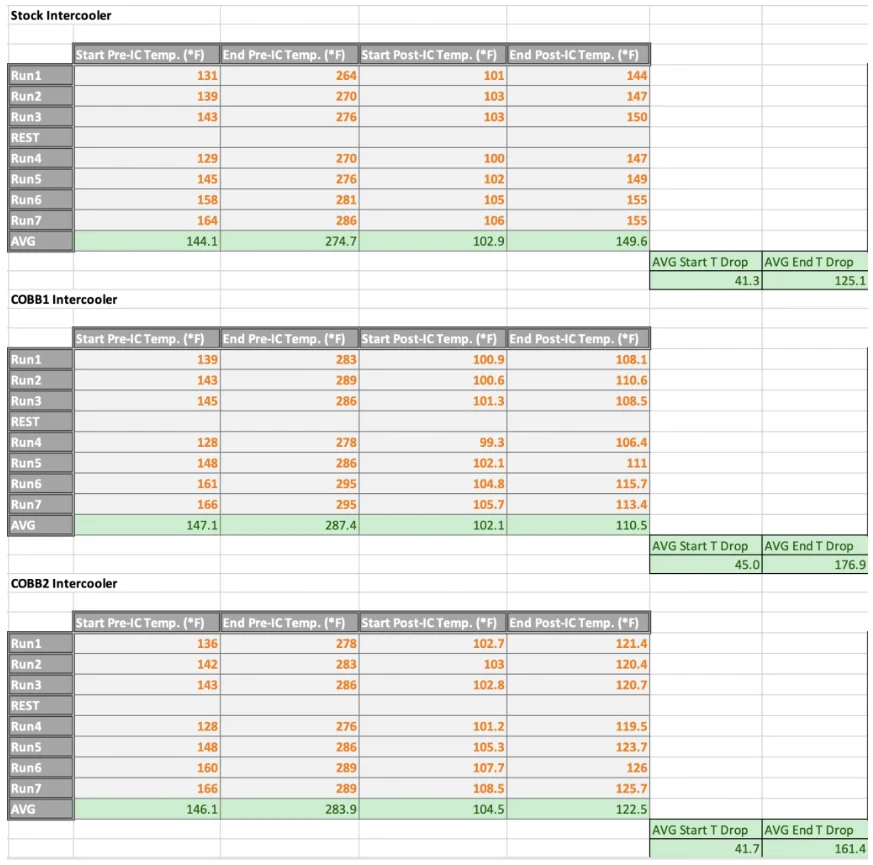
Not sure if anyone has seen this before, but it's more of an FYI to really answer some questions. Their methodology was pretty consistent, and all testing was done of the factory ECU calibration from Ford, with time for octane learn after PCM reset between swapping IC's. For factory turbos and typical street / high reliability calibrations (i.e., Ford Performance), the smaller ICs are a better option. I would not recommend a large "race grade" IC unless running big turbo's, but there are absolutely benefits even on a bone stock Ecoboost engine when using an upgraded intercooler.

Over on the thread with 0-60 times, mostly run by those with a FP Pro Cal, sever reported about 1-2 tenths gain on quarter mile going from stock IC to upgraded, it's always picked up on the back half in the taller gears where the engine is loaded more heavily for longer periods of time. I doubt anyone would see any gains in 0-60, but at higher speeds (passing or highway speeds) is where you will see the benefits, or possibly towing up-hill in constant boost, especially in hot weather where the factory IC is really pushed to it's thermal capacity limits.

If you live in a cold climate that sees low average ambients, like Alaska, it is probably not worthwhile, but anyone in the south or 4-season states that get hot summers, absolutely.

Ford Ranger Impact of an intercooler only on stock EcoBoost engines -- COBB's Well Documented Testing 1770819183102-u5
Sponsored

 
Last edited:
OP
OP
Lion77

Lion77

Well-Known Member
Joined
Feb 27, 2025
Threads
28
Messages
786
Reaction score
1,150
Location
United States
Vehicle(s)
2024 Ranger Raptor
Occupation
Electrical Engineer
Note that testing was done on a Bronco 2.7L, which is the middle ground between the 2.3L and 3.0L, but back when I had a Mustang Ecoboost (2015) and later upgarded to a 2016 GT 5.0L, it was well known that the 2.3L Ecoboost mustangs had a big issue with heat soak at higher speeds, but most didn't really see much improvement in 0-60 unless in very hot weather.

Areas of Most Improvement:

1. Taller gears (passing, highway speeds, back half of quarter mile passes).
2. Hot / Humid summer days where the thermal capacity of the stock units was marginal.

I'm keeping my RR on the stock IC until at LEAST 36k, possibly til 60k once the powertrain warranty is up, but after that I may upgrade for a little more performance, but if I had a choice between an IC and a Pro Cal, Pro Cal 100% hands down, far bigger difference between the added power, thorttle mapping and transmission tuning.

My next on the list would be the lightweight Method 705's, HUGE difference in response (acceleration / braking / response to turn-in). Intercooler is last on the powertain mod list which for me is very shor and limited.
 

embedded rock

Well-Known Member
Joined
May 6, 2023
Threads
15
Messages
638
Reaction score
672
Location
Earth
Vehicle(s)
One truck, two motorcycles
Good to see the data for the cooling and not just a calculated claim based off of IC dimensions.
 

embedded rock

Well-Known Member
Joined
May 6, 2023
Threads
15
Messages
638
Reaction score
672
Location
Earth
Vehicle(s)
One truck, two motorcycles
Yeah, and in the 2.7l charts at the COBB website, one should look at the engine RPM's where the HP and TQ are gained.
 

Jason B

Well-Known Member
First Name
Jason
Joined
Apr 27, 2023
Threads
1
Messages
1,185
Reaction score
1,263
Location
Louisiana
Vehicle(s)
2024 Ranger XLT FX4
Occupation
machinist
1 or 2 tenths in a quarter mile might be fine for racing, doesn't do anything but take your money for just everyday driving.
And I don't trust manufactures' claims of performance improvements that don't translate or are realized in real world performance (I'm looking at you, K&N).
 

Sponsored

superj

Well-Known Member
First Name
Jason
Joined
Feb 8, 2025
Threads
40
Messages
3,481
Reaction score
3,200
Location
Corpus christi texas
Vehicle(s)
2004 ford ranger, 2024 ford ranger
Occupation
Aircraft examiner
i know my son and i put an larger intercooler on his focus st and it made a good difference with heat soak here in south texas when he was autocrossing.

i know he said he saw lower intake temps just daily driving it but not sure if it made a noticeable difference for just driving around.

my list of mods is short also, engine wise. an intercooler is one of the few i am considering since i already have the procal on my 2.3
 
OP
OP
Lion77

Lion77

Well-Known Member
Joined
Feb 27, 2025
Threads
28
Messages
786
Reaction score
1,150
Location
United States
Vehicle(s)
2024 Ranger Raptor
Occupation
Electrical Engineer
There are quite a few Mustang Ecoboost and Focus ST dyno runs showing real world differences. Its really not so much a power adder as it is a power keeper.

Its about consistency over a variety of conditions. You cant cool below ambient, so thats the lower limit of any air to air heat exchanger. But you can try to get as close as possible as often as possible for as long as possible which helps with making consistent power.

So my focus on ICs is more about consistency of performance and keeping the turbos running in a more ideal range.

The ECU will increase boost to compensate for heat to achieve the target air density (within the safe range), a more efficient IC would require less boost to achieve that, so your not pushing the turbos quite as hard on boost = lower back pressure. So it helps in other ways as well.

Just be sure to reset the ECU after an IC swap so it can relearn as the parameters are now different in terms of boost / air density relationship.
 
OP
OP
Lion77

Lion77

Well-Known Member
Joined
Feb 27, 2025
Threads
28
Messages
786
Reaction score
1,150
Location
United States
Vehicle(s)
2024 Ranger Raptor
Occupation
Electrical Engineer
BTW, any gains really only show up above 4k rpm due to heat loading in the power band. At lower rpms there's not enough thermal waste from the turbos to matter over a stock IC.

Factory ICs are far from garbage, but they really aren't optimized for sustained high rpm loads and Im of the mindset that Ford sizes them marginally so they run a bit hotter for 1. Emissions and 2. To avoid a repeat of the Gen 1 Ecoboost moisture accumulation issue they had with larger core.

I think the biggest benefit is in hot climates. In winter, even a stock IC will rarely see temps over 120 where a lower load limit will be used, but in summer its much easier to get into the 130-150F CAC.
 
Last edited:

stemplar

Well-Known Member
Joined
Sep 7, 2023
Threads
19
Messages
680
Reaction score
959
Location
Pennsylvania
Vehicle(s)
2025 Ranger Lariat 2.7
Good to see the data for the cooling and not just a calculated claim based off of IC dimensions.
edit: nevermind the following comment; my app lost its mind and it looked like the third comment was the original post. Nothing to see here; move along…

Can you share a link to what you're talking about? I can only imagine that it would be good to see the data for the cooling... I looked on their site, but didn't see it in the blog section and didn't drill into the product pages because they only have stuff for ranger raptors and not for us common folk with the 2.3 or 2.7...
 
Last edited:

embedded rock

Well-Known Member
Joined
May 6, 2023
Threads
15
Messages
638
Reaction score
672
Location
Earth
Vehicle(s)
One truck, two motorcycles
Based on the spreadsheet of data in post #1. It's also at the website in the link in post #1.
 

Sponsored

stemplar

Well-Known Member
Joined
Sep 7, 2023
Threads
19
Messages
680
Reaction score
959
Location
Pennsylvania
Vehicle(s)
2025 Ranger Lariat 2.7
Based on the spreadsheet of data in post #1. It's also at the website in the link in post #1.
Huh, my app must be doing something weird; what I replied to looks like the original post an I don’t see any attachments or links :-(

edit: quit the app, cleared the cache, and now all is well
 

jordantii

Well-Known Member
First Name
Jordan
Joined
Dec 12, 2025
Threads
18
Messages
391
Reaction score
360
Location
Tampa Bay
Website
www.straptacademy.com
Vehicle(s)
2025 RR
BTW, any gains really only show up above 4k rpm due to heat loading in the power band. At lower rpms there's not enough thermal waste from the turbos to matter over a stock IC.

Factory ICs are far from garbage, but they really aren't optimized for sustained high rpm loads and Im of the mindset that Ford sizes them marginally so they run a bit hotter for 1. Emissions and 2. To avoid a repeat of the Gen 1 Ecoboost moisture accumulation issue they had with larger core.

I think the biggest benefit is in hot climates. In winter, even a stock IC will rarely see temps over 120 where a lower load limit will be used, but in summer its much easier to get into the 130-150F CAC.
Hey Lion, have you made a decision on what IC you’re gonna go with? I’m in FL and temps are fine but we are about to turn the corner and hit spring which can just be summer…
 
OP
OP
Lion77

Lion77

Well-Known Member
Joined
Feb 27, 2025
Threads
28
Messages
786
Reaction score
1,150
Location
United States
Vehicle(s)
2024 Ranger Raptor
Occupation
Electrical Engineer
Ill probably go with the Wagner just to keep my grill shudders for fuel economy and faster warmups. Its the only unit that allows you to keep both front and rear shudders. Why does it matter you might ask?

My truck is used in a wide variety of things, including long family trips, home depot runs, sometimes for a range day, to work, hot rodding around back roads, baka in my uncle's corn field, sand dunes, trails, towing etc., so warmup on cold starts and fuel economy are important to not make worse than stock for me for longer term durability. Yes, the IC shutters affect warmup, but not nearly as much as the radiator ones.

Also if you look at the factory timing maps, IC temps under 120F use the more aggressive timing, so I think the Wagner, even with the shutters will keep it under that for most use cases, a couple degrees more by leaving in the shutters isnt going to matter in off road uses or most real world conditions. Really the IC just stops heat soak.
 
Last edited:
OP
OP
Lion77

Lion77

Well-Known Member
Joined
Feb 27, 2025
Threads
28
Messages
786
Reaction score
1,150
Location
United States
Vehicle(s)
2024 Ranger Raptor
Occupation
Electrical Engineer
Note that you won't likely see any differences just driving around....its in high performance driving applications where youll see the difference. I don't even think it matters for towing, I didnt see high IC temps towing.

But if you actually use the truck for performance driving its a different story, so on the back half of the 1/4 mile it makes an difference. For Baja mode in hot weather, it will make a difference. Probably won't matter for wheelin' since thats not high speed.

So keep in mind where it matters. Im just waiting until warranty is up before I do mine. Stock isnt as bad as people make it out to be, but it can be meaningfully improved!
 

MasterCylinder

Well-Known Member
First Name
Jay
Joined
Aug 2, 2025
Threads
20
Messages
293
Reaction score
452
Location
Texas
Vehicle(s)
2025 XLT FX4, 1991 1st Gen Ranger
Occupation
Retired, FF, CET, Mechanic
Ford Bronco Intercooler Upgrade - COBB Tuning

Not sure if anyone has seen this before, but it's more of an FYI to really answer some questions. Their methodology was pretty consistent, and all testing was done of the factory ECU calibration from Ford, with time for octane learn after PCM reset between swapping IC's. For factory turbos and typical street / high reliability calibrations (i.e., Ford Performance), the smaller ICs are a better option. I would not recommend a large "race grade" IC unless running big turbo's, but there are absolutely benefits even on a bone stock Ecoboost engine when using an upgraded intercooler.

Over on the thread with 0-60 times, mostly run by those with a FP Pro Cal, sever reported about 1-2 tenths gain on quarter mile going from stock IC to upgraded, it's always picked up on the back half in the taller gears where the engine is loaded more heavily for longer periods of time. I doubt anyone would see any gains in 0-60, but at higher speeds (passing or highway speeds) is where you will see the benefits, or possibly towing up-hill in constant boost, especially in hot weather where the factory IC is really pushed to it's thermal capacity limits.

If you live in a cold climate that sees low average ambients, like Alaska, it is probably not worthwhile, but anyone in the south or 4-season states that get hot summers, absolutely.
1770819183102-u5.webp
I'm always a bit leery of any inter-coolers being sold on there cooling effect alone. Sorry but my mechanics genes kick in, not trying to bust any bubbles or company. It's only part of the equation. In the real world if you can achieve a temperature within 30-40 degrees of ambient it's doing a pretty good job. Turbos get hot as hades, just take look at them at night sometime after working them hard you'll see them glowing cherry red. I've even replaced some that were heat cracked. The limits that come into play for inter-cooler efficiency are the restrictions of the air flow, esp in stock form. In a standard stock application say your making 17psi boost if you actually get 14-15psi at the intake your doing good. Give it a bump to 21psi you might get 17-18 usable boost. The piping size, bends, curves, shape and the internal design of the inter-cooler even the turbo all decrease the air flow (CFM) and air density. If you add boost you also add losses into the equation because of not only added heat but you haven't added any air flow efficiency to let that added boost flow. Sure a bit of temperature drop is great as cooler air is denser and creates more power (hello Nitrous Oxide of old) but to truly see increases in day to day driving, flow of air makes it all more efficient even on stock inter-coolers. It’s the relationship between the two variables, the balance of temperature and air pressure(air flow) that determines air density AKA power. A inter-cooler that does drop temps usually coimcides with a slight flow increse but your still restricted by the rest of the system, heat saturation can still occur. That's science that will not change. Most manufactures have done a pretty good job in design for the varables today.
Let me add in here, I have cleaned many an inter-cooler out on the inside and removed some pretty nasty stuff 🤢 and the outside, bugs dirt and road trash, so add that in to your maintence to keep things working efficiently in the future! Ranger On! :sunglasses:
Sponsored


Top